Copper Ends First Losing Week Since June on Tariff Stall
Key Facts
- Copper ended Friday, September 11, 2026, at US$14,233 a tonne on the London Metal Exchange, close to flat on the day but down 1.2% on the week.
- That was copper’s first losing week since June, ending a run of ten straight weekly gains and coming days after a record high.
- The reversal began on Thursday, when Reuters reported that the White House had stalled its plan to tax imported refined copper.
- Chile mined 5.3 million tonnes in 2025, or 23% of world output, with the Democratic Republic of the Congo second on 13.9% and Peru third on 11.7%.
- Southern Copper closed at US$193.49 and Freeport-McMoRan at US$71.07, both barely moved on Friday after losing about 7% each on Thursday.
- The catch: the tariff story is noise beside the ore. Escondida’s rock is getting poorer, and BHP has guided its output down by a fifth.
Today’s Focus
Trade date: Friday, September 11, 2026. Copper settled at US$14,233 a tonne in London, barely changed on the day after a violent Thursday.
The week still ended 1.2% lower. That is copper’s first weekly loss since June, and it ends a run of ten consecutive weekly gains.
Thursday was the break. Copper had touched a record US$14,875 a tonne in the morning before Reuters reported that Washington had shelved a decision on taxing imported refined metal.
Miners fell harder than the metal. Southern Copper lost 7.2% that day and Freeport-McMoRan 6.6%, before both steadied on Friday.
What matters today. The tariff headline moved copper for a day. Falling ore quality in Chile will move it for years, and that story is barely priced.
01 The session in one read
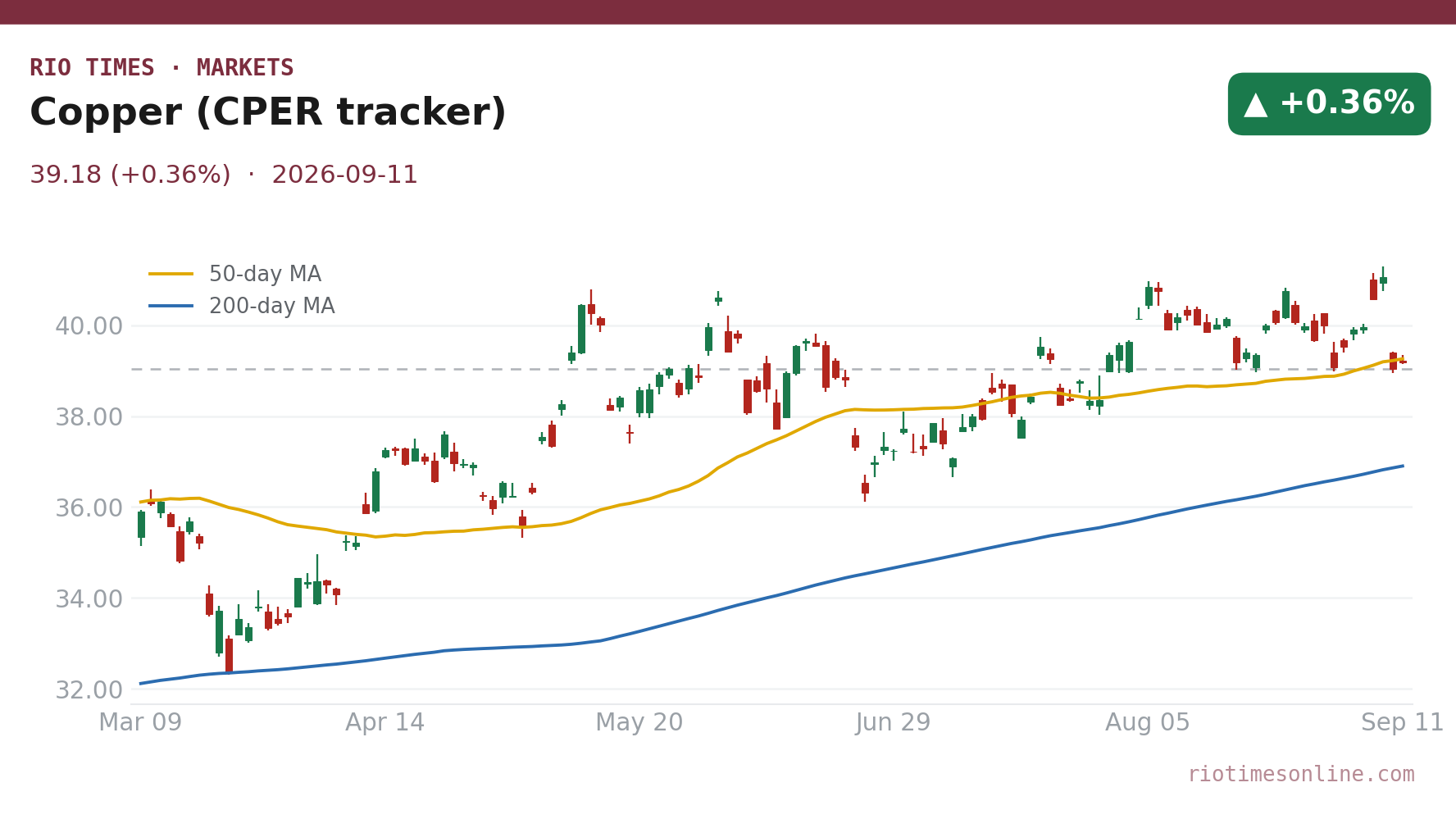
Copper finished Friday at US$14,233 a tonne on the London Metal Exchange, a little below Thursday’s close. The copper-tracking fund CPER rose 0.36% to US$39.18 in New York.
On the American exchange, copper was quoted around US$6.55 a pound. That is roughly US$14,441 a tonne, a premium of about 1.4% over the London price.
The gap exists because American buyers still pay a tariff risk premium. It has narrowed since Thursday, which is itself the clearest evidence of what moved the market.
Copper spent the week trading on a policy headline rather than on anything happening underground. That is normal for a week, and misleading for a year.
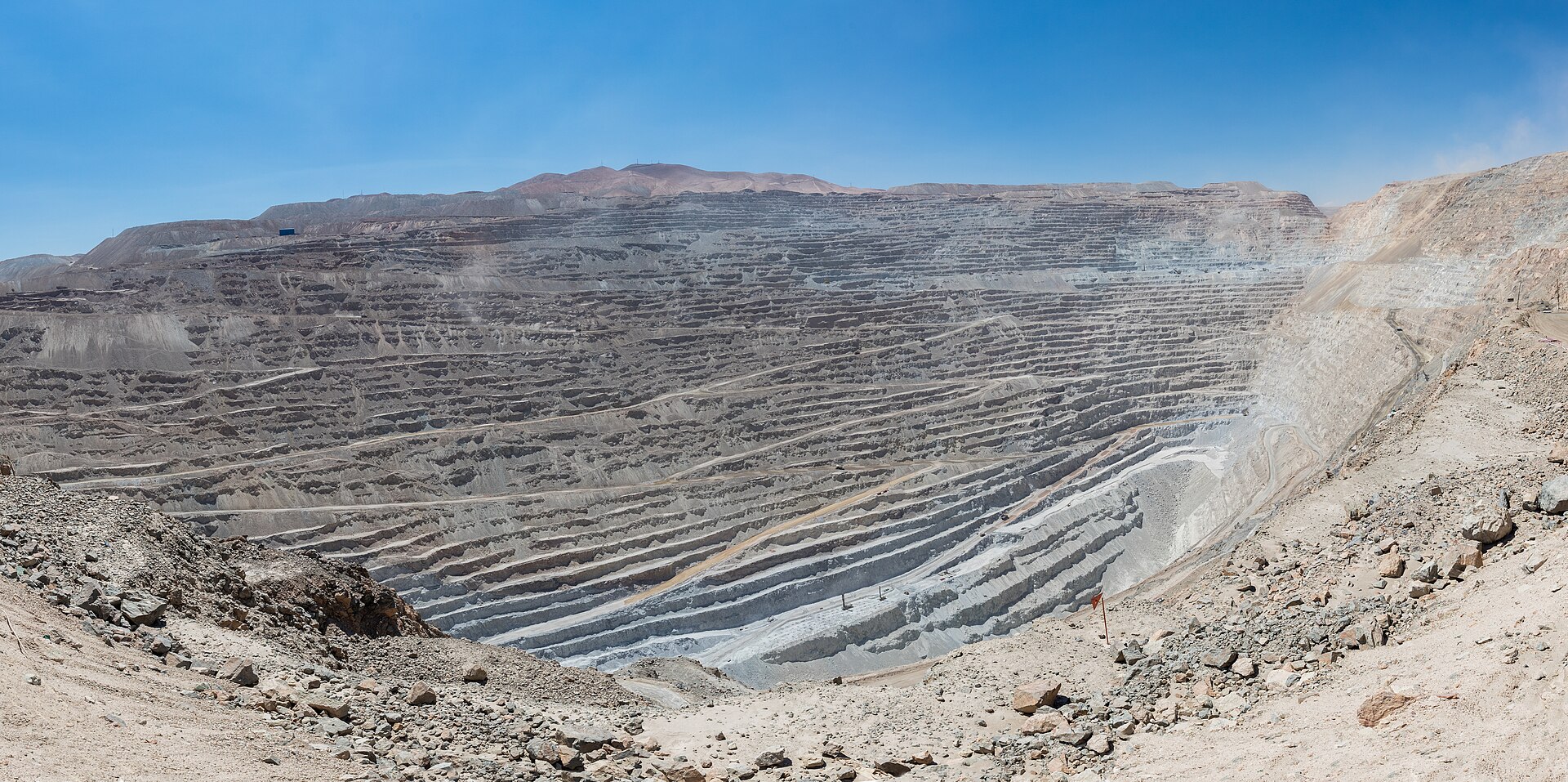
The supply numbers coming out of Chile are the bigger story. Escondida, the world’s largest copper mine, is digging rock with 0.90% copper in it, down from 1.02%, and BHP expects that to fall to about 0.70% next year.
El Teniente, Codelco’s flagship, produced 27% less in the first five months of 2026 than a year earlier. Its Andes Norte expansion was suspended on August 4 over seismic risk.
The variable to watch is not the tariff decision. It is whether Chile can hold 5 million tonnes a year at all.
02 The board
Friday was a session of stabilisation rather than recovery. The copper fund rose 0.36%, while Southern Copper and Freeport-McMoRan each slipped by less than half a percent.
Two Latin American miners did better. Nexa Resources gained 1.29% and Teck Resources 0.82%, both clawing back a fraction of Thursday’s losses.
| Asset | Level | Change |
|---|---|---|
| Copper, LME three-month | US$14,233/t | flat |
| Copper fund (CPER) | US$39.18 | +0.36% |
| Southern Copper (SCCO) | US$193.49 | -0.33% |
| Freeport-McMoRan (FCX) | US$71.07 | -0.20% |
| Teck Resources (TECK) | US$66.44 | +0.82% |
| Nexa Resources (NEXA) | US$13.31 | +1.29% |
Trade date 2026-09-11. Equity closes from RT; London Metal Exchange three-month settlement from exchange data. Where a commodity has no spot feed, an exchange-traded tracker or leading producer is shown as a labelled proxy.
Live Market IntelligenceThe live market board
Rio Times · Live Market Intelligence
Latin America — Cross-Market Board
| Instrument | Last | Change | YoY | Prev. | High | Low | Volume |
|---|---|---|---|---|---|---|---|
| IBOV | 187,206.89 | -0.56% | +21.85% | 188,268.59 | 168,310 | 167,142 | — |
| IPSA | 11,220.60 | -0.16% | — | 11,238.58 | 11,210 | 10,984 | 1,513,213,483 |
| IPC MEX | 63,924.77 | -0.28% | +12.17% | 64,106.82 | 66,121 | 65,405 | 108,886,187 |
| MERVAL | 3,098,898 | -1.87% | +30.51% | 3,022,485 | 3,042,365 | 2,991,150 | — |
| COLCAP | 2,589.69 | -1.41% | — | 9.04 | 9.05 | 9.02 | 4,133 |
| BVL PERÚ | 59,373.28 | — | — | — | — | — | — |
| USD/BRL | 5.16 | +0.01% | -5.13% | 5.16 | 5.18 | 5.14 | — |
| EUR/BRL | 5.95 | +1.01% | -5.83% | 5.89 | 5.98 | 5.94 | — |
| USD/MXN | 17.06 | -0.24% | -8.58% | 17.10 | 17.08 | 17.01 | — |
| USD/CLP | 913.98 | +0.04% | -5.67% | 913.65 | 915.11 | 906.68 | — |
| USD/COP | 3,140 | +0.03% | -22.04% | 3,139 | 3,141 | 3,105 | — |
| USD/PEN | 3.36 | -0.66% | -4.82% | 3.38 | 3.38 | 3.35 | — |
| USD/ARS | 1,493 | +0.10% | +12.96% | 1,491 | 1,494 | 1,480 | — |
| USD/UYU | 40.27 | +1.24% | +1.80% | 39.77 | 40.27 | 40.23 | — |
| USD/PYG | 5,939 | +1.68% | -19.54% | 5,841 | 5,939 | 5,925 | — |
| USD/BOB | 11.64 | -0.76% | +72.04% | 11.73 | 11.72 | 11.64 | — |
| USD/DOP | 58.34 | +1.25% | -3.44% | 57.62 | 58.34 | 58.04 | — |
| USD/CRC | 445.92 | +0.89% | -9.71% | 441.97 | 448.50 | 445.92 | — |
03 What moved it
The trigger was a Reuters report on Thursday, September 10. It said the White House plan to tax imported refined copper had stalled over worries about what it would do to manufacturing costs.
What exists today is narrower than most people assume. A 50% tariff has applied to semi-finished copper, such as pipe, wire, rod and sheet, since August 2025.
Refined cathode, the form that trades on the exchanges, has never been taxed. Nor have ores, concentrates or scrap.
The proposal on the commerce secretary’s desk would add 15% on refined copper from January 2027 and 30% from January 2028. No decision has been made.
Expectations of that duty were a central plank of the rally. When the report landed, the positions built on it unwound in hours.
The selling was not confined to copper. Silver fell 5.6% the same day and gold 1.8%, as hot producer-price data and crude oil above US$105 a barrel lifted the odds of a US rate rise.
04 The Latin American read
Chile remains the world’s largest copper producer, at 5.3 million tonnes in 2025, according to the US Geological Survey. That is 23% of a world total of 23 million tonnes.
The ranking behind it has changed and most coverage has not caught up. The Democratic Republic of the Congo is now second at 3.2 million tonnes, or 13.9%, and Peru third at 2.7 million tonnes, or 11.7%.
Chile’s share was about 30% in 2015. The slide since then is gradual, steady and driven by geology rather than politics.
Reserves tell the same story. Chile holds 180 million tonnes and Peru 85 million, together 27% of the world total, both revised down in this year’s survey.
Chile’s copper commission expects national output to fall 2.6% in 2026, to 5.27 million tonnes, before recovering in 2027. July figures showed Escondida down 22.1% from a year earlier and Codelco down 5%.
Peru had its own disruption. Two workers were killed at Las Bambas on August 18 during maintenance, and the mine restarted progressively from August 21.
05 The names to watch
Southern Copper mines in Peru and Mexico, not Chile, and Grupo México owns 88.9% of it. Group output fell 3.8% in the first half of 2026, which the company blamed on lower ore grades in Peru.
Its Tía María project in Peru is 42% built, with production targeted for the second half of 2027. Peru’s mining council voided its authorisation in March and the ministry restored it in April.
Freeport-McMoRan carries more exposure to Indonesia and the United States. That makes it the useful contrast whenever American trade policy is the story.
Codelco, which is owned by the Chilean state, has guided to 1.344 million tonnes this year. In August the government let it keep all of its 2025 profit, US$2.42 billion, for the first time since it was founded in 1976.
06 The outlook
Two things land this week. China publishes August industrial production on Tuesday, and the US Federal Reserve decides on interest rates on Wednesday.
Chinese demand is softer than the inventory numbers suggest. Exchange stocks in Shanghai fell 13% last week to 54,780 tonnes, their lowest since January 2024, but that reflects tight supply rather than eager buyers.
Refined copper and concentrate imports into China both fell about 10% in August from a year earlier. The copper rod mills that feed the cable industry were running at 62% of capacity.
A US rate rise, which markets price at roughly 90%, would lift the dollar and weigh on all dollar-priced metals. Mexican markets are closed on Wednesday for Independence Day.
07 What to watch
- China industrial production, Tuesday: The August reading is the clearest near-term signal of demand from the country that consumes more than half the world’s copper.
- Federal Reserve decision, Wednesday: Consensus is a rise to 4.00%. A stronger dollar makes copper more expensive for buyers outside the United States.
- A refined copper tariff decision: The 15% duty proposed for January 2027 is stalled, not dead. Any announcement would reprice the gap between American and London prices within minutes.
- Chilean output data: Monthly figures from the copper commission will show whether Escondida’s 22% July decline was a one-off or the start of the guided fall.
Frequently Asked Questions
Why did copper fall so sharply on Thursday?
Reuters reported that the White House had not decided whether to tax imported refined copper, and that the plan had stalled over concerns about costs. Expectations of that tax had driven much of the rally, so traders unwound their positions at once.
Are American copper tariffs already in force?
Only on semi-finished products such as pipe, wire, rod and sheet, taxed at 50% since August 2025. Refined cathode, the form traded on exchanges, has never been taxed, and a proposed 15% duty from January 2027 has not been approved.
Which countries mine the most copper?
Chile leads with 5.3 million tonnes in 2025, or 23% of world output, according to the US Geological Survey. The Democratic Republic of the Congo is now second at 3.2 million tonnes, and Peru third at 2.7 million tonnes.
What is the biggest risk to copper supply?
Falling ore quality in Chile. BHP expects Escondida, the world’s largest copper mine, to produce 1.0 to 1.1 million tonnes in its 2027 financial year, down from 1.26 million, as the grade of rock mined drops to about 0.70% from 0.90%.
Market data: RT equity closes and London Metal Exchange settlements for Friday, September 11, 2026. Production and reserve data: US Geological Survey, Mineral Commodity Summaries 2026, and Cochilco.
This article was produced by The Rio Times’ automated newsroom system. How we use AI · Report an error
LatAm Markets: Live Signals → — real-time movers, turnover leaders and FX across Latin America.
Read More from The Rio Times