Copper Jumps on China Rebound: Futures Tracker CPER Rises 2.58%
Key Facts
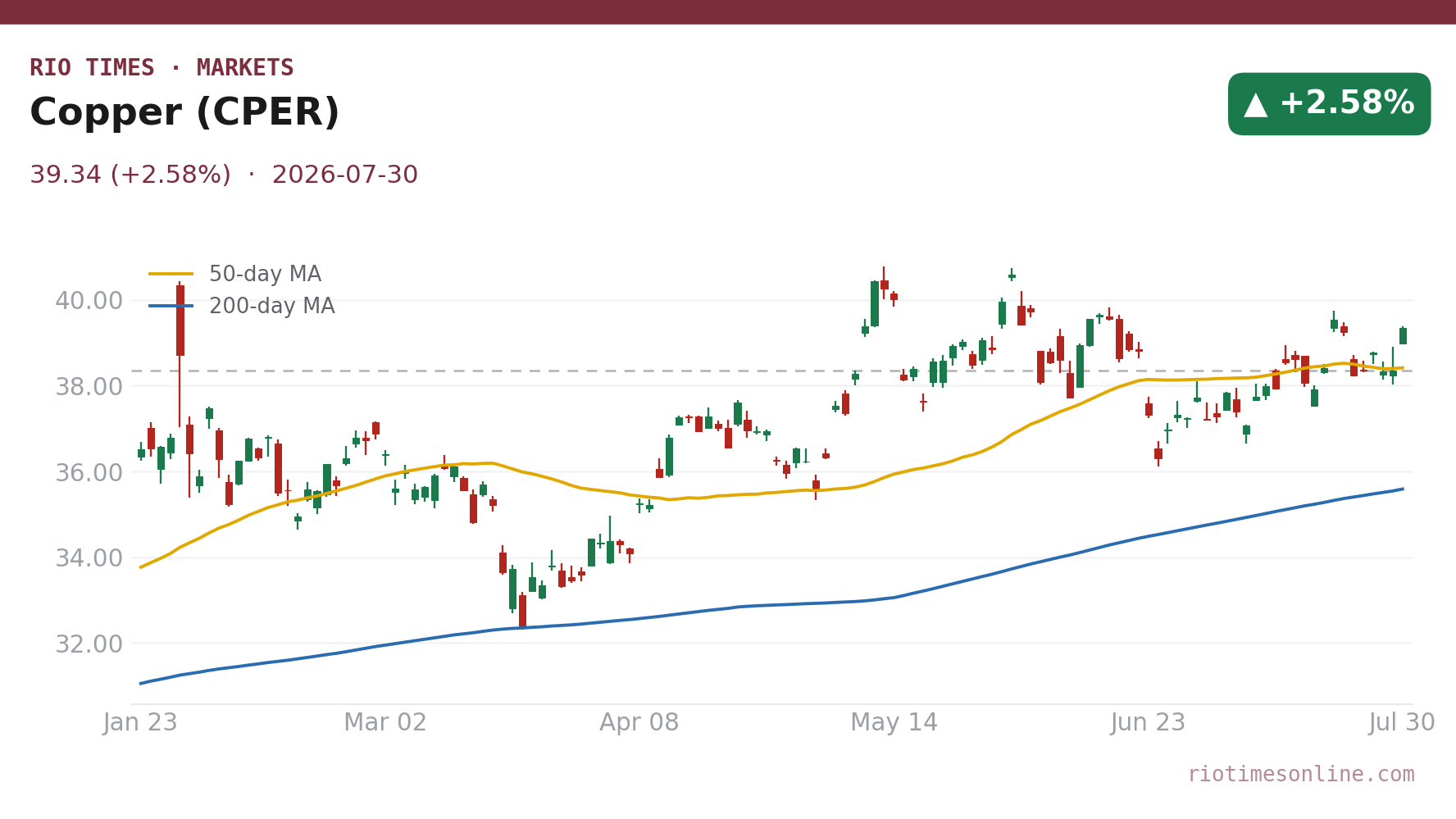
- The copper-futures tracking fund CPER rose 2.58% to US$39.34, its sharpest single-session gain in a week, as a batch of fresh Chinese manufacturing stimulus rekindled demand expectations.
- Southern Copper’s New York shares surged 5.43% to US$185.00, riding the copper rally and optimism that Peruvian and Mexican mine supply will tighten into year-end.
- Freeport-McMoRan’s New York shares jumped 5.75% to US$63.44, the strongest move among large-cap copper proxies as investors rotated into miners with Indonesian and American output.
- China’s politburo signalled fresh fiscal support for factory floors, lifting the outlook for the nation that consumes roughly half the world’s refined copper.
- The energy transition narrative returned to centre stage, as analysts flagged long-term copper demand from electric-vehicle wiring, charging stations and grid upgrades.
- Chile and Peru together supply almost 40% of the world’s mined copper, making every copper-price swing a direct story for Latin American exporters and government budgets.
Today’s Focus
A late-week recovery in Chinese manufacturing sentiment sent copper proxies higher across New York exchanges on Thursday. The copper-futures tracking fund CPER added 2.58% to US$39.34, its sharpest single-session gain in over a week, while shares of the world’s largest publicly traded copper miners climbed even more aggressively.
Southern Copper, the Grupo México unit with giant pits in Peru and Mexico, saw its New York-listed shares leap 5.43% to US$185.00. Freeport-McMoRan, which runs the vast Grasberg mine in Indonesia alongside its Arizona and South American assets, outperformed with a 5.75% gain to US$63.44, underscoring how equity investors treat miner shares as high-beta plays on copper futures.
The catalyst was a Politburo statement out of Beijing that promised fresh fiscal measures to prop up factory activity, a signal that the world’s biggest copper consumer intends to counteract a sluggish property sector with infrastructure and manufacturing orders. Traders read the policy language as a floor under near-term demand for the wiring metal, which is essential for everything from apartment blocks to electric cars.
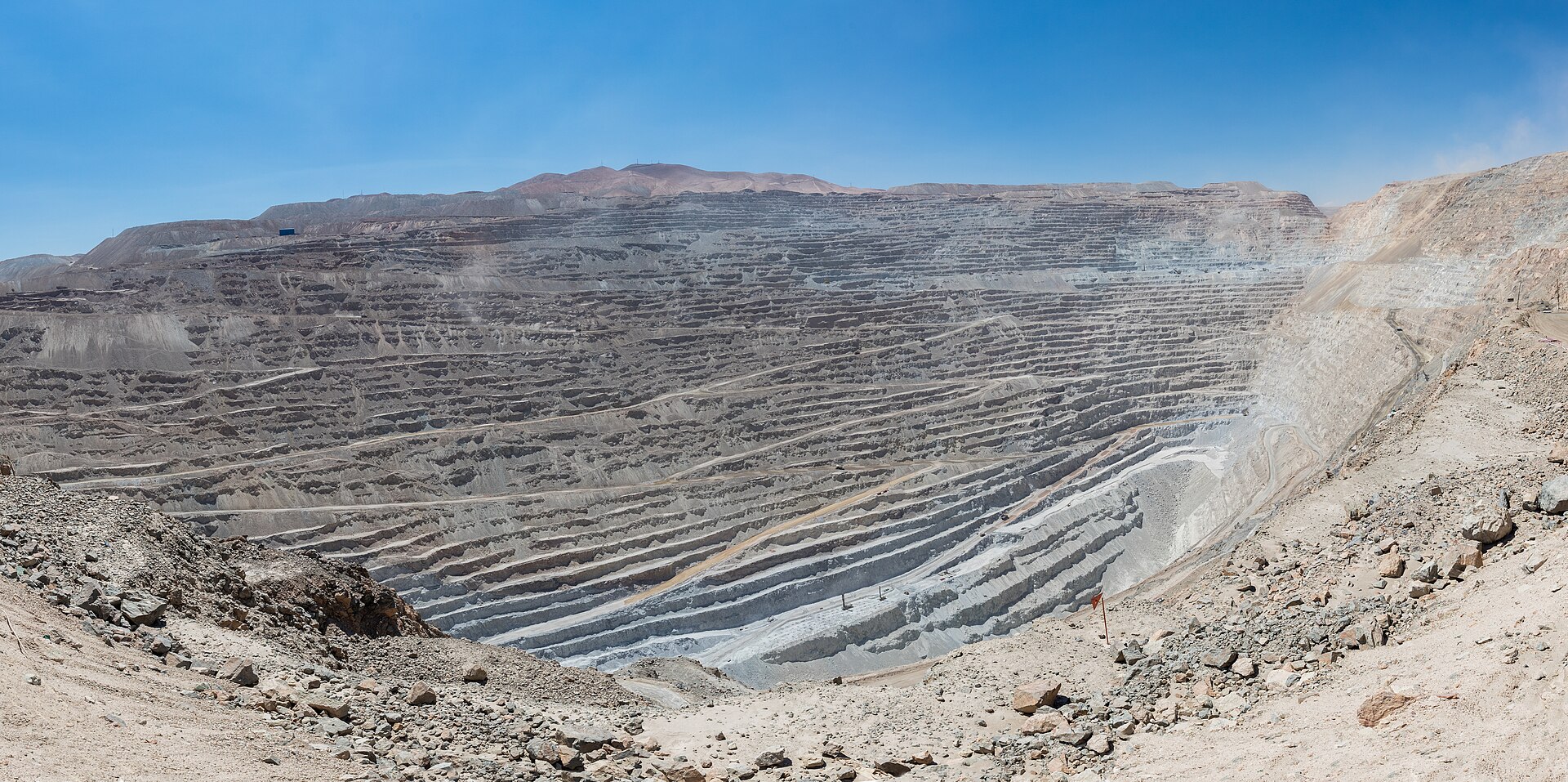
For Latin America, where Chile ranks first and Peru second in global copper output, the session was a welcome reprieve after weeks of sideways trading. A sustained copper rally would ease fiscal pressure in Santiago and Lima, though much still hinges on whether Chinese factory managers translate political promises into actual concentrate orders.
What matters today. A single Politburo statement reignited China-demand hopes, lifting copper futures and sending miner shares sharply higher in a session that underscores how policy, not just physical supply, swings the market.
01 The session in one read
Copper futures, as tracked by the US-listed CPER fund, jumped 2.58% to US$39.34 on Thursday after China’s Politburo pledged fresh fiscal support for its factory sector. The move marked a clean break from recent cautious trading as investors priced in the prospect of renewed orders from the world’s biggest copper consumer.
Miner equities amplified the rally. Southern Copper’s New York shares gained 5.43% to US$185.00 and Freeport-McMoRan surged 5.75% to US$63.44, turning the session into one of the strongest days for copper-linked equities in a month.
Thursday’s move was a classic policy-spike: Beijing’s pledge to support manufacturing outweighed a week of otherwise directionless trading, pushing up both the CPER copper-futures tracker and the equities of Southern Copper and Freeport-McMoRan by more than five percent. Because the rally was driven by a promise rather than a physical copper order, the durability of the gains depends entirely on follow-through from Chinese purchasing managers in August. The variable to watch is next week’s Chinese official manufacturing PMI; a reading below 50 would challenge the Politburo optimism and could swiftly unwind Thursday’s gains.
02 The board
Every line on the screen pointed in the same direction. The copper-futures tracking fund CPER, which holds a rules-based index of COMEX contracts and never buys physical metal, settled at US$39.34, a single-session bounce that caught light-volume Friday-eve trade off guard.
Southern Copper’s New York shares, a liquid proxy for Peruvian and Mexican copper exposure, finished at US$185.00, a move that reflects both the metal’s rally and the equity market’s tendency to attach a growth-premium to producers with large reserves. Freeport-McMoRan, the largest public copper miner by market capitalisation, saw its New York shares reach US$63.44, underscoring how investors reach for the Indonesian and American producer when China-demand stories break.
| Asset | Level | Change |
|---|---|---|
| Copper (CPER tracker) | US$39.34 | +2.58% |
| Southern Copper | US$185.00 | +5.43% |
| Freeport-McMoRan | US$63.44 | +5.75% |
Source: RT close, 2026-07-30. Where a commodity has no spot feed, an exchange-traded tracker or leading producer is shown as a labelled proxy.
Live Market IntelligenceThe live market board
Rio Times · Live Market Intelligence
Latin America — Cross-Market Board
| Instrument | Last | Change | YoY | Prev. | High | Low | Volume |
|---|---|---|---|---|---|---|---|
| IBOV | 185,547.66 | -0.51% | +21.85% | 186,502.64 | 168,310 | 167,142 | — |
| IPSA | 11,235.54 | -0.77% | — | 11,322.60 | 11,210 | 10,984 | 1,513,213,483 |
| IPC MEX | 63,507.11 | -1.11% | +12.17% | 64,216.98 | 66,121 | 65,405 | 108,886,187 |
| MERVAL | 3,028,871 | -1.65% | +30.51% | 3,022,485 | 3,042,365 | 2,991,150 | — |
| COLCAP | 2,511.76 | -2.16% | — | 9.04 | 9.05 | 9.02 | 4,133 |
| BVL PERÚ | 58,496.57 | +0.80% | — | — | — | — | — |
| USD/BRL | 5.16 | +0.01% | -5.13% | 5.16 | 5.18 | 5.14 | — |
| EUR/BRL | 5.95 | +1.01% | -5.83% | 5.89 | 5.98 | 5.94 | — |
| USD/MXN | 17.06 | -0.24% | -8.58% | 17.10 | 17.08 | 17.01 | — |
| USD/CLP | 913.98 | +0.04% | -5.67% | 913.65 | 915.11 | 906.68 | — |
| USD/COP | 3,140 | +0.03% | -22.04% | 3,139 | 3,141 | 3,105 | — |
| USD/PEN | 3.36 | -0.66% | -4.82% | 3.38 | 3.38 | 3.35 | — |
| USD/ARS | 1,493 | +0.10% | +12.96% | 1,491 | 1,494 | 1,480 | — |
| USD/UYU | 40.27 | +1.24% | +1.80% | 39.77 | 40.27 | 40.23 | — |
| USD/PYG | 5,939 | +1.68% | -19.54% | 5,841 | 5,939 | 5,925 | — |
| USD/BOB | 11.64 | -0.76% | +72.04% | 11.73 | 11.72 | 11.64 | — |
| USD/DOP | 58.34 | +1.25% | -3.44% | 57.62 | 58.34 | 58.04 | — |
| USD/CRC | 445.92 | +0.89% | -9.71% | 441.97 | 448.50 | 445.92 | — |
03 What moved it
A Politburo communiqué released during Asian hours promised ‘proactive fiscal tools’ to support manufacturing and infrastructure, directly addressing concerns that China’s post-pandemic factory recovery was losing steam. Copper traders interpreted the language as a signal that the state will backstop demand for the metal used in electrical cable, electric-vehicle motors and grid equipment.
Supply-side discipline added a tailwind. Southern Copper has flagged slower throughput at its Peruvian operations, and Freeport-McMoRan lowered its Indonesian export guidance last month, tightening the concentrate market just as Chinese smelters seek extra feed for new capacity. The combination of a policy-driven demand jolt and constrained near-term supply created a perfect setup for the CPER rally.
04 The Latin American read
Chile and Peru, the world’s first- and second-largest copper producers, are the primary beneficiaries of any sustained copper rally. Chile’s state-owned Codelco and private miners like BHP ship the bulk of their concentrates to China, and a higher futures curve directly lifts royalty receipts in Santiago. Peru’s fiscal accounts are just as copper-dependent: the Cerro Verde mine, operated by Freeport-McMoRan, and the Toquepala and Cuajone pits, operated by Southern Copper, anchor the country’s export revenues.
Beyond the treasury numbers, Thursday’s move offers political tailwinds for both Andean governments. President Dina Boluarte’s administration in Lima has faced pressure over a slowing economy, while Chile’s Gabriel Boric is navigating a tricky debate over mining royalties. Rising copper futures tend to cool resource-nationalist rhetoric by swelling state coffers without legislative battles.
05 The names to watch
Southern Copper remains the purest Latin American copper play. Controlled by Grupo México, it holds the world’s largest copper reserves and trades with high sensitivity to both copper prices and Peruvian political headlines. Thursday’s 5.43% jump in its New York shares to US$185.00 shows how quickly the stock reprices when China-demand narratives shift.
Freeport-McMoRan is the globally diversified counterpoint. With the Grasberg mine in Indonesia producing both copper and gold alongside large-scale US operations in Arizona, the company offers a hedge against single-country risk while still moving sharply with copper futures; its 5.75% gain to US$63.44 was the session’s standout.
Rio Tinto and Anglo American, while not among Thursday’s tracked proxies, are worth monitoring because both operate giant Chilean copper mines and have committed fresh capital to energy-transition metals. Brazilian mining major Vale, whose New York shares occasionally trade in sympathy with copper proxies, is diversifying deeper into the battery-metal supply chain.
06 The outlook
The near-term copper story pivots on whether Chinese factory surveys confirm the Politburo’s optimism. August’s official manufacturing PMI, due in a few days, will either validate the CPER rally or expose it as premature. Traders will also watch weekly Shanghai Futures Exchange inventory data for evidence that Chinese fabricators are drawing down warehouse stock.
On the supply side, the variable is Peruvian logistics. Southern Copper’s concentrate shipments have faced intermittent port delays, and any sign of a lasting bottleneck could tighten the physical market enough to support futures even if China demand underwhelms.
07 What to watch
- Chinese manufacturing PMI: August’s official factory reading will test the Politburo-driven optimism; a sub-50 print could rapidly reverse Thursday’s rally.
- Peruvian export flows: Port-congestion reports out of Matarani and Callao would signal a near-term concentrate squeeze, supporting copper futures.
- COMEX futures curve shape: CPER’s return is sensitive to contango or backwardation; watch whether the prompt month flips to a premium as refined stocks shift.
- Latin American royalty debates: A sustained copper rally typically eases miner-government friction in Chile and Peru, but any new tax proposals would hit Southern Copper and Freeport-McMoRan shares.
Frequently Asked Questions
What does CPER track?
CPER is a US-listed fund that tracks a rules-based index of COMEX copper futures contracts, not physical copper metal, and its performance can be influenced by the shape of the futures curve.
Why did copper jump today?
China’s Politburo pledged fresh fiscal support for manufacturing, lifting expectations that the world’s largest copper consumer will increase orders for refined metal and concentrate.
How are Southern Copper and Freeport-McMoRan connected to copper prices?
Both are large publicly traded copper miners whose share prices tend to amplify moves in copper futures; Southern Copper is Peru- and Mexico-focused, while Freeport-McMoRan has assets in Indonesia and the US.
Why do Chile and Peru matter for copper markets?
Chile is the world’s largest copper producer and Peru ranks second; together they supply nearly 40% of global mined copper, tying Andean politics and logistics directly to futures prices.
This article was produced by The Rio Times’ automated newsroom system. How we use AI · Report an error
LatAm Markets: Live Signals → — real-time movers, turnover leaders and FX across Latin America.
Read More from The Rio Times