Colombia Confirms Mega-Prisons but Names No Sites or Price
Colombia · JUSTICE
Key Facts
- —Announcement De la Espriella confirmed maximum-security mega-prisons on August 26 in Bogotá.
- —Count The campaign promised ten prisons; the government programme lists seven through 2030.
- —Model Private concession or public-private partnership, with no contract signed or published.
- —System 101,457 inmates held against 81,061 official places on July 31, 2026.
- —Cost No official price has been published for any of the planned prisons.
A confirmed promise, a concession model and a prison system already 25 percent over capacity.
President Abelardo de la Espriella confirmed on August 26 that his government will build maximum-security mega-prisons with private money. Almost everything that would turn the Colombia mega-prison plan into a project is still missing.
What the president actually confirmed
President Abelardo de la Espriella confirmed the prison programme on August 26 at a military ceremony in Bogotá. The setting was the José María Córdova army officers’ school in the capital.
His words in Spanish were mantengo intacto mi compromiso de construir megacárceles de máxima seguridad. That translates as: I keep my commitment to build maximum-security mega-prisons.
He added that esas obras se harán con la empresa privada, or the works will be done with private business. That clause is the entire public description of how the prisons get paid for.
He also told the prison service director to recover command inside the jails, after 117 high-profile inmates were moved in August. Officials who fail to produce results will leave, he said.
How many prisons, and where nobody says
Two different numbers have followed this promise. The campaign offered ten privately built prisons, while the government programme lists seven for 2026 to 2030.
The August 26 confirmation carried no figure at all. It named no department, no municipality and no plot of land.
Justice Minister Iván Cancino said in July that locations were withheld on national security grounds. He is a criminal defence lawyer and took office on August 7.
No capacity has been published for any single site either. Without a bed count, the Colombia mega-prison plan cannot be measured against the shortfall it is meant to close.
The private investment model on offer
In the campaign the model was a concession rather than a normal public works contract. Private groups would pay for construction and then run the prisons themselves.
De la Espriella put the concession length at fifty, seventy or eighty years, in his phrase lo que sea. On that design the state would commit no construction money.
Cancino has since called the vehicle an asociación público-privada, or APP, the Colombian term for a public-private partnership. He said the government would also seek multilateral lenders to hold down the cost to taxpayers.
Law 1508 of 2012 already sets the general rules for an APP in Colombia. Nothing in that statute is written for prisons, and no Colombian prison has yet opened under one.
The closest precedent is a district project in Medellín, a remand centre for 1,339 people. Its own agency calls it the first prison partnership of its type, and it remains under execution.
What it might cost, and what is not known
No cost estimate has been published for the Colombia mega-prison plan. Neither the presidency nor the justice ministry has attached a peso figure to any of it.
A recent conventional build gives a rough yardstick. The new national prison at Riohacha, in La Guajira, was contracted at 307.969 billion pesos (US$98.8 million).
That facility holds 1,722 people, which works out near 179 million pesos (US$57,400) per place. Conversions use the official market rate, or TRM, of 3,118.24 pesos per dollar for August 27, 2026.
Running costs are the other half of the bill. Norberto Hernández Jiménez, a criminal law scholar at Javeriana University, puts monthly upkeep near two million pesos (US$640) per inmate.
The prison system he inherits
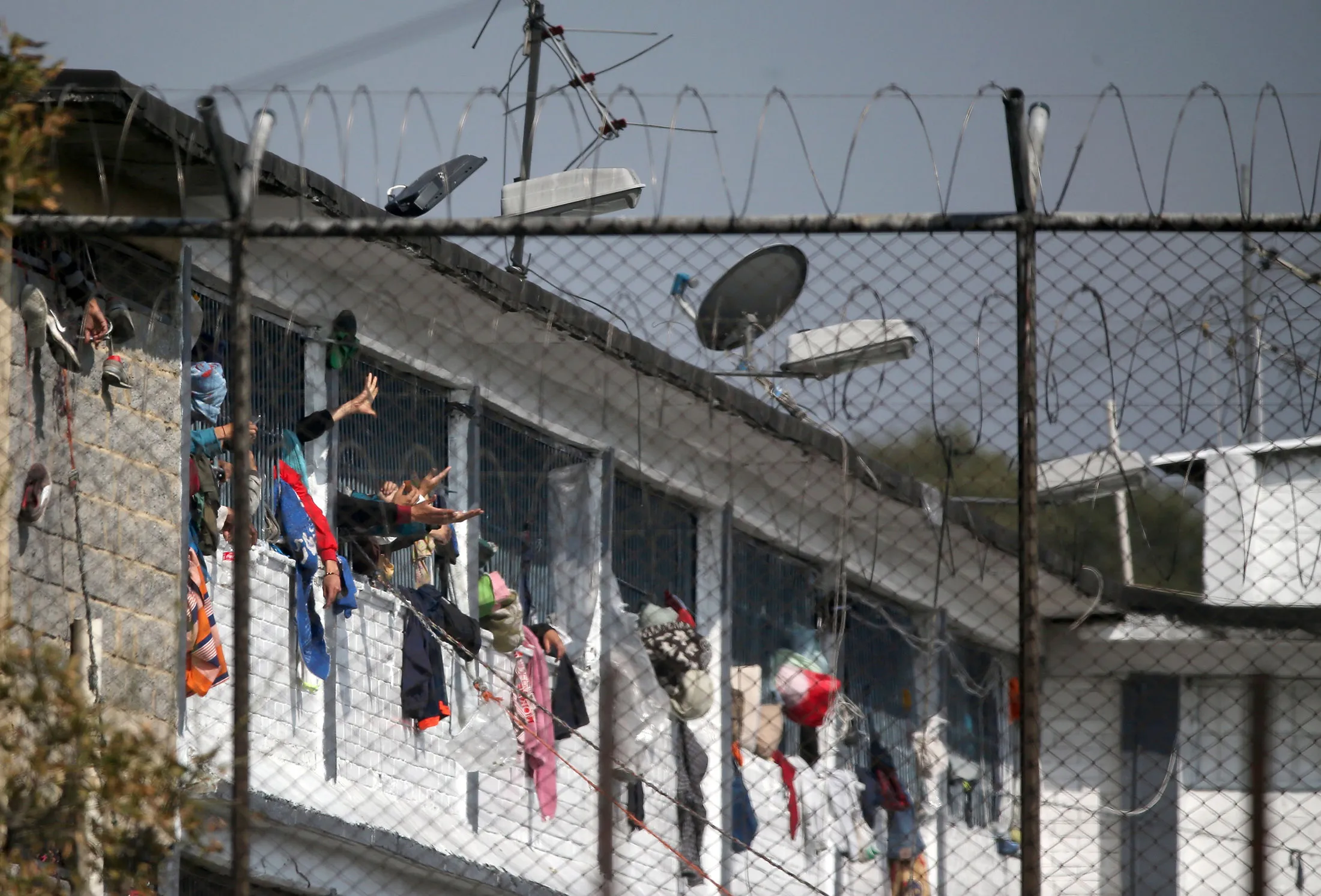
Colombia held 101,457 prisoners on July 31, 2026, against an official capacity of 81,061 places. That is an occupancy level of 125.2 percent, on World Prison Brief figures.
The prison service is the Instituto Nacional Penitenciario y Carcelario, or INPEC, the national penitentiary institute. It ran 125 establishments as of 2025 and reported 27.1 percent overcrowding in March 2026.
Capacity grew by only 378 places in four years while the inmate population rose by 6,246. The guard corps is short of about 12,000 officers.
Building the estate falls to a separate body, the Unidad de Servicios Penitenciarios y Carcelarios, or USPEC. The national audit office has logged 306 findings against INPEC since 2009.
The court order sitting in the background
The Colombia mega-prison plan runs into a standing constitutional ruling. The Constitutional Court has declared an estado de cosas inconstitucional, an unconstitutional state of affairs, in the prison system.
That declaration came in judgment T-388 of 2013 and was reinforced by T-762 of 2015. Ruling SU-122 of 2022 extended it to police holding cells used as improvised jails.
The court still monitors compliance. In an order dated April 22, 2026, it counted 18,624 people in transitory cells built for 9,711.
That is 88 percent overcrowding in the holding cells alone. The order told authorities to clear the obstacles blocking transfers into proper prisons.
The El Salvador question
Colombian outlets routinely describe the Colombia mega-prison plan as modelled on El Salvador. The government’s own position is more mixed than that.
El Salvador’s vice-president, Félix Ulloa, offered technical advice on August 6, 2026. He named his country’s terrorism confinement centre, the Centro de Confinamiento del Terrorismo or CECOT, as a pillar of its security plan.
Colombian officials agreed to create a binational security commission. Nothing beyond that commission has been announced since the meeting.
Cancino has distanced the design from Nayib Bukele’s version and promised resocialisation programmes. His words were no van a ser cárceles que violen los derechos humanos, meaning they will not violate human rights.
The critics, and the missing paperwork
Hugo Acero, a former Bogotá security secretary who ran the city’s district jail, wrote against the design on August 17. In Razón Pública he said prisons turn unmanageable above roughly 2,000 to 2,500 inmates.
He pointed to Ecuador’s mega-prison, where tuberculosis outbreaks and abuse allegations followed. Smaller, well-run jails in Bogotá and Medellín already meet international standards, he added.
Hernández Jiménez warns that conditions in very large prisons can collide with human dignity guarantees. Angélica Beltrán of Corporación Humanas notes capacity rose 49 percent from 2000 to 2008 before overcrowding returned above 40 percent.
The Defensoría del Pueblo, the ombudsman office, reported on May 21, 2026 that only 58.6 percent of detainees had a bed. Its inspectors found 82.5 percent of people in holding cells stayed beyond the 36-hour limit.
The next visible steps are a named site, a bed count and a signed concession structure. Until those exist, the Colombia mega-prison plan is an announced intention rather than a project.
More: Colombia news in English, every day from The Rio Times.
Frequently Asked Questions
How many prisons does the Colombia mega-prison plan include?
The campaign promised ten privately built prisons, and the government programme lists seven for 2026 to 2030. The August 26 confirmation gave no number.
Who would pay for the new prisons?
The stated model is private capital under a long concession or a public-private partnership. No contract, investor or financing package has been published.
How crowded are Colombia’s prisons right now?
There were 101,457 inmates against 81,061 official places on July 31, 2026, an occupancy level of 125.2 percent. Police holding cells are far worse, at 88 percent over capacity in April 2026.
Connected Coverage
Colombia Orders Five Petro-Era Negotiators Extradited to the US
Sources
- www.semana.com
- www.colombia.com
- www.pulzo.com
- www.semana.com
- www.eldiario.com.co
- www.infobae.com
- www.lafm.com.co
- www.infobae.com
- www.asuntoslegales.com.co
- www.elespectador.com
- www.funcionpublica.gov.co
- www.app.gov.co
- politicacriminal.uexternado.edu.co
- www.eltiempo.com
- www.eltiempo.com
- www.prisonstudies.org
- www.corteconstitucional.gov.co
- www.corteconstitucional.gov.co
- www.infobae.com
- razonpublica.com
- cambiocolombia.com
- www.semana.com
- www.datos.gov.co
- riotimesonline.com
This article was produced by The Rio Times’ automated newsroom system. How we use AI · Report an error · Editorial responsibility: Matthias Camenzind, Editor-in-Chief