Colombia Central Bank Minutes Reveal 4-2-1 Rate Split

MARKETS · COLOMBIA
Key Facts
- —The country Colombia, a major oil and coffee exporter, targets 3% inflation through its independent central bank, the Banco de la República (BanRep).
- —Why it matters The minutes explain why a split board raised rates and hint at what comes next. That shapes returns for US investors in Colombian bonds and the peso.
- —Why now BanRep published the minutes of its Wednesday 30 September meeting on Monday 5 October, at 6:27 p.m. Bogotá time.
- —What happened Four directors backed a 25-basis-point rise to 12.25%, two voted to hold and one wanted 50 points. A second director first voted for 50 before joining the majority.
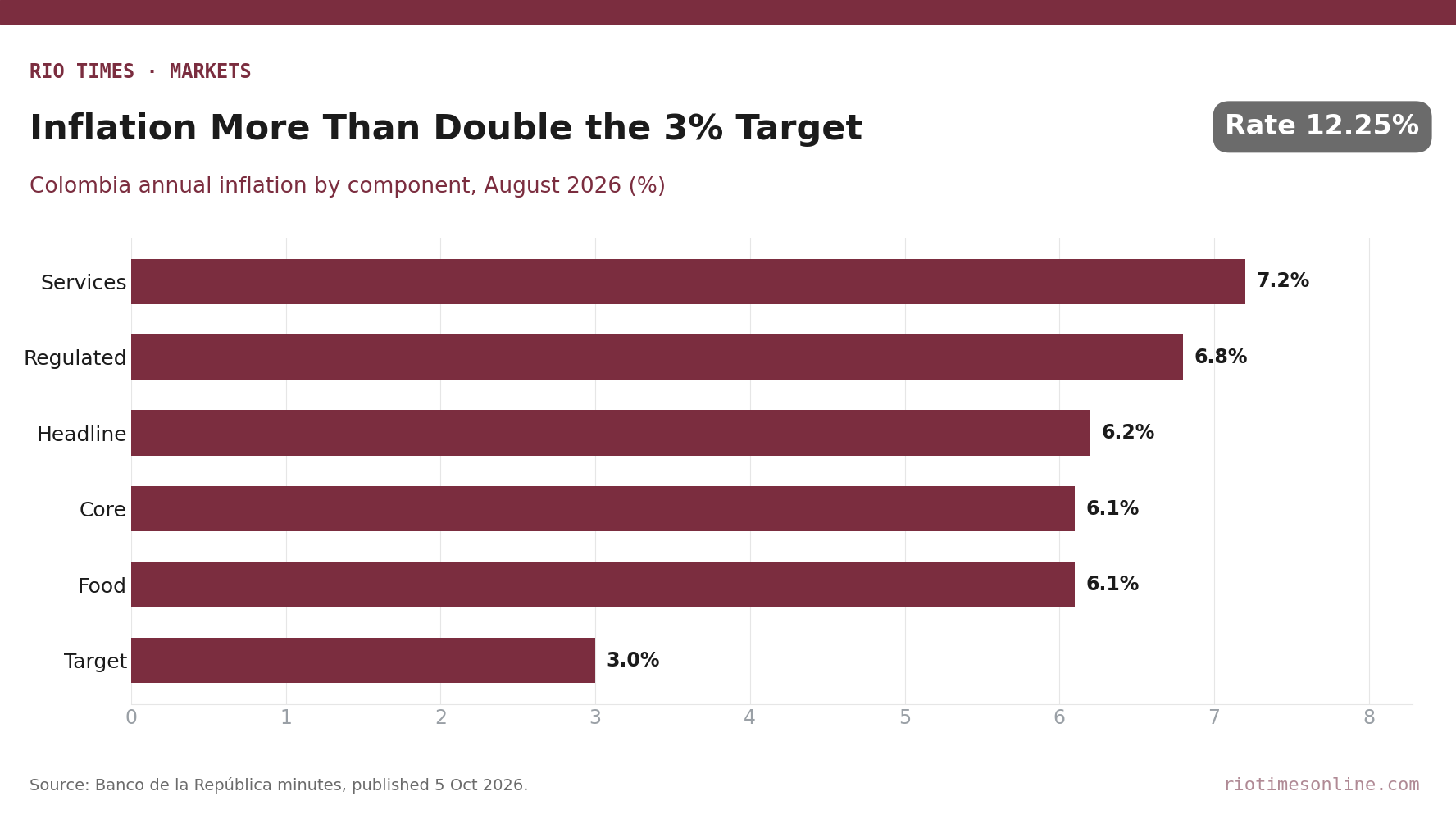
- —The numbers Inflation was 6.2% in August. Core inflation reached 6.1%, its highest since June 2024. Analysts expect 6.8% by the end of 2026.
- —What it means for you Peso loans stay expensive and peso deposits keep paying high rates. Investors face a central bank that still leans towards tighter policy.
- —Still open Whether the board raises rates again at its next meeting on Friday 30 October, and how hard El Niño hits food and energy prices.
- —Prediction markets Polymarket gives no change at the 30 October meeting a 46% chance, another 25-point hike 37% and a bigger hike 17% (6 October, 3:20 a.m. ET).
The Colombia central bank minutes, published on Monday 5 October, show how close the board came to a bigger rate rise. One director voted for a 50-basis-point hike, and a second only dropped that demand to secure a majority. For US investors in Colombian bonds and the peso, the message is that inflation, not growth, still drives policy.
The Banco de la República, known as BanRep, raised its policy rate by 25 basis points to 12.25% on Wednesday 30 September. The new rate has applied since Thursday 1 October. The move, reported in Colombia Raises Its Policy Rate to 12.25%, surprised most analysts. In a survey by ANIF, a Colombian economic think tank, 16 of 22 analysts had expected no change.
BanRep is Colombia’s independent central bank. Its seven-member board includes the finance minister, Miguel Gómez, and the governor, Leonardo Villar. The minutes do not say which directors voted which way. Gómez has said publicly that he voted for the rise, according to the Medellín daily El Colombiano.
Why the Majority Raised Rates
Four directors voted for the 25-point rise. They said headline inflation has climbed to more than double the 3% target. The pressure is no longer limited to food and regulated prices such as energy tariffs.
Core inflation, which strips out food and regulated prices, rose to 6.1% in August. The minutes call this its highest level since June 2024. Services inflation climbed to 7.2% from 7.0% in July.
The majority warned that inflation could rise further in the short term. They pointed to El Niño, the weather pattern that can raise food prices and energy costs. They also cited higher oil and farm input prices linked to the conflict in the Middle East.
Inflation expectations remain a worry. Analysts in BanRep’s September survey expect 6.8% inflation at the end of 2026. The majority said expectations remain unanchored from the 3% target, even over long horizons.
They also see an economy running hotter than its capacity. Domestic demand is growing faster than output, which fuels a strong rise in imports and widens the external deficit.
The minutes also look abroad. The majority said recent rate rises in developed economies reduce investors’ appetite for risk. That could raise Colombia’s risk premium and reverse the peso’s gains, pushing prices up.
One director in the majority initially voted for a 50-point rise, arguing that acting early lowers long-term costs to growth. That director switched to 25 points during the discussion so that a majority could be reached.
Why Two Directors Wanted No Change
The two directors who voted to hold argued that policy is already highly restrictive. With a 12% policy rate in August and 6.2% inflation, they put the real interest rate near 6%.
They noted that rates have risen 275 basis points since the end of 2025 without clear progress towards the target. In their view, the economy is still absorbing earlier hikes, given the usual delays in monetary policy.
They added that food and regulated prices respond little to interest rates in the short term. Indexed services such as rents behave in a similar way. So they questioned the extra benefit of more hikes against the rising cost to growth, investment, credit and the exchange rate.
The pair also raised a point US investors will recognise. The wide rate gap with developed economies encourages carry trades, in which investors borrow cheaply abroad to buy high-yielding peso assets. That flow has helped strengthen the peso, they said.
A high real rate and a strong peso are hurting producers of goods and farm products, according to these directors. One of them warned that a tighter policy combined with cuts to public investment could slow the economy too sharply.
The Case for a Bigger Hike
The director who voted for 50 basis points said inflation risks still point upwards. That director warned that El Niño could reach exceptional intensity.
Facing a supply shock with unanchored expectations is harder than facing it with high credibility, the director argued. In the minutes’ words, “waiting does not eliminate the cost; it shifts it and can increase it.”
What It Means for You
For borrowers in Colombia, loans and credit cards stay expensive for longer. Savers holding peso deposits continue to earn high nominal returns.
For US investors, the minutes point to a board that sees more risk in doing too little than too much. That supports peso yields, but the dissenters’ warning about the strong peso shows the board is watching the currency closely. Colombia’s Peso Strengthens to Around 3,300 per US Dollar After a Surprise Rate Hike describes the market reaction to the hike.
The board also struck a stabilising note. It said the decision keeps policy restrictive and is consistent with inflation falling in 2027. All directors agreed that fighting inflation helps savings and private investment.
What Is Not Known
The minutes do not name the directors behind each vote, and only Gómez has disclosed his. It is not known whether the director who first sought 50 points would back another hike in October.
The board said El Niño, recovery from the recent earthquake and the government’s fiscal measures will shape its next decisions. The scale of the planned fiscal adjustment is still unclear, according to the minutes.
Growth is also uncertain. Seasonally adjusted GDP grew 3.4% in the second quarter, but BanRep’s monthly activity index slowed to 1.1% in July from 3.5% in June. Manufacturing fell 2.3%, while retail sales rose 5.3%.
What Prediction Markets Say
Bets on Polymarket show traders split on the next move. At 3:20 a.m. ET on Tuesday 6 October, no change at the 30 October meeting traded at a 46% chance. Another 25-point hike traded at 37%, and a hike of 50 points or more at 17%.
About US$33,600 has been traded on the October market since it opened in mid-September, including about US$5,100 in the past 24 hours. The price for a 25-point hike has gained about 14 percentage points over the past week.
Why we show this: prediction markets turn real-money bets into a live probability that moves within minutes of the news, which is why investors, campaigns and newsrooms in the United States now follow them closely. We show them next to polls and official results, never instead of them.
What do the Colombia central bank minutes show?
They show four directors backed a rise to 12.25%, two wanted no change and one sought 50 basis points. A second director first voted for 50 before joining the majority.
Why did BanRep raise rates?
The majority cited inflation of 6.2%, core inflation at its highest since June 2024, El Niño risks, higher oil prices and unanchored inflation expectations.
When is the next rate decision?
The board meets next on Friday 30 October. It said El Niño, the earthquake recovery and fiscal policy will shape that decision.
Sources: Banco de la República, minutes of the September 2026 board meeting, 5 October 2026; Banco de la República, calendar of meetings; ANIF, 1 October 2026; Valora Analitik, 5 October 2026; El Espectador, 30 September 2026; El Colombiano, 30 September 2026.
This article was produced by The Rio Times’ automated newsroom system. How we use AI · Report an error · Editorial responsibility: Matthias Camenzind, Editor-in-Chief
In depth
LatAm Markets: Live Signals → — real-time movers, turnover leaders and FX across Latin America.