Key Facts
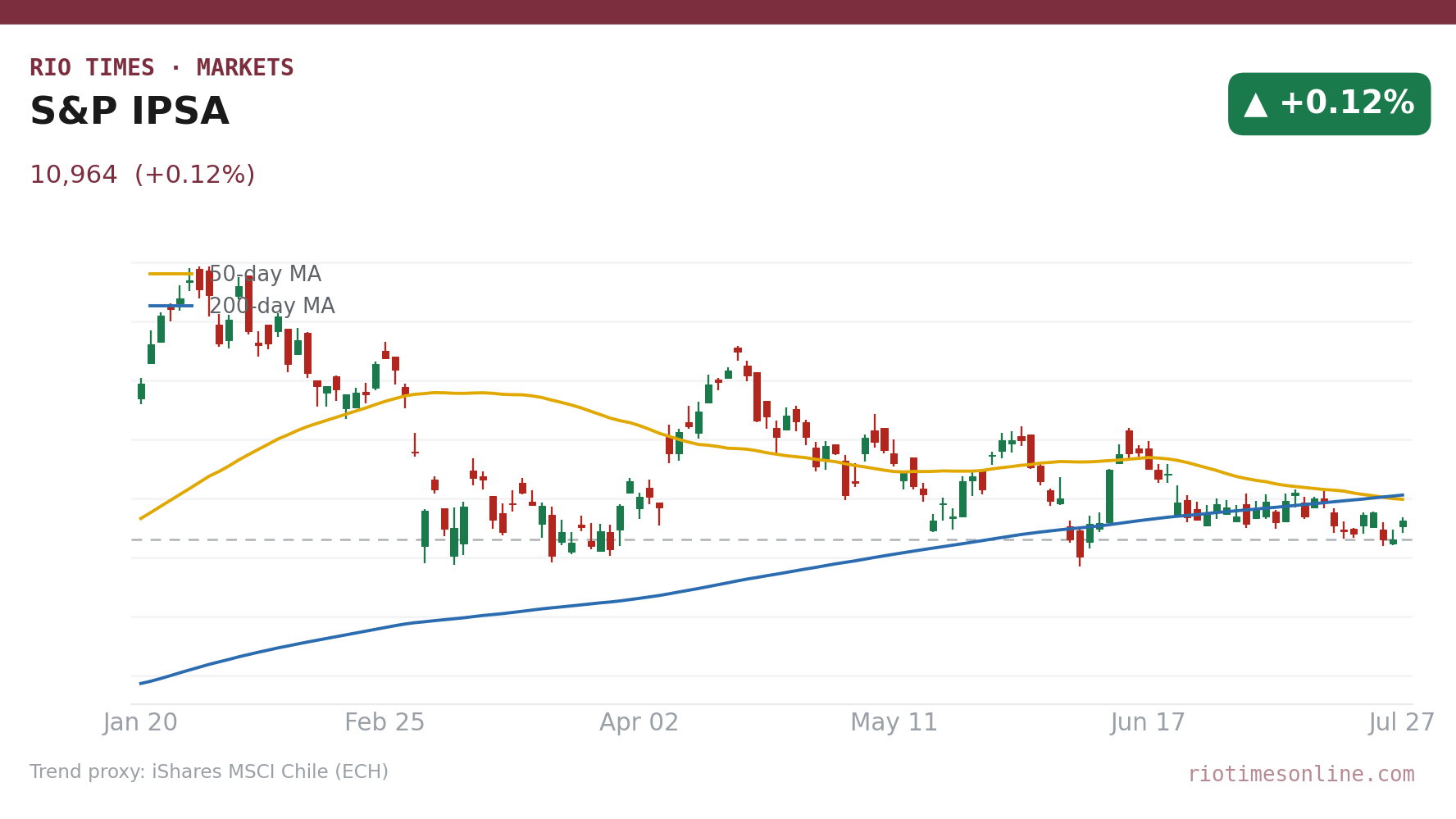
- The benchmark S&P IPSA rose 0.12% to 10,964 a modest gain that extended a cautious recovery off recent lows.
- The Chilean peso strengthened sharply, with USD/CLP sliding 0.95% to 939.85 recording its best single-day advance in weeks against the dollar.
- Retail giant Falabella jumped 2.8% on strong turnover leading the session’s most-traded names and buoying consumer sentiment.
- Lithium heavyweight SQM-B dipped 1.1% bucking the trend and acting as a drag on the materials sector.
- The IPSA remains 5.7% below its 52-week high of 11,628 leaving the index in recovery mode but not yet breaking out.
Today’s Focus
Chilean equities inched higher on Monday in a quiet session defined more by a muscular peso than by stock-market fireworks. The S&P IPSA—Chile’s principal blue-chip share index, home to the country’s largest and most liquid companies—added 0.12% to settle at 10,964.
The real story was in the foreign-exchange market, where the Chilean peso delivered its strongest session in weeks, driving the dollar down 0.95% to 939.85 pesos. Analysts broadly tied the move to a firm copper price, the country’s economic anchor, though specific commodity levels were hard to pin to the exact session.
Retail proved the session’s backbone: department-store and financial-services group Falabella climbed 2.8% and was the most-traded stock, while shopping-centre operator Cencomalls surged 4.1%. In contrast, lithium miner SQM-B slipped 1.1% and supermarket giant Cencosud lost 2.2%, keeping the overall index gain in check.
What matters today. The peso’s sharp rally and resilient retail names suggest local investors are betting on domestic demand, even as the index remains well below its recent peak.
01 The session in one read
Monday’s session on the Santiago Stock Exchange was a tale of two markets: one for equities, where movement was measured, and another for the currency, where the Chilean peso flexed real muscle. The S&P IPSA, Chile’s benchmark stock index that tracks the exchange’s 30 most-traded large-cap names, ended the day up a slender 0.12% at 10,964.
It was the peso that grabbed attention. The dollar slumped 0.95% against the local currency to close at 939.85 pesos—a significant daily fall for USD/CLP and one that marked the peso’s best single-session gain in weeks. For foreign investors, the move matters because it tilts the total return equation: a strengthening peso boosts dollar-based returns on Chilean holdings.
Beneath the flat index headline, retail stocks showed verve. Falabella, a household name in Chilean shopping and financial services, rose 2.8% and topped the turnover table. Cencomalls, which runs shopping centres across the region, surged 4.1%. Yet not every corner of the market joined in: lithium miner SQM-B dipped 1.1%, supermarket group Cencosud dropped 2.2%, and utility Colbun slumped 3.2%, illustrating a market that was picking winners rather than rallying across the board.
For a newcomer, the day looked like this: the main index barely moved, but the currency jumped, shoppers’ shares were in demand, and copper’s steady backdrop quietly supported the whole picture without making headlines itself.
The numbers tell a story of modest optimism rather than conviction. The IPSA’s 0.12% advance, while positive, barely registers against a 5.7% gap to its 52-week high of 11,628, and volume was concentrated in a handful of names like Falabella and LTM, the Latam Airlines group, which rose 3% but whose move partly tracks broader travel-demand sentiment. The peso’s 0.95% surge is the session’s standout statistic—it hints at flows betting on copper stability or positioning ahead of the next central bank decision, though no official catalyst was confirmed. For now, the evidence points to a market finding a floor rather than launching a rally; the variable to watch is whether copper holds these levels through the week, as that will either cement the peso’s strength or reverse it rapidly.
02 The day’s numbers
| Measure | Level | Change | Read |
|---|---|---|---|
| S&P IPSA | 10,964 | +0.12% | Modest gain; 5.7% below 52w high |
| IPSA 52-week high | 11,628 | — | Peak set in recent months |
| IPSA 52-week low | 5,480 | — | Trough from deep sell-off |
| USD/CLP | 939.85 | −0.95% | Peso strengthens materially |
| USD/CLP 52-week high | 981.38 | — | Weakest peso level in 52 weeks |
| USD/CLP 52-week low | 851.67 | — | Strongest peso level in 52 weeks |
The IPSA’s close at 10,964 keeps the index firmly in the lower half of its 52-week range, which runs from 5,480 to 11,628. Being 5.7% below the high is not alarming, but it signals that the index has not yet reclaimed the momentum it carried earlier in the cycle.
The currency story is markedly brighter. At 939.85, USD/CLP sits roughly 4.2% below its 52-week peak of 981.38, meaning the peso has recovered some ground from its weakest point but remains well above the 52-week low of 851.67. For a dollar-based observer, the peso’s Monday leap was a friendly tailwind. Rio Times · Live Market Intelligence
Live Market IntelligenceChile — Live Market Board
Chile — Live Market Board
Instrument Last Change YoY Prev. High Low Volume
IPSA
10,575.59
-1.59%
—
10,746.36
11,210
10,984
1,513,213,483
USD/CLP
913.98
+0.04%
-5.67%
913.65
915.11
906.68
—
COPPER
6.61
+0.03%
+46.70%
6.61
6.71
6.61
39,543
SQM-B
65,305
-0.84%
+49.03%
65,860
66,949
64,978
76,539
COPEC
5,964
-1.09%
-11.70%
6,030
6,100
5,960
634,331
BSANTANDER
78.37
-2.28%
+35.94%
80.20
81.69
78.34
36,288,711
FALABELLA
6,334
-1.48%
+23.28%
6,429
6,450
6,300
26,085,814
ENELAM
87.09
+0.10%
-10.13%
87.00
87.40
86.50
13,106,417
CENCOSUD
1,946
-2.19%
-35.30%
1,990
2,010
1,945
966,528
CMPC
1,020
-1.96%
-29.10%
1,040
1,050
1,015
3,526,677
BANCO CHILE
184.96
-1.01%
+32.87%
186.85
189.99
184.33
18,101,240
LATAM AIR
24.08
-1.11%
+16.61%
24.35
24.59
23.88
573,612,753
SOUTHERN COPPER
193.97
-0.26%
+104.01%
194.48
199.36
192.59
367,102
03 Why it moved — copper’s quiet hand and retail optimism
No single news release or government announcement drove Monday’s trade. Instead, the session reflected a gentle current of positive sentiment, anchored by copper, Chile’s main export and its traditional macroeconomic compass. The red metal held firm in global trading, and because Chile is the world’s largest copper producer, a steady copper price often acts as a quiet magnet for the peso—making the 0.95% rally in CLP less surprising than it first looks.
Retail stocks like Falabella and Cencomalls rose on a mix of local conviction and possibly some catch-up buying. Chilean consumers have been navigating a period of tighter monetary policy—the central bank’s benchmark interest rate sits at 4.5%, a level that cools credit-fuelled shopping—yet the market appeared to look through that, rewarding names tied to household spending.
On the other side, SQM-B’s 1.1% dip reminded investors that not all commodities work in Chile’s favour simultaneously. Lithium prices have faced pressure from global supply growth and unease about electric-vehicle demand, and SQM, as one of the world’s largest lithium producers, feels that chill directly. The same stock-by-stock logic applied to Colbun, a power generator, which dropped 3.2% on no visible company-specific catalyst, simply drifting lower in a session that rewarded consumers over utilities.
Copper set the stage, retail led the charge, and lithium took a back seat—a tidy, three-part narrative for a day that otherwise lacked dramatic headlines.
04 The day’s movers
| Driver | Level / Move | Change | Note |
|---|---|---|---|
| Cencomalls | — | +4.1% | Shopping-centre operator; top gainer |
| Falabella | — | +2.8% | Retail and finance; highest turnover ($30m) |
| LTM (Latam Airlines) | — | +3.0% | Airline; second-highest turnover ($29m) |
| BSantander | — | +1.8% | Bank; solid gain on moderate volume |
| Cencosud | — | −2.2% | Regional retailer; notable loser |
| Colbun | — | −3.2% | Power utility; heaviest drag |
| SQM-B | — | −1.1% | Lithium miner; $13m turnover |
Falabella’s session was one of those days where everything seemed to click: the stock rose 2.8% and saw $30m in turnover, making it both the most-traded name and a genuine market leader. Closely behind, airline LTM climbed 3% on $29m in volume, reflecting a parallel narrative of travel demand resilience.
The losers’ column was headlined by Colbun, down 3.2%, and Cencosud, off 2.2%. Neither move was pinned to a single news event; rather, they illustrate the rotation effect—money flowed towards select consumer names and away from utilities and a giant grocer that has faced margin questions in recent quarters.
05 The regional scoreboard
| Index | Country | Change |
|---|---|---|
| Ibovespa | Brazil | +0.74% |
| S&P/BMV IPC | Mexico | +1.20% |
| S&P Merval | Argentina | +0.65% |
| COLCAP | Colombia | +0.37% |
| S&P IPSA | Chile | +0.12% |
Chile’s IPSA was the region’s laggard on a day when every major Latin American equity benchmark posted gains. Mexico’s IPC led the way with a 1.17% advance, while Brazil’s Ibovespa—the heavyweight of Latin American equities—rose a solid 0.74%.
The gap between Chile’s 0.12% and Mexico’s 1.17% is not a red flag. It simply confirms that Santiago was in a holding pattern, waiting for a clearer signal—perhaps Tuesday’s central bank interest-rate decision—while other markets found their own more immediate catalysts.
06 The technical picture
The IPSA chart remains a work in progress. At 10,964, the index is closer to its 52-week low of 5,480 than to its high of 11,628, but that tells only the raw range story. More usefully, the index is consolidating in a band roughly 5% to 6% below the peak, a zone where buyers have started to show interest without yet forcing a breakout.
The peso’s technical picture is equally instructive. USD/CLP at 939.85 is down 4.2% from the 52-week high of 981.38, meaning the pair has broken below short-term resistance and is now testing waters that could open a path towards the mid-900s or beyond. A sustained move below 935 would shift the trend language from ‘corrective rally in CLP’ to ‘potential trend change.’
For equity traders, the variable to track is whether the IPSA can hold above 10,900 on any retest. That level has served as a pivot in recent sessions, and losing it would invite questions about a deeper slide towards the mid-10,000s. Holding it, meanwhile, keeps the recovery story intact.
07 What to watch
- Central bank rate decision: Chile’s monetary authority meets Tuesday; the decision and any guidance on future moves will directly impact bank stocks, the peso, and rate-sensitive sectors like retail and housing.
- Copper price direction: As the country’s macroeconomic anchor, any sharp move in copper futures will flow immediately into the peso and mining shares, particularly given SQM’s weight in the IPSA.
- Retail rotation: Falabella and Cencomalls posted strong gains; watch whether Monday’s consumer optimism was a single-session event or the start of a broader shift into domestic-demand plays.
- US Fed meeting: Global liquidity conditions hinge on Wednesday’s Fed decision; Latin American assets, including the Chilean peso, are highly sensitive to changes in US rate expectations.
Background: Valle Nevado Owner Drops Andacor Ski-Resort Deal.
Background: Chile Seeks $100 Billion in Copper to Cut China Reliance.
More: Chile news in English, every day from The Rio Times.
Frequently Asked Questions
What is the S&P IPSA?
It is Chile’s main stock index, made up of the 30 most-traded large companies on the Santiago Stock Exchange. Think of it as the Chilean equivalent of the FTSE 100 or the S&P 500—a quick temperature check on the country’s biggest listed businesses.
Why did the Chilean peso strengthen so much?
A nearly 1% daily move in USD/CLP is notable. While no single event was pinned to the session, steady copper prices—Chile’s top export—almost certainly helped, as did broader emerging-market currency flows. A firm copper price typically means more dollars flowing into Chile, pushing the peso higher.
Why did SQM fall when other stocks rose?
SQM is a lithium miner, and lithium prices have been under pressure globally due to rising supply and questions about electric-vehicle demand. The stock’s 1.1% decline was driven by that commodity-specific story, which is distinct from the retail and copper narratives that lifted other names.
Is the IPSA expensive or cheap right now?
At 10,964, the index sits 5.7% below its 52-week high of 11,628, which suggests it is not at stretched levels. Whether that makes it ‘cheap’ depends on earnings, but the technical picture shows a market consolidating rather than euphoric—more cautious than overpriced.
This article was produced by The Rio Times’ automated newsroom system. How we use AI · Report an error · Editorial responsibility: Matthias Camenzind, Editor-in-Chief
LatAm Markets: Live Signals → — real-time movers, turnover leaders and FX across Latin America.