
CANADA · ANALYSIS
Key Facts
- —What is happening The United States applies a 25% Section 232 tariff to Canadian passenger vehicles and auto parts; USMCA-compliant parts are fully exempt, while the tariff applies to the non-U.S. content of USMCA-compliant vehicles.
- —Why it matters The Canadian and US auto industries operate as one production system, so tariffs raise costs on both sides of the border and threaten jobs in Detroit and Ontario.
- —What to watch The USMCA joint review took place on July 1, 2026; because the United States declined to confirm an extension, annual reviews now follow and the agreement expires on July 1, 2036 unless the parties agree to extend it, while Canada’s auto remission framework is available through April 8, 2027.
- —What it means for you US consumers and auto workers face higher vehicle prices and potential plant disruptions because Canadian parts and vehicles feed directly into American assembly lines and dealerships.
Canada US auto tariffs in 2026 are taxing a single integrated North American production system, not two separate national industries. The result is higher costs for American car buyers, pressure on Detroit-linked plants, and a political fight over whether to protect domestic capacity or preserve the continental market.
Canada and the United States do not simply trade cars; they build them together across a border that parts and vehicles cross repeatedly before a finished automobile reaches a customer. This analysis explains how that system developed, what the current tariffs do to it, and what the options are, drawing on the USA-Canada Intelligence Brief and official trade data.
How the Integrated System Developed
The 1965 Canada–United States Automotive Products Agreement, usually called the Auto Pact, created duty-free trade in qualifying vehicles and parts. Its core logic was reciprocal specialisation: manufacturers could rationalise production across the two countries while selling vehicles and components across the border without tariffs.
That arrangement changed the geography of production. Plants did not need to duplicate every model on both sides of the border; instead, a Canadian plant could specialise in particular models or components, export them to the United States, and import other models or parts for the Canadian market.
The system also included production and value-added commitments intended to ensure that duty-free trade generated Canadian manufacturing activity rather than simply allowing imports into Canada. The Auto Pact was later challenged at the World Trade Organization and was no longer the principal framework after Canada and the United States moved to broader free-trade arrangements.
The 1989 Canada–U.S. Free Trade Agreement and the 1994 North American Free Trade Agreement placed automotive trade within wider continental rules. USMCA replaced NAFTA on July 1, 2020, and imposed more demanding requirements for automobiles, including higher regional value-content thresholds, separate treatment for core parts, principal parts and complementary parts, labour-value-content requirements, and rules concerning North American steel and aluminium purchases.
The policy objective was to encourage more North American production and reduce reliance on inputs from outside the region. The practical effect was to make tariff-free treatment more valuable but also more administratively complex, with more extensive certification and tracing obligations.

The Trade Flows That Matter
A modern vehicle can cross the Canada–U.S. border several times before reaching a customer. Engines, transmissions, batteries, stamped body panels, electronics and other components are manufactured at different facilities, assembled into subcomponents, and shipped between plants.
That means the gross value of exports exaggerates the amount of domestic value created in any one country, but it accurately illustrates the sector’s dependence on open borders.
These figures cover value added and employment attributable to US demand, not necessarily the entire number of people employed in every Canadian plant or supplier whose products may eventually reach the United States. The point is that the border is not a line between two industries; it runs through the middle of one.

What the Tariffs Currently Do
The most consequential current US measure is the Section 232 tariff regime on automotive products. Section 232 is a national-security authority under the Trade Expansion Act of 1962, and as summarised by the Congressional Research Service, passenger vehicles and auto parts face a nominal 25% tariff, trucks face a 25% tariff, buses face a 10% tariff, and related parts generally face a 25% tariff.
The treatment differs by product and USMCA compliance. USMCA-compliant auto parts receive a full exemption, while vehicles that satisfy USMCA rules receive only a partial exemption: the tariff applies to the non-US content rather than the entire vehicle.
This distinction is crucial. A Canadian-built vehicle with sufficient North American content may avoid a 25% tariff on its entire transaction value, but it can still be exposed to tariffs on non-US content; a vehicle or component that fails USMCA requirements can face the full tariff.
The compliance calculation is therefore not simply Canadian versus American. It depends on the vehicle’s regional value content, the origin of core components, labour-value-content compliance, steel and aluminium sourcing, the exact product classification, and whether the item qualifies under USMCA and the relevant Section 232 exemption.
Canada responded with tariffs on US goods and vehicles. The Congressional Research Service reported that Canada imposed 25% tariffs on non-USMCA-compliant US vehicles, tariffs on the non-Canadian, non-Mexican content of US vehicles traded under USMCA, and additional tariffs on selected US imports, including steel and aluminium; Canada’s Department of Finance states that existing counter-tariffs on US autos continue to apply.
The Detroit–Ontario Connection
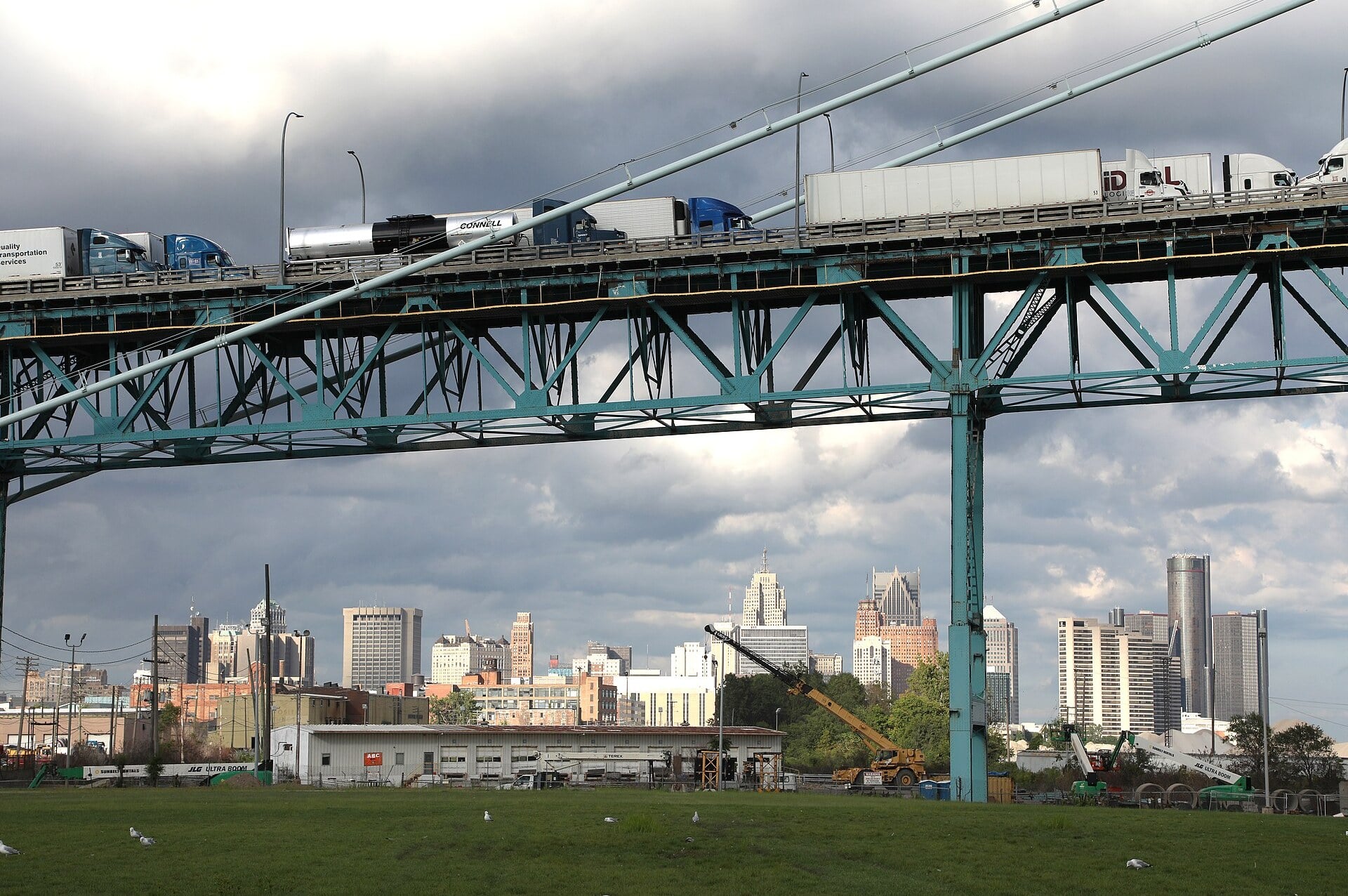
Detroit and southern Ontario form one of the most integrated automotive corridors in the world.
The economic relationship is not limited to vehicle assembly. It includes original-equipment manufacturers, tier-one and lower-tier suppliers, tool-and-die companies, logistics firms, engineering and software services, battery and electric-vehicle investments, steel, aluminium and plastics producers, and dealers and aftermarket businesses.
For Detroit, Canadian plants and suppliers provide nearby production capacity and inputs. For Ontario, the United States is the overwhelmingly larger end market; this mutual dependence is why tariffs can hurt both jurisdictions even when policymakers describe them as a protectionist measure against the other country.
Conservative Leader Pierre Poilievre is promoting a Tariff-Free Auto Pact, modelled politically on the 1965 agreement.
Poilievre’s Detroit visit is designed to make that pitch directly to American auto executives and workers. The proposal is a political response to tariff anxiety, but it also reflects a structural reality: any workable solution must recognise that the two countries share a production system, not merely a trading relationship.
Why Tariffs Are Economically Disruptive
A tariff on a completed car is visible to consumers, but tariffs on parts may be more damaging operationally. A vehicle manufacturer can pay duties on engines and transmissions, electronic systems, batteries and battery materials, steel and aluminium components, seats, glass, tires and wiring, and parts that cross the border multiple times.
Even when the final vehicle qualifies for preferential treatment, imported content can increase the vehicle’s tariff cost. Manufacturers must either absorb the expense, raise prices, redesign sourcing, or shift production.
Tariffs increase the cost base before a vehicle reaches the dealer. The eventual effect on consumers depends on whether the vehicle is imported or assembled domestically, the percentage of non-exempt content, whether manufacturers absorb part of the cost, dealer pricing and inventory levels, exchange-rate movements, demand conditions, and whether suppliers pass duties through to automakers.
A tariff does not necessarily produce a one-for-one increase in the sticker price, but it creates upward pressure and can reduce discounts, delay model launches, encourage smaller production runs, and make cross-border inventory management more difficult. For US consumers, tariffs on Canadian inputs can raise costs at Detroit-linked plants even when the final car is assembled in the United States.
Auto plants require high utilisation rates. A plant built around a specific model cannot easily switch production overnight; if tariffs make cross-border shipments uneconomic, a plant may face temporary layoffs, reduced shifts, lower supplier orders, delayed investment, model reassignment, or permanent closure if the loss of scale becomes structural.
The USMCA Review and Political Stakes
The USMCA joint review took place on July 1, 2026; because the United States declined to confirm an extension, annual reviews now follow and the agreement expires on July 1, 2036 unless the parties agree to extend it.
The review process is now the central arena for the tariff fight. Canada’s official objective is removal of the Canada–US auto tariffs, while the United States has used the review to press for changes to the agreement’s automotive rules.
Canada also established a remission framework under which qualifying Canadian vehicle producers can obtain relief for a specified number of USMCA-compliant vehicles, conditional on maintaining production in Canada. The framework is scheduled to remain in place until April 8, 2027.
The political stakes are high on both sides.
In the United States, the same integration means that tariffs on Canadian inputs raise costs for American manufacturers and consumers.
What It Means for the United States and Latin America
For US readers, the immediate consequence is higher vehicle costs and potential disruption at plants that depend on Canadian parts. A tariff on Canadian inputs is a tax on American assembly lines, not just on Canadian exporters.
The longer-term risk is that persistent tariffs encourage automakers to relocate production outside North America or to reduce their reliance on cross-border supply chains. That would weaken the integrated system that has made Detroit and Ontario competitive against Asian and European manufacturers.
For Latin America, the dispute matters because Mexico is the third party to USMCA and a major auto producer in its own right. Canadian–Mexican automotive trade remains tariff-free under USMCA, but the broader uncertainty affects investment decisions across the region.
Mexico’s position in the review process is significant. Canada and Mexico sought renewal together in July 2026, and any resolution will shape the rules for North American automotive production as a whole, including Mexican plants that export to both the United States and Canada.
The dispute also affects global supply chains. Automakers with operations in Brazil, Argentina and other Latin American markets watch North American trade rules closely because they influence where future investment in electric vehicles, batteries and components will be located.
The Scenarios
One scenario is a negotiated settlement that preserves the integrated market. If the three governments agree to remove or reduce auto tariffs during the USMCA review, the system could stabilise, investment could resume, and prices could ease.
A second scenario is prolonged tariff friction. If the United States maintains Section 232 tariffs and Canada keeps its countermeasures, manufacturers would face sustained cost pressure, and some production could shift or shrink.
A third scenario is a partial deal, such as Poilievre’s proposed Tariff-Free Auto Pact. That would link duty-free access to Canadian production commitments, potentially preserving some Canadian assembly while allowing more imports.
What would stabilise the situation is a clear, durable agreement on automotive rules of origin and tariff treatment. What would tip it toward crisis is a breakdown in the USMCA review that leaves the annual review process as a source of recurring uncertainty through 2036.
What It Means for You
If you are a US consumer, expect continued upward pressure on vehicle prices as long as tariffs apply to Canadian parts and vehicles. The effect may not be immediate or uniform, but it is real and cumulative.
If you work in the US auto industry, the risk is not just higher costs but potential production disruptions. Plants that depend on Canadian suppliers may face delays, and smaller parts suppliers are especially vulnerable.
If you are an investor, the key question is whether the USMCA review produces a settlement or a prolonged standoff. The answer will shape capital allocation across North American auto manufacturing for years.
What Is Not Known
It is not known whether the United States will agree to remove or reduce Section 232 auto tariffs during the USMCA review. The official position as of October 2026 is that the United States declined to confirm renewal in the existing form.
It is not known whether Poilievre’s Tariff-Free Auto Pact would be acceptable to the United States or to Canadian auto workers. The proposal is a political platform, not a negotiated agreement.
It is not known how long Canada’s remission framework will remain in place beyond April 8, 2027, or whether it will be extended or modified. The Department of Finance has described the measures as continuing for as long as necessary, but no specific expiry date has been announced.
What to Watch
Watch the USMCA joint review process. The USMCA joint review took place on July 1, 2026; because the United States declined to confirm an extension, annual reviews now follow and the agreement expires on July 1, 2036 unless the parties agree to extend it.
Watch April 8, 2027, the scheduled end date for Canada’s auto remission framework. Any decision to extend, modify or end that framework will signal the direction of Canadian policy.
Watch for any US announcement on Section 232 tariffs.
Watch Poilievre’s Detroit visit and any response from US automakers or the administration. A political proposal can become a negotiating position if it gains traction on both sides of the border.
Frequently Asked Questions
How integrated are the Canadian and US auto industries?
They operate as a single North American production system.
What is the current US tariff on Canadian vehicles?
The United States applies a 25% Section 232 tariff to Canadian passenger vehicles and auto parts, as of October 2026. USMCA-compliant parts receive a full exemption, while qualifying vehicles receive only a partial exemption for their US content.
What is the 1965 Auto Pact?
The Canada–United States Automotive Products Agreement created duty-free trade in qualifying vehicles and parts, provided manufacturers maintained production and Canadian value-added commitments. It encouraged a continental production system rather than two separate national industries.
What is the USMCA review timeline?
The USMCA joint review took place on July 1, 2026; because the United States declined to confirm an extension, annual reviews now follow and the agreement expires on July 1, 2036 unless the parties agree to extend it.
What is Pierre Poilievre’s Tariff-Free Auto Pact?
Conservative Leader Pierre Poilievre is promoting a plan modelled on the 1965 agreement.
How do tariffs affect US car prices?
Tariffs increase the cost base before a vehicle reaches the dealer, creating upward pressure on prices. The effect depends on whether the vehicle is imported or assembled domestically, the percentage of non-exempt content, and whether manufacturers absorb part of the cost.
When does Canada’s auto remission framework end?
Canada’s remission framework for qualifying vehicle producers is scheduled to remain available until April 8, 2027. It allows defined volumes of US-made vehicles to be imported tariff-free, conditional on maintaining production in Canada.
Sources: riotimesonline.com, congress.gov, cbc.ca, article.wn.com, icpainc.org, canada.ca. Retrieved 12 October 2026.
This article was produced by The Rio Times’ automated newsroom system. How we use AI · Report an error · Editorial responsibility: Matthias Camenzind, Editor-in-Chief