Foreigners Keep Full Freehold Rights Buying Property Paraguay Notary Process
Guides · Paraguay
—The stakes. Buying property paraguay gives foreigners the same freehold ownership rights as Paraguayan citizens, with no residency or local company required.
—The process. A licensed escribano público drafts the public deed, runs registry due diligence and files it for inscription in Paraguay’s real estate registry.
—The costs. Transaction costs are built around transfer taxes, notarial fees and registry charges, with reservation deposits commonly ranging from 10 to 20 percent or a fixed USD1,000 to USD5,000 for new builds.
—The restrictions. The main structural limit affects rural land inside a 50 km border security zone for nationals of Argentina, Brazil and Bolivia, with separate rules for agrarian reform land.
—The registry. Legal ownership is only perfected after the deed is inscribed with the national public registry, the DGRP.
For foreign investors, Paraguay’s property market is unusually open: foreign nationals can hold freehold title directly in their own names, on the same terms as citizens. The process is a civil law notary conveyancing system, with Paraguay’s public registries acting as the final safeguard of enforceable ownership.

Foreigners hold property with the same freehold rights as citizens
Under Paraguayan law, foreign nationals can buy houses, apartments, commercial real estate and most rural land with the same ownership rights as Paraguayan citizens.
No special permit is required, and the buyer does not need to create a Paraguayan company or use a nominee.
Paraguay imposes no legal cap on the number of properties or hectares a foreigner may own, outside specific restricted land categories.
Residency is not a requirement for purchase, because buying real estate and obtaining Paraguayan residency are legally separate processes.
A valid passport is accepted as identification, and the deed can be registered directly in the foreign buyer’s personal name.
The public deed is prepared by a licensed escribano público
Paraguay follows a classic civil law conveyancing model centred on the escribano público, a licensed notary with specific authority under notarial law.
Property is transferred through an escritura pública, a public deed that the notary drafts and authenticates.
The notary verifies the identities and legal capacity of the parties at the moment of signing.
The buyer may sign in person or through a poder notarial, a notarised power of attorney, which allows a local representative to complete the purchase remotely.
A foreign buyer is generally advised to hire an independent notary or lawyer, not the seller’s notary.
Registration at the national real estate registry perfects title
A notarised deed alone is not enough to create fully enforceable ownership in Paraguay.
Legal ownership is only perfected after the deed is inscribed in the real estate registry, the Registro de Inmuebles, which sits under the Dirección General de los Registros Públicos.
The registry authority is commonly known by its Spanish initials DGRP.
In 2026 the property registry and cadastre operate through the Dirección General de Registros Públicos (DGRP), the national public registry.
This integration allows the notary to obtain a unified cadastral-registry certificate, the Certificado Catastro Registral Inmobiliario, confirming that cadastre and registry data align.
Due diligence covers title, encumbrances, boundaries and restricted land
Before signing, the notary verifies that the seller is the registered owner through a certificate known as the certificado de condición de dominio.
A standard review includes a thirty year chain of title designed to detect breaks, competing claims or multiple titles on the same parcel.
The notary also searches for liens called embargos, mortgages known as hipotecas, encumbrances, usufructs, easements and litigation notes.
For rural or older parcels, an updated cadastral survey called a mensura is typically recommended to confirm physical boundaries.
The notary must also check whether the land is fiscal land administered by INDERT or subject to agrarian reform restrictions, and whether it falls inside the border security zone.
Municipal, condominium and anti-money laundering clearances are routine
Due diligence includes municipal property tax clearance and confirmation of payment of the local impuesto inmobiliario.
For apartments, the notary checks condominium building dues and reserve fund obligations known as gastos comunes.
Anti-money laundering compliance is handled under Paraguay’s financial intelligence framework, SEPRELAD.
Transfers above certain thresholds face standard scrutiny, with USD10,000 frequently cited as a typical review level for significant operations.
Buyers should expect to provide proof of funds or origin of funds as part of the notary’s compliance file.
Reservation agreements and escrow precede the final deed
A buyer usually begins with a reservation agreement, called a reserva or seña, or a private preliminary purchase contract known as a boleto de compraventa.
For standard resale deals, the reservation deposit typically ranges from 10 to 20 percent of the purchase price.
For developer new builds, the reservation is often a fixed amount in the range of USD1,000 to USD5,000.
Professional buyer services commonly recommend holding funds in escrow controlled by the buyer’s own notary until title conditions are met.
The notary can also lodge a priority reservation at the registry to temporarily freeze the title and prevent intervening transactions before inscription.
Farmland and agrarian reform land carry specific limits
The main structural exception to open foreign ownership affects rural land inside a 50 kilometre border security zone.
This restriction is based on Ley 2532/2005 and later modifications, with the zone running adjacent to Paraguay’s international land and river borders.
The law principally targets foreigners from neighbouring countries, namely Argentina, Brazil and Bolivia.
Separate restrictions apply to land granted through Paraguay’s agrarian reform system, administered by the Instituto Nacional de Desarrollo Rural y de la Tierra, known as INDERT.
Such agrarian reform land may carry a transfer restriction, often described as a ten year tenure lock, and in some cases cannot legally be sold to foreigners during that period.
Transaction costs are built around transfer taxes, notary fees and registry charges
Exact fee amounts vary by property value and municipality, so buyers should obtain a current notary quote before committing.
The notary calculates and collects applicable transfer taxes together with judicial and registry fees at closing.
The notarial fee covers drafting the public deed, running due diligence and filing the deed for registry inscription.
Registration typically takes several weeks after the deed; the full timeline from accepted offer to inscribed title commonly runs 60 to 120 days.
More general registry processing is usually described as 30 to 90 days, depending on registry bottlenecks.
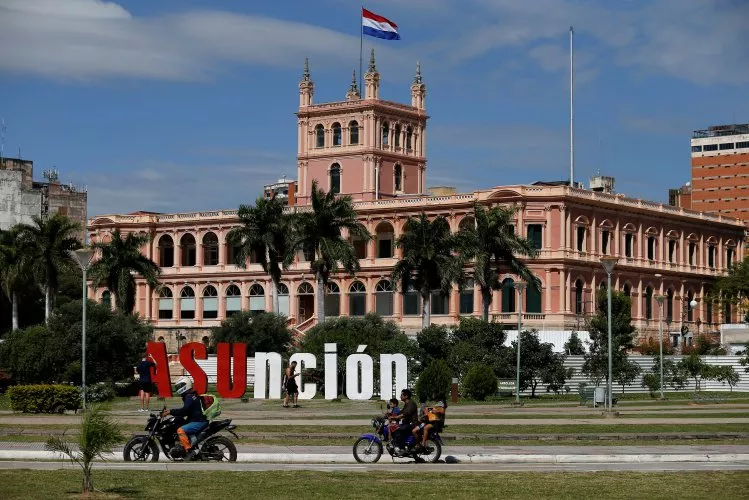
Prices in Asunción vary by neighbourhood
Asunción’s residential market is not uniform across the capital, with neighbourhood type and proximity to services shaping price levels.
Buyers generally see higher prices in established central and diplomatic districts with mature infrastructure.
Mid market neighbourhoods offer a step down in price while remaining connected to the city’s commercial core.
Outer residential zones tend to trade at lower levels, in line with longer commutes and newer or less consolidated services.
A practical approach is to compare current asking prices and recent registry inscriptions within a specific neighbourhood, rather than relying on a single city-wide average.
Rental yields depend on location, building type and tenant demand
Paraguay’s rental market rewards well located apartments and houses that match the needs of working professionals and foreign assignees.
Asunción’s central districts and areas near business and diplomatic offices tend to produce stronger tenant demand.
Yields are best assessed case by case, because gross annual rent relative to purchase price shifts with property condition and financing structure.
A buyer should factor in municipal tax, condominium charges and maintenance when calculating net returns.
The strongest rental candidates are typically apartments with clear legal title, updated utilities and manageable monthly common costs.
Residency remains separate but can support a long term property strategy
Paraguay does not require residency as a condition for purchasing property.
However, many foreign buyers later pursue residency because property ownership can form part of a broader relocation or tax residence plan.
A Paraguayan tax ID number, known as a RUC, may be arranged by the notary during the purchase process even for non residents.
Marital status documentation may be requested because community property rules can have legal implications for the deed.
The key point for foreign investors is that the property purchase itself remains valid and registrable regardless of whether residency is later obtained.
Connected Coverage
Paraguay’s Export Boom Undone by a Stronger Guaraní
Paraguay Economy Expands 6.6% in 2025 as Itaipu Revenue and Soy Exports Lift Investor Appeal
The Big Picture
This article was produced by The Rio Times’ automated newsroom system. How we use AI · Report an error · Editorial responsibility: Matthias Camenzind, Editor-in-Chief
Expat Guide to Paraguay
What The Rio Times publishes for foreigners who live in or move to Paraguay.
Start here
- Best Places to Live in Paraguay for Expats 2026, Ranked
- Investing in Paraguay as a Foreigner 2026 — Taxes and Property
- Uruguay vs Paraguay for Expats in 2026: Cheap Living or a Tax Holiday
- Moving to Paraguay in 2026 — Rents, Heat and the First Year
City guides
Coming up in Paraguay
- Los Iracundos Ciudad del Este, Paraguay: Lago Shopping Show on 25 October 25 Oct
- Marco Antonio Solís in Asunción, Paraguay: Gratitud Tour Plays the Jockey Club on 31 October 31 Oct
- Ed Sheeran in Asunción, Paraguay: First-Ever Show in the Country at La Nueva Olla on November 26, 2026 — FINNEAS Opens 26 Nov
Understand Paraguay