Brazil’s military crisis enters international radar for fear of democratic breakdown
RIO DE JANEIRO, BRAZIL – “Stress test”. This is the term foreign diplomats have used to describe the situation of Brazilian democracy. The events of recent days have raised international alerts about a potential institutional crisis in the country, as governments seek to know if the political gestures made by the President represent a real risk of democratic breakdown.
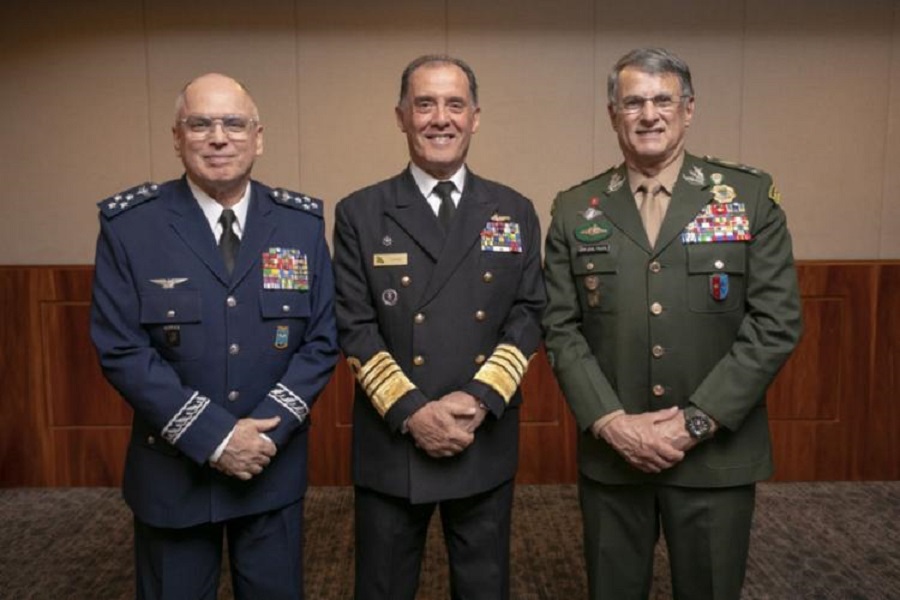
On Tuesday, March 30, Edson Leal Pujol (Army), Ilques Barbosa (Navy), and Antônio Carlos Bermudez (Air Force) resigned their posts, one day after the dismissal of Defense Minister Fernando Azevedo e Silva. The message was clear: the military is not willing to participate in any coup adventure.

Nevertheless, what foreign intelligence services are looking to find out is whether there is support for the president in specific groups within the different forces that would justify the fear of an uprising encouraged by the most radical Bolsonarism. The new leadership was announced on Wednesday, with the appointment of Paulo Sérgio Nogueira de Oliveira (Army), Almir Garnier Santos (Navy) and Carlos Almeida Baptista Júnior (Air Force).
The declaration of a commemoration of the 1964 coup and a frustrated bill to give greater powers to the president have also deepened international fears. Over the past few days, Brazilian ambassadors abroad have been sought out by members of foreign governments who have asked, in private, what the current moment represents in institutional terms.
The risk of democratic rupture has been denied by high-ranking officials, such as Vice President Hamilton Mourão. “The Armed Forces will always be guided by legality,” the reserve general said in an interview with journalist Andréia Sadi on Tuesday.
When appointing the new commanders of the Forces, the new defense minister Walter Braga Netto declared that “the Brazilian Navy, the Brazilian Army and the Brazilian Air Force remain faithful to their constitutional missions of defending the homeland, guaranteeing the constitutional powers and democratic freedoms.” He added: “The greatest patrimony of a nation is the guarantee of democracy and the freedom of its people.”
United Nations Human Rights Rapporteurs have already been informed about the events in Brazil and were evaluating whether to officially request Jair Bolsonaro’s government to explain what such signaling could mean in terms of violations of democracy. In Washington, the Inter-American Commission on Human Rights is also following the case, in a sign that there is a clear concern regarding the fate of the country.
Less than a month ago, the entity published a comprehensive survey of all aspects of human rights in Brazil and found that democracy “has been facing challenges and setbacks.”
Other institutes, such as the University of Gothenburg, Sweden, found that Brazil was one of the four countries that saw the greatest setback in its democracy in the last decade, especially in the last two years. Even at the UN summit, the Brazilian crisis is closely followed by António Guterres, secretary-general of the entity and a person who, throughout his history, has always been close to the country’s affairs.
In recent months, the office of the UN high commissioner for human rights Michelle Bachelet warned of the “shrinking civic space” in the country.
In the European Parliament, the fragility of Brazilian democracy has entered the radar, especially in view of the pressure that exists for MEPs to consider a trade agreement between Mercosur and the European Union.
The European Commission, the EU’s executive body, insists that it does not talk about other governments’ internal affairs. But the perception is that the world, at a time of crisis, cannot afford to see yet another focus of international instability.
“What we are seeing is a stress test of Brazilian democracy,” said a delegate in Brussels. The test is to know, according to him, if the institutions are in fact working or if there is a real possibility of rupture.
At the World Health Organization, the central concern is that, in the face of the institutional crisis, the government may end up relegating the pandemic to a secondary level. “There is a sense that the priority today in Brazil is another, even with more than 3,000 deaths per day from Covid-19,” lamented a senior health agency official.
Source. El País
More: Brazil news in English, every day from The Rio Times.
This article was produced by The Rio Times’ automated newsroom system. How we use AI · Report an error · Editorial responsibility: Matthias Camenzind, Editor-in-Chief