Brazilians Develop Cranial Reconstruction Technology
RIO DE JANEIRO, BRAZIL – Researchers from eight federal, state, and municipal institutions have developed a cranial reconstruction technology that will be able to assist patients in the Unified Health System (SUS). According to Fiocruz researcher and neurophysiologist Renato Rozental, coordinator of the multidisciplinary team, a prosthesis has been developed for reconstruction of extensive cranial cap bone defects.

The researcher said that patients sometimes wait seven or eight years for a solution, because the existing options on the market are very expensive, with a titanium prosthesis costing up to R$200,000 (US$50,000). This figure involves only the titanium mesh, he said. “It is not feasible”.
The solution that the group led by Renato Rozental has developed is 20 times cheaper, it costs around R$10,000. The researcher pointed out that this price is without scaliing. “When we scale up, the procedure will be much less expensive.”
Rozental clarified that once the patient has a window, a hole or a bone wound in the skull, it becomes fragile. If a titanium mesh is put in and the patient’s head is impacted again, the skull that is already fragile may crack. The prosthesis introduced by the group led by Fiocruz was developed in such a way that, should there be another impact, the prosthesis and not the individual’s skull will fragment.
Custom mold
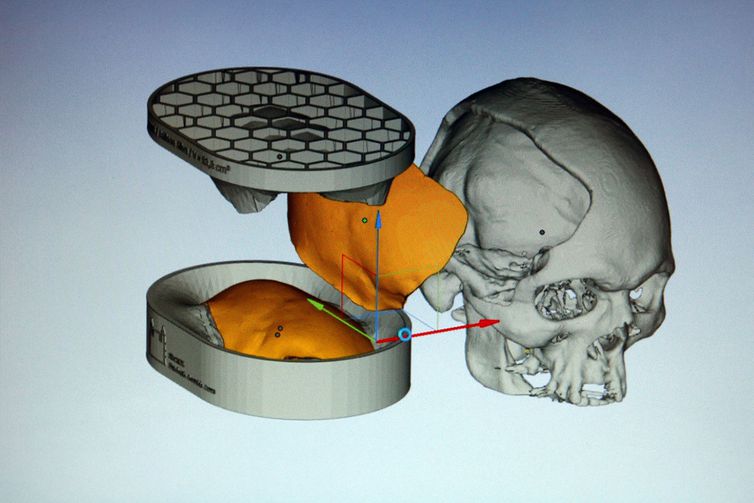
The researcher explained that the mold is customized for each patient. It is made from the bone wound using tomography images, which makes the negative of that hole. The cast is made in a 3D printer. “It’s like making the cake shape you’re going to bake in the oven. The shape you keep and use again when you want to make another cake. The mold is made from that patient’s bone wound.”
“The tomographic image provides the full dimension of the skull. The missing piece is then calculated and the 3D printer makes the corresponding negative or mold. Therefore, if necessary, a new mold can be prepared in a very quick process, and it can be sterilized quickly. This allows the patient to leave the surgical center with a new prosthesis”, explained Rozental.
This year alone, 32 molds were made, 23 for Pernambuco State and nine for Rio de Janeiro State.
The researchers attend civil and military patients included in this first stage. The military officers were victims of gunshot wounds. The selected civilians, on the other hand, suffered brain tumors, strokes, or traumatic brain injury, which led to increased cranial pressure and it was necessary to open an enlarged window in the cranial cap, which the specialists call a bone defect.
In such patients, the intraoperative reconstruction of the bone defect was performed (the period in which a surgical operation takes place), a stage allowed by the National Health Surveillance Agency (ANVISA).
Rozental emphasized that the prosthesis was not placed in animals, nor in the laboratory, but in patients who had extensive bone defects because they had undergone decompression craniectomy, “to decompress the brain or encephalon, due to a variety of situations”.
Pilot unit
Sponsored by the Ministry of Health, the researchers’ goal is to set up a 3D printing pilot unit in order to supply SUS network hospitals and military hospitals throughout the country. “In all these units, you see queues of people who have undergone this procedure and are waiting for a chance to reconstruct the bone defect, in addition to the new cases that happen every year”.
Renato Rozental said hospitals’ ICUs in Brazil are crowded with people who have been injured in road accidents, including those who have been injured by a firearm.
The restoration or reconstruction of a bone defect, according to the researcher, is not only an aesthetic issue.
“It’s not just closing a bone defect, which in itself would justify it. It is dantesque. Another important point is that when you leave that bone defect open, it alters the cerebral blood flow. When you reconstruct, it improves brain perfusion and, consequently, you directly impact patients’ cognition and behavior. Without the reconstruction, patients feel excluded from society. But by performing the procedure, you make it possible to reintegrate patients not only because of their appearance, but also to improve their cerebral perfusion and a whole different social integration from the previous situation. It’s a very important process because it reintegrates patients and costs a much less”.
According to the Fiocruz researcher, the new technology was made possible by the Economic and Industrial Complex of the Ministry of Health.
Protocol
The multidisciplinary group intends to define a protocol in 2020 that will be forwarded to the Ministry of Health, in order to gain support from the federal government for this additive manufacturing unit to be set up at Fiocruz, with an assistance component. “The recipe for the cake will be standardized for all the ovens,” Rozental said.
Renato Rozental said the annual demand is between 200 and 300 cranioplasties. According to data from the Ministry of Health’s DataSUS, from January 2008 to September 2019, the highest number of such cases occurred in the Southeast Region, with 49 percent, followed by the Northeast Region, with 19 percent, and the South Region, with 15 percent.
Still according to DataSUS, depending on the procedure, around 2,000 to 3,000 decompression craniectomy cases are performed each year in Brazil.
The project involves the Oswaldo Cruz Institute Foundation (Fiocruz); the Federal University of Rio de Janeiro (UFRJ); the Fluminense Federal University (UFF); and the Brazilian Physical Research Center (CBPF); the Renato Archer Center for Information Technology, located in Campinas and linked to the Ministry of Science, Technology, Innovation and Communications (MCTIC); the Institute of Metrology, Quality and Technology (INMETRO); the Restauração Hospital, in Pernambuco; and the Miguel Couto Municipal Hospital, in Rio de Janeiro.
Source: Agência Brasil
More: Brazil news in English, every day from The Rio Times.
Editorial responsibility: Matthias Camenzind, Editor-in-Chief · Editorial standards · Report an error
LatAm Markets: Live Signals → — real-time movers, turnover leaders and FX across Latin America.