Brazil Army Receives First Fully National Bomb-Disposal Robot
BRAZIL · DEFENSE
Key Facts
—The delivery:. Brazil’s Army received its first fully national explosive ordnance disposal robot, an EOD robot built in the country.
—The maker:. It was produced by Ambipar Robotics, based in Jacarei, in the interior of Sao Paulo state.
—The unit:. The robot is bound for the 6th Combat Engineering Battalion in Sao Gabriel, Rio Grande do Sul.
—Why it matters:. The Army had relied on imported systems that were hard and costly to maintain from abroad.
—Latin American impact:. A marker of Brazil’s push for defense-industry self-sufficiency, with relevance for the region’s armed forces.
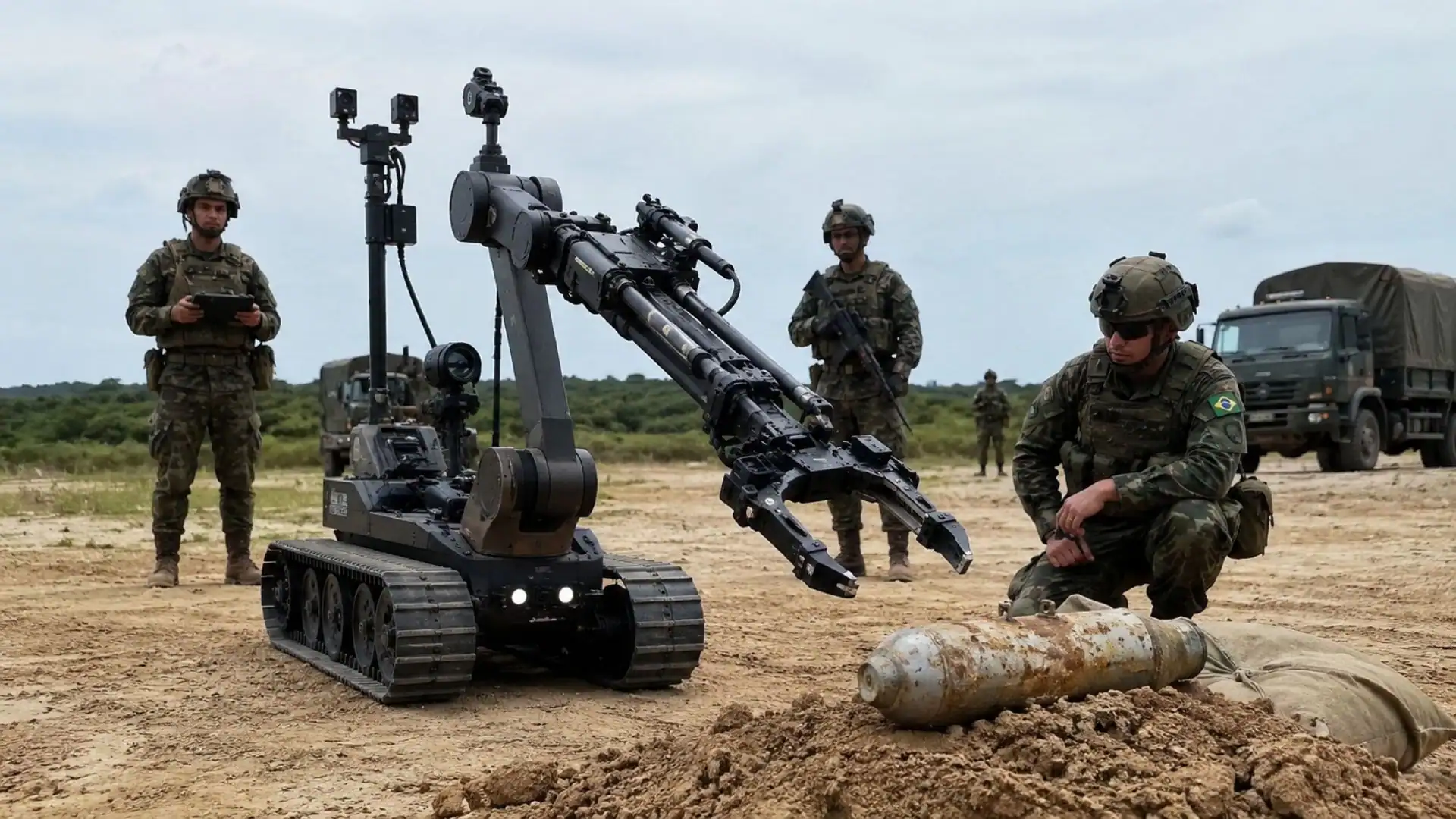
Brazil’s Army has received its first fully national EOD robot, a remotely operated machine for handling explosives that was built in the country, in a step toward reducing the force’s dependence on imported systems.
What the EOD robot does
The machine performs explosive ordnance disposal, the task of identifying, handling and neutralizing dangerous devices from a safe distance. Such remotely controlled systems are designed to keep soldiers away from improvised explosive devices, a persistent risk in modern operations.
It was produced by Ambipar Robotics, a company based in Jacarei, in the interior of Sao Paulo state. According to the Army, the equipment is destined for the 6th Combat Engineering Battalion, a unit based in Sao Gabriel, in Rio Grande do Sul.
That battalion takes part in training cycles that prepare Brazilian troops for peacekeeping. In September 2025, the unit hosted centralized training for explosive-disposal and peace-force engineering companies, with a view to future United Nations evaluations.
Why a national EOD robot matters
Until now, the Army has operated imported disposal robots, including German-made models. Those systems depend on external suppliers for maintenance, spare parts and delivery timelines, with costs set outside the country.
The strain was real. One of the imported robots sat unavailable for more than two years because of high maintenance costs and long procurement times, with the Air Force’s aerospace research institute at one point reproducing a part to keep it running.
A domestically built system changes that calculus. Local production means parts, support and repair times can be handled inside Brazil, which the Army links to the operational readiness of its units.
The wider defense-industry picture
The delivery fits a broader Brazilian effort to build out its defense industrial base and lean less on imports. National production keeps engineering know-how and supply chains in the country, a recurring goal across the region’s larger militaries.
It also has a peacekeeping dimension. Brazil has long contributed engineering and disposal capabilities to international missions, where reliable, serviceable equipment matters for both effectiveness and safety.
For other Latin American forces watching, a locally built disposal robot is a reference point. It signals that the capability can be developed regionally rather than only bought abroad.
Frequently Asked Questions
What is an EOD robot?
It is a remotely operated machine used for explosive ordnance disposal, meaning it identifies, handles and neutralizes dangerous devices so that soldiers do not have to approach them directly.
Who built it and where is it going?
It was produced by Ambipar Robotics, based in Jacarei, Sao Paulo state, and is destined for the 6th Combat Engineering Battalion in Sao Gabriel, Rio Grande do Sul.
Why is a national version significant?
The Army had relied on imported robots that were costly and slow to maintain from abroad. A domestically built system allows parts, support and repairs to be handled inside Brazil.
How does it connect to peacekeeping?
The receiving battalion trains for international missions, and Brazil has contributed engineering and explosive-disposal capabilities to peacekeeping, where serviceable equipment is important for safety.
What did Brazil use before?
Imported disposal robots, including German-made models, one of which was unavailable for more than two years due to maintenance costs and procurement delays.
Connected Coverage
The investment fits the country’s wider spending choices, traced in our coverage of the federal budget freeze and fiscal squeeze. For the trade backdrop to Brazil’s industrial base, see our report on the record trade surplus.
This article was produced by The Rio Times’ automated newsroom system. How we use AI · Report an error · Editorial responsibility: Matthias Camenzind, Editor-in-Chief
Read More from The Rio Times