Political Analysis: Bolsonaro Nods to Brazil’s Armed Forces Nationalist Wing
RIO DE JANEIRO, BRAZIL – On Tuesday, November 10th, President Jair Bolsonaro declared that “when you run out of words, you must have gunpowder“. The direct threat to the United States was a reaction to comments by American President-elect Joe Biden about the potential imposition of trade barriers to Brazil due to deforestation of the Amazon.
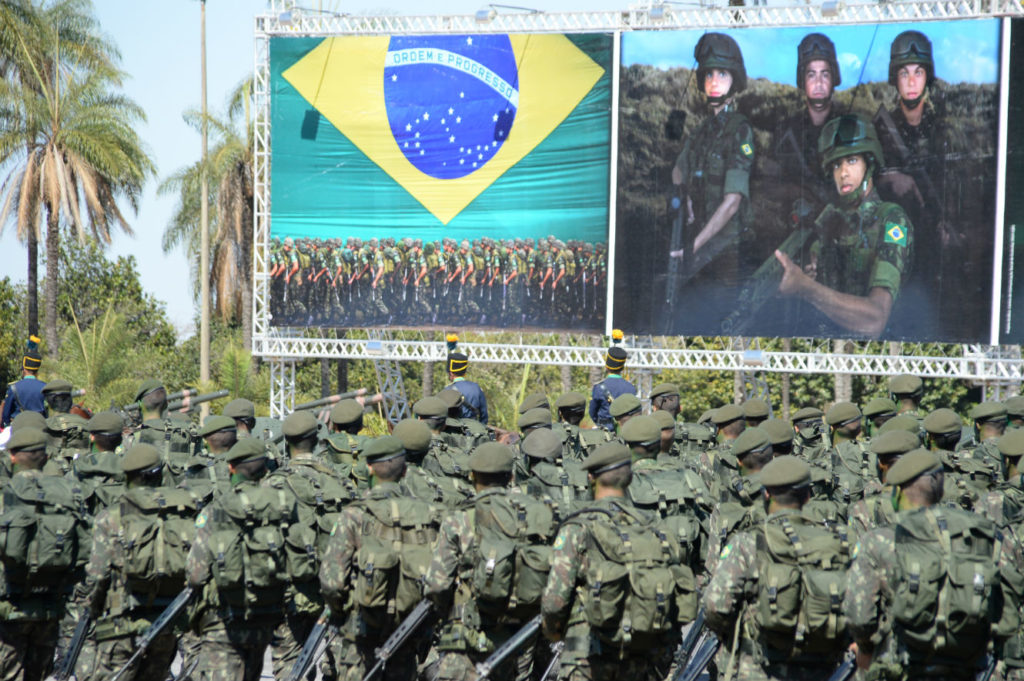
However foolish and inconsequential the President’s statement may be, it does not spring out of thin air, but rather from a primitive fear, held by many Brazilian Army officials. Maurício Santoro, professor of International Relations at UERJ (Federal University of Rio de Janeiro) explains that “the main scenario of a Brazilian war is that the U.S. would invade the Amazon and how the Army would react to this.”
“It’s a delirious scenario,” Santoro says, adding that “the Army should be concerned with organized crime at the borders or attacks on Brazilian communities in neighboring countries, the two real scenarios of higher risk. But it is part of the doctrine that a power from outside the region would occupy the Amazon.”

“The notion is that the Guararapes Battle of the colonial era would be the model to be repeated in the event of an Amazon invasion: that is, a guerrilla war when the Americans invade the Amazon. It is both laughable and tragic, but the institution as a whole is trapped in a worldview that has evolved inadequately, slowly in relation to Brazil’s real challenges. It is still dominated by anti-communist sentiment out of contemporary reality, still an experience of the cold war, of internal conflicts against left-wing guerrillas. Fitting a concern with the environment becomes complicated,” explains Santoro.
In other words, as empty as Bolsonaro’s threats may seem, there is reason for concern, since the issue strikes one of the most sensitive points of Brazil’s military strategy and, as we know, Bolsonaro is anything but stable and reliable. It is debatable whether the Armed Forces would embark on an adventure following Bolsonaro’s statements, but it is a fact that this “obsolete and inadequate thinking,” as Santoro explains, is something always present.
“It is a strong mindset in the military mentality that speaks of ‘international greed’ over the Amazon and manifests itself in a critical outlook on the role of international institutions in the Amazon, as missionaries, NGOs, and at the limit, this rhetoric can become a xenophobic, paranoid discourse of seeing enemies everywhere and failing to understand the political and economic reality of the 21st century, where borders are porous, there is a greater presence of international networks of research and activism,” says Santoro.
It is no surprise that recently several civil society organizations published an open letter repudiating Vice-president Hamilton Mourão’s plans to control 100 percent of the NGOs operating in the Amazon. Bolsonaro’s statements, even before the elections, against NGOs in the Amazon, are based on the same logic – there is an international plan to invade Brazil and steal its riches.
Last year, Milton Deiró de Mello Neto, professor of International Relations, spoke about the G7’s offer to help Brazil contain the large fires that ravaged the Amazon. The government refused, accusing the offer of being a handout and also of infringing on Brazilian sovereignty. Furthermore, France maintains a significant military contingent in bordering French Guyana, which caused the military’s warning signal to go off.
Deiró then said that “the military, while agreeing with the sovereignist stance of the President of the Republic, is privately disagreeing with his methods of debate and discussion.” He added that “because they are state institutions, the Armed Forces avoid debate in political terms, at least in the public sphere. But either privately (in the case of active military personnel) or discreetly (in the case of reserve military personnel) they adopt a sovereignist stance, although they want guarantees of sustainable development. This basis for sustainable development in the Amazon is also present in the basic documents guiding National Defense in Brazil: the National Defense Strategy and the National Defense Policy”.
In a more recent conversation, after Monday’s incident, Deiró confirmed that the feeling among the military remains the same. Cautious support, but seeking to protect all flanks – the case of NGO control proposed by Mourão. But if everything were to go wrong, would Brazil be able to fight the U.S.? The answer is no.
“Brazil is not in a position to fight head-on with the U.S., neither from a military nor an economic perspective,” explains Deiró. “With respect to the military, although Brazil has relative power, it still falls far short of the territory’s full defense capacity. Not even the fact that we are the 11th largest spender on defense in the world reflects the strategic reality, since most of these resources are for personnel or pension payments.
Very little remains for the development of advanced military technologies that can be used in territorial defense. Even the organization of forces on Brazilian territory still follows a geopolitical logic of the 19th and early 20th centuries. Our Navy is virtually all docked in Rio de Janeiro, and the units with the most firepower in the Army and Air Force are in southern Brazil, too far from any epicenter of conflict with the U.S. or any other global power”.
So what does the Brazilian President want?
“Bolsonaro is using this rhetoric to please the nationalist wing of the Armed Forces,” explains Deiró. “But lacking any notion, the President spoke of ”gunpowder”, which immediately conveys the sense of a military threat, and Ambassador [Todd] Chapman (from the U.S.) has already reacted between the lines by congratulating the United States Marine Corps, which is the expeditionary force used by the U.S. to attack countries located beyond the continental reach of the U.S.”. A way to contain the President’s “verbiage” by taking diplomatic action and between the lines, Deiró says.
Deiró adds that “even the nationalist wing and the ‘center’ military officers who are sovereignists agree with Bolsonaro’s sovereign stance, but even they were extremely displeased with the way Bolsonaro made the statement.”
In short, the President’s statements seem to be nothing more than bravado within an outdated logic of the Brazilian Armed Forces. However, they cannot simply be dismissed, as they are diplomatically relevant, particularly with the new U.S. government due to take office in a few months, led by a Democrat who has already made countless claims that he will adopt a much stronger stance than current President Donald Trump on the environmental issue, particularly the Amazon.
Whether Biden will retaliate against Brazil for threats of this nature or whether economic issues will prevail, remains to be seen.
Source: UOL
More: Brazil news in English, every day from The Rio Times.
This article was produced by The Rio Times’ automated newsroom system. How we use AI · Report an error · Editorial responsibility: Matthias Camenzind, Editor-in-Chief