Organizations see “hypocrisy” in Boric’s failure to address the maritime claim of Bolivia for access to the Pacific
On the Day of the Sea, the president of Bolivia, Luis Arce, proposed to his Chilean counterpart, Gabriel Boric, to open a dialogue agenda to solve issues pending for 144 years.
Social movements expressed their disappointment because Boric didn’t fulfill what he said.
March 23 marked 144 years since Bolivia lost its access to the Pacific Ocean in the war between 1879 and 1884 between Chile and Peru and Bolivia, the so-called War of the Pacific.
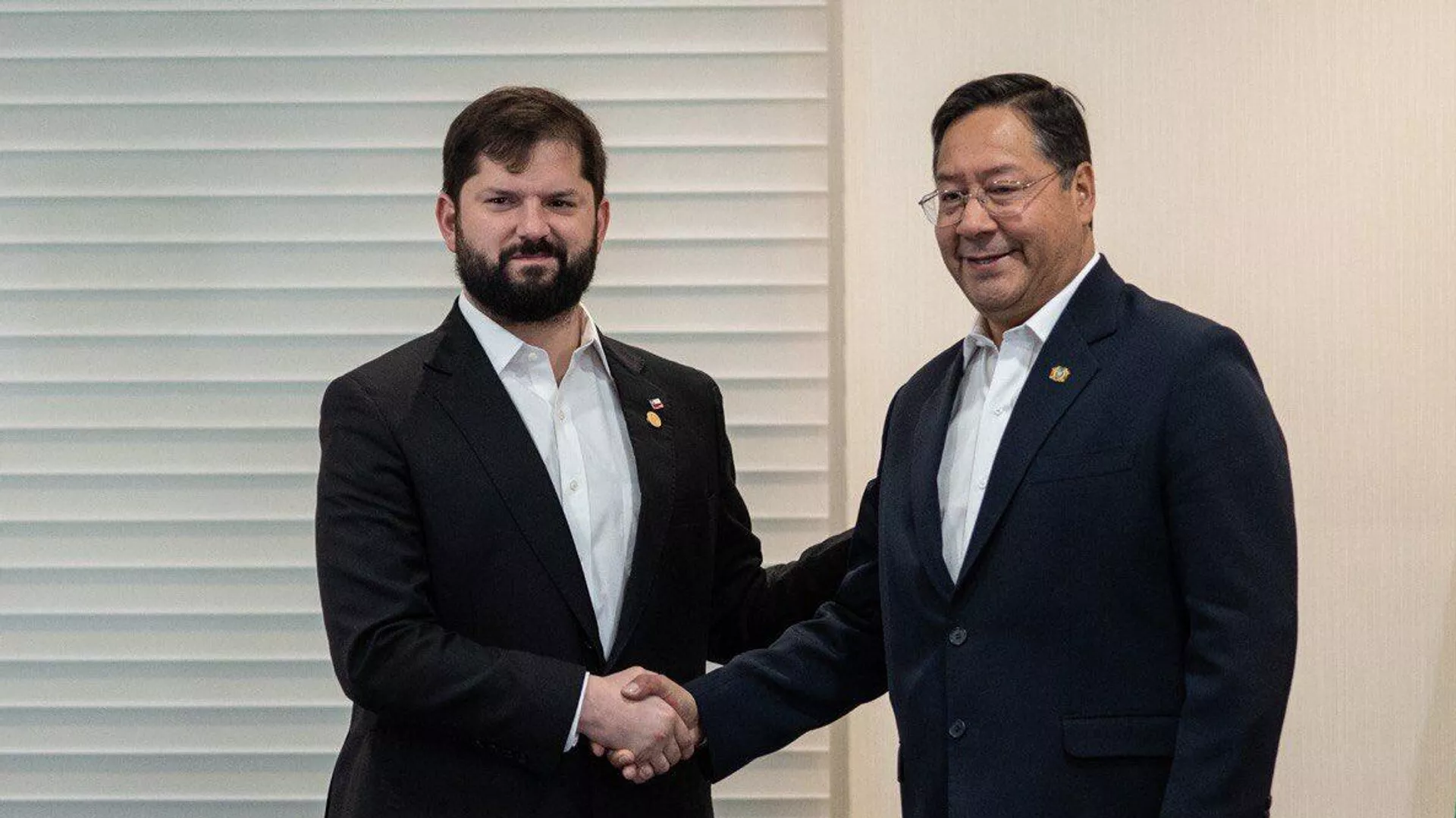
Although some time ago, the Chilean president, Gabriel Boric, had declared himself in favor of returning the sea to his neighbor, since he assumed the executive power, he gave no signs that he intends to move forward in this aspect.
In Abaroa Square in La Paz, commemorating one of the main martyrs of the tri-national war conflict, Arce offered Boric to follow an agenda of seven points to remedy the relationship between the two nations.
Among them, the access to the sea for Bolivia and resolving the dispute over the use of the waters of the Silala River, shared by both nations.
Years ago, the current Chilean president stated on his Twitter account that “many of us agree with a sovereign outlet to the sea for Bolivia”.
Without the obligation to maintain the forms that the Bolivian president must follow, social organizations expressed themselves bluntly.
“According to our criteria, the apparent popular tendency of Mr. Boric is complete hypocrisy. He is a subject who obeys the interests of capitalism,” Omar Ramirez, secretary of international relations of the Bolivian United Confederation of Peasant Workers (CSUTCB), told Sputnik.
“Many years ago, we addressed the issue of the recovery of our sea. But unfortunately, under petty interests, the Chilean government has closed to any possibility of granting an outlet to the sea,” explained the union fighter.
“It is a sadness that the governments of Chile do not have the minimum intention to look for options to give a maritime exit to the Bolivian people”, he added.
The CSUTCB leader commented that he maintains a permanent dialogue with Mapuche organizations in Chile.
“They show us their solidarity and maintain integration because, before the colony, our peoples had no limits.”
“Unfortunately, the sectorial interests of Latin America’s business lodges have divided it into countries.”
As he does every year, President Arce spoke in the shadow of the statue of Eduardo Abaroa in the La Paz neighborhood of Sopocachi.
The war hero was a merchant who enlisted in the militias of Calama – a city inside Bolivian territory that today belongs to Chile – to repel the invasion of the neighboring nation during the War of the Pacific.
Abaroa was the last man left defending the strategic Topater Bridge.
Wounded and with a hundred enemy soldiers in front of him, he was asked to surrender.
In his response were also his last words:
“I surrender? Let his grandmother surrender!” was the phrase immortalized in the history books.
President Arce stated that if Bolivia still had a sea, its economic situation would be very different.
“It has been calculated that we lose the possibility of growing at least 1% of the Gross Domestic Product (GDP) due to our secluded condition annually. Other studies raise this figure,” commented the South American leader.
“We were born with the sea and, as a result of this war, motivated by imperial interests, we became a country deprived of its coastline with limited connections with the rest of the world. This fact had negative implications for our country’s economic and social growth,” Arce reproached.
“It is an amputation of the soul, which is more painful to the extent that one realizes that the relationship of our peoples with the sea goes further back than colonial times when the inhabitants of Tiwanaku transited from the Andes to the Pacific coast,” he mentioned about the ancient civilization settled in the territory before the establishment of the Inca Empire.
Arce appealed to the memory of Chilean President Salvador Allende (1970-1973).
“We are sure that, at some point, as it happened during the socialist government of comrade Salvador Allende, it will be possible to make viable the just, legitimate, and historical aspirations of a people that was born with maritime coasts and has the conviction that it will have them again”.
Without mentioning it, Arce addressed Boric:
“We must not be afraid of healing wounds, building brotherhood, integration and hope for the peoples, articulating the pending issues we have with the new challenges presented by the reality of a world in constant movement”.
LITHIUM, AT THE CENTER OF THE DEBATE
The Bolivian president had a separate paragraph for lithium during his speech.
Just as the 1879 invasion was motivated by interests in minerals and other resources, in the past few weeks, clear signals have come from the United States that they wish to exploit this concentrated metal on a massive scale in the Uyuni salt flats, regardless of the sovereign decisions taken by Bolivia to industrialize it.
Once again, Arce advocated for energy integration among the countries of the continent that possess lithium:
“It is a natural resource for integration and living well with sovereignty. One of the issues we must deal with since new common doors are opening for us is that of lithium. We have lithium in Bolivia, Chile, Argentina, and Peru”.
And he added:
“We are willing to jointly design a policy that ensures the position of our countries as suppliers of this type of energy under sovereign conditions that favor our peoples”.
In this sense, Arce said:
“We do not want our lithium to be in the eyes of any Southern Command or to be a reason for destabilization of democratically elected governments or external harassment”, he said.
He was referring to the head of such US command, Laura Richardson, who, before legislators of her country, expressed her dismay because the loss of land in her “backyard” benefits their opponents, China and Russia.
The mayor of La Paz, Iván Arias, who was Minister of Public Works during the de facto government of Jeanine Áñez (2019-2020), was also in the Abaroa square.
Arias spoke with Sputnik and evaluated the following:
“It is important to sit down with Chile to discuss this lithium issue. This way, we could have a better deal in the ports of Arica so that the 1904 treaty is complied with”, aimed at guaranteeing the international trade of the Plurinational State without tariffs affecting its economy.
According to Arce and Arias, this part of the treaty is not complied with and is one of the points of the agenda proposed by the Bolivian government to recompose relations with Chile.
“That’s the way forward,” commented the mayor.
With information from Sputnik
More: Bolivia news in English, every day from The Rio Times.
Editorial responsibility: Matthias Camenzind, Editor-in-Chief · Editorial standards · Report an error