Argentina Approves US$12.24bn Vaca Muerta RIGI Project

ECONOMY · ARGENTINA
Key Facts
- —The country Argentina offers tax, customs and currency benefits to projects above US$200 million under the RIGI, the large-investment regime created by the 2024 Ley Bases reform.
- —What happened On Friday 2 October 2026, Economy Minister Luis Caputo said the RIGI evaluation committee approved a US$12.24 billion Vaca Muerta project by Pluspetrol and GyP (Crónica, La Nación).
- —The numbers More than 620 horizontal wells over 25 years, output above 100,000 barrels of oil a day at peak, and over 2,350 direct jobs, according to the company (La Nación, 2 Oct).
- —What it means for you More oil and gas exports would bring in dollars, which Argentina’s economy depends on. Caputo put the export value above US$2.3 billion a year once the field peaks.
- —Still open When drilling speeds up, why company sources cite US$12.4 billion against Caputo’s US$12.24 billion, and when the formal resolution appears in the official gazette.
A new Vaca Muerta RIGI project worth US$12.24 billion won approval on Friday 2 October. Economy Minister Luis Caputo announced it from Paris, where the government is promoting Argentina to foreign investors.
The project belongs to Pluspetrol, a private Argentine oil company, and GyP, the Neuquén provincial energy firm. It covers the Bajo del Choique–La Invernada block in northern Neuquén.
What Was Approved
Caputo said the committee that vets applications under the RIGI approved the plan. RIGI stands for Régimen de Incentivo para Grandes Inversiones, Argentina’s incentive regime for large investments.
He wrote on X that the field would yield 613 million barrels of oil and 50.37 billion cubic metres of gas. More than 92% of that output is destined for export, he added, as quoted by Crónica.
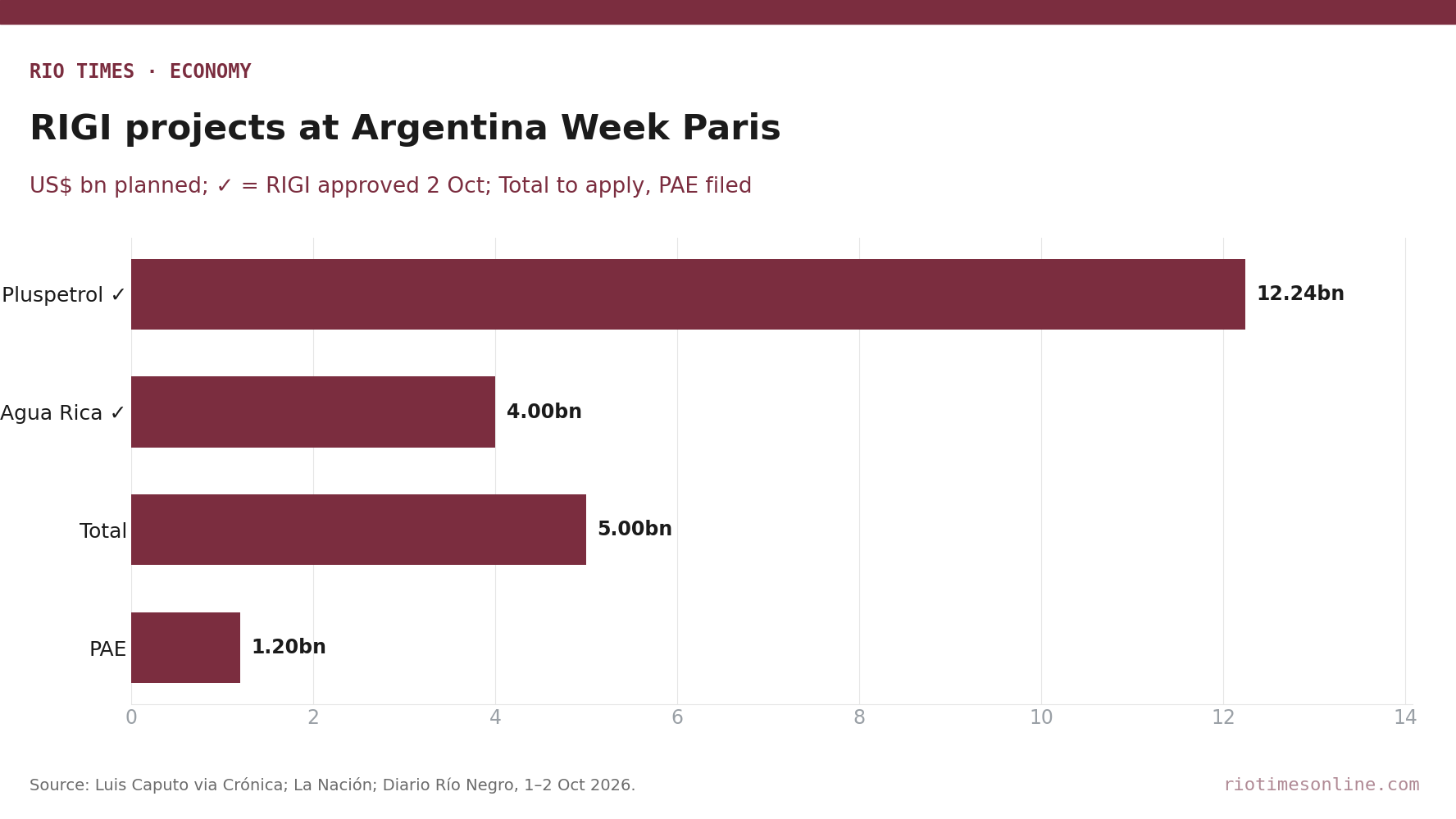
Company sources told La Nación the investment comes to US$12.4 billion over 25 years. The gap with Caputo’s figure was not explained on Friday.
The Vaca Muerta RIGI Plan in Numbers
Pluspetrol plans more than 620 horizontal wells, four processing plants and export pipelines, La Nación reported. Three dedicated rigs would drill an average of 41 wells a year.
The first phase targets 50,000 barrels of oil a day and 6 million cubic metres of gas. The second would double both, to over 100,000 barrels and 12 million cubic metres a day.
Today the block produces about 27,000 barrels a day of condensate, the company said. Pluspetrol bought the area from ExxonMobil in a deal completed on 16 December 2024.
The firm expects more than 2,350 direct jobs and about 4,640 indirect ones. Most of the effect would be felt around Rincón de los Sauces, the oil town nearest the block.
Why Argentina Wants It, and What Could Slow It
Caputo said the project would export more than 100,000 barrels a day, worth over US$2.3 billion a year. The company’s own estimate is US$2.2 billion a year in export earnings.
Julián Escuder, Pluspetrol’s country manager, called the regime a key tool for long-term predictability. He said it gives capital-heavy shale projects the stable rules they need, La Nación reported.
Approval locks in tax and currency benefits, but it does not guarantee output. Shale economics depend on oil prices, and Vaca Muerta’s exports need new pipeline and port capacity to keep pace.
Pluspetrol holds stakes in two of those pipeline projects, Vaca Muerta Oil Sur and Oldelval. The company said joining the regime lets it drill faster, lifting output 34% above a slower plan.
A Busy Week in Paris
Before Argentina Week began, 23 projects worth US$49.77 billion had been approved under the regime, La Nación reported. Another US$159.48 billion of proposals were under evaluation.
On Thursday Pan American Energy filed a US$1.2 billion bid for its Cerro Dragón field, as covered in Pan American Energy Files US$1.2 Billion RIGI Bid. TotalEnergies said it will apply for a US$5 billion project called San Roque, after the plans in Milei Paris Visit: TotalEnergies Plans Nearly US$10 Billion for Argentina Oil and Gas.
Later on Friday the committee also approved Glencore’s US$4 billion Agua Rica copper project in Catamarca, Diario Río Negro reported.
What Is Not Yet Known
It is not clear when the formal approval will be published in the Boletín Oficial, the official gazette. The reason for the US$160 million gap between the two investment figures is also unexplained.
Neither the government nor Pluspetrol has given a date for the start of the first phase. The share of the investment carried by GyP has not been disclosed.
Sources: Luis Caputo on X, as reported by Crónica (2 Oct 2026); La Nación (2 Oct 2026); Diario Río Negro (2 Oct 2026); Rio Times reporting on Argentina Week (1 Oct 2026).
This article was produced by The Rio Times’ automated newsroom system. How we use AI · Report an error · Editorial responsibility: Matthias Camenzind, Editor-in-Chief
In depth