Argentina has the highest number of scientific researchers per capita in Latin America
RIO DE JANEIRO, BRAZIL – “The most important actors in improving a country’s productivity and competitiveness are scientists,” Daniel Filmus said in an interview with Infobae.
On the occasion of the Day of Scientific Researchers, the Ministry of Science and Technology pointed out that Argentina has the highest number of scientific researchers per inhabitant in Latin America, with 3.18 per thousand employed. “We have developed Argentine developments at the highest level, which we export today,” the minister stressed.
Every year on April 10 is celebrated the Day of the Scientific Researcher and also the Day of Science and Technology. This date was chosen in honor of Dr. Bernardo Houssay (1887-1971), the first Latin American Nobel Laureate in Science for his work linking diabetes to the pituitary gland.
A breakthrough that revolutionized the treatment of this disease. But that was not all, as he was also the driving force behind the creation of the National Council for Scientific and Technical Research (CONICET).
Read also: Check out our coverage on Argentina
ARGENTINA: THE COUNTRY WITH THE HIGHEST NUMBER OF SCIENTIFIC RESEARCHERS PER 1,000 GDP
According to the MINCyT, in 2020 there were 90,397 people working in research, including not only researchers but also fellows at all levels of their professional careers. Of these, 21,850 belong to CONICET, while the remaining 68,547 belong to other public and private entities, including universities, national commissions (CONAE, CONEA, among others), and institutes (such as INTI and INTA), as well as companies and organizations.

According to the National Science Portfolio, Argentina is at the top of Latin America in terms of the number of scientists. “For international comparison, the indicator used is researchers, expressed in full-time equivalents per 1,000 labor force (EAP),” the authors said. According to MINCyT estimates, there would be 1992 researchers for every million inhabitants in 2020.
In addition, in terms of scientific human resources, the Ministry of Science and Technology indicated that in Argentina, there are 3.18 people working in research for every thousand EAPs. It is followed by Brazil (with 1.68 researchers per thousand employed), Uruguay (1.41) and Chile (1.01).
However, in a global comparison, it is still behind Spain (with 6.25 researchers per thousand employed population), Canada (with 8.4), the United States (with 9.51), and Portugal (with 9.55). There are even countries with more than 10 researchers per EAP, such as Germany, France, and South Korea.

According to the National Ministry of Science and Technology, as of April 2022, there were 23,264 researchers registered in the main national research institution, CONICET, of which 11,876 are grantees.
Of the total, 5,835 (25%) are working in agricultural, engineering and material sciences, 6,195 (26%) in biological and health sciences, 4,860 (20%) in exact and natural sciences, 5,790 (24.8%) in social sciences and humanities, and 584 (2.5%) in technology. Of these, 53% are women researchers and 60% are women scholars.
“The enormous response of scientists in the context of the COVID-19 crisis, for example, is a clear expression of the process to improve productivity and competitiveness,” Filmus told Infobae.
At the same time, he assured us that “we have top-level Argentine developments that we are exporting today, and that this has been possible because there is very good basic research in Argentina. I am very proud of our Argentine scientists, of their work, their commitment, and their adaptability,” the national official continued.
“On this day, I hope that as a ministry and as a society we have the capacity to awaken early vocations in science. Our goal is to make science fashionable, and I hope we never lose sight of that. We should be proud of these achievements, and so on this day I would like to thank all the researchers in our country.”
CONICET RECONSTRUCTS 8 FILES OF MISSING SCIENTIFIC RESEARCHERS
On March 24, as part of the National Day of Commemoration for Truth and Justice, the National Council for Scientific and Technical Research (CONICET) reconstructed for the first time the history and information of the files of eight members of the organization who had fallen victim to state terrorism and handed them over to their families and relatives.
The event was attended by the country’s President, Alberto Fernández, the Minister of Science and Technology, Daniel Filmus, and Horacio Pietragalla Corti, head of the Secretariat for Human Rights, as well as members of the CONICET Board of Directors, national ministers, CONICET directors from around the country, authorities, and representatives of national universities and science and technology organizations, and human rights representatives.
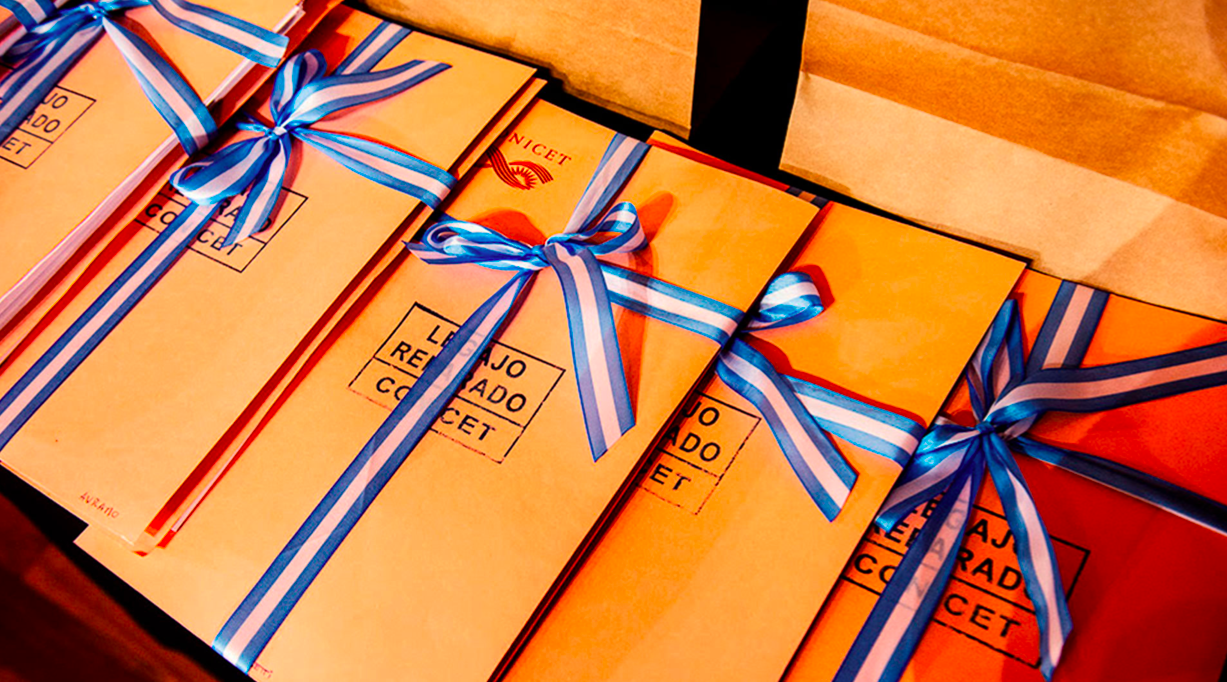
The 8 scientists whose files were reconstructed were:
- Dante Guede, member of the Support Staff Career (CPA) at the Argentine Institute of Radioastronomy (IAR);
- Alicia Cardoso, CPA at the Institute of Astronomy and Space Physics (IAFE);
- Liliana Galletti, a fellow at the Faculty of Humanities of the National University of La Plata (UNLP);
- Mario Oreste Galuppo, a fellow at the National Technological University (UTN) Rosario;
- Federico Gerardo Ludden, a fellow at the Faculty of Exact Sciences of UNLP;
- Martín Toursarkissian, a researcher at the Argentine Museum of Natural Sciences “Bernardino Rivadavia” (MACN);
- Manuel Ramón Saavedra, librarian at MACN; and
- Roberto Luis López Avramo, CPA at the Institute of Oncology “Ángel H. Roffo.”
The technical report submitted by the CONICET Memorial Commission reviewed all of the agency’s resolutions between 1976 and 1983 and also recognized the “dismissed, exonerated, exiled, dismissed, and those who were prevented by the military government from continuing their research.”
More: Argentina news in English, every day from The Rio Times.
Editorial responsibility: Matthias Camenzind, Editor-in-Chief · Editorial standards · Report an error