Xi and Modi’s Meeting Signals New Chapter in China-India Relations
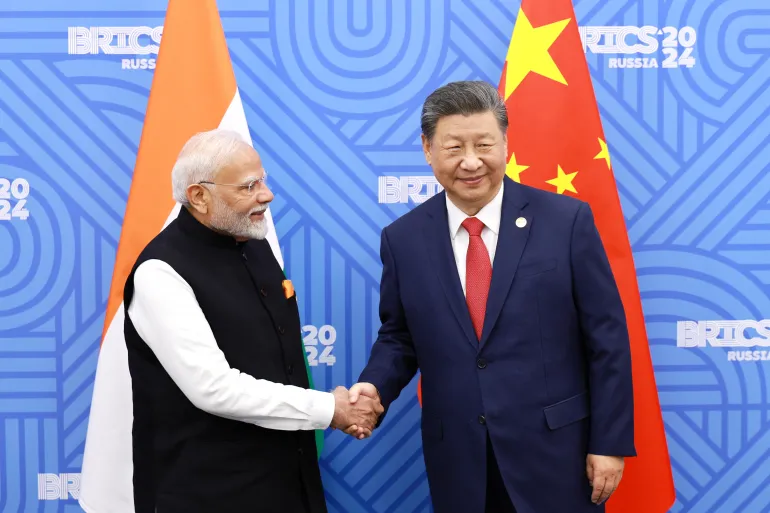
Indian Prime Minister Narendra Modi and Chinese President Xi Jinping met on October 23, 2024, during the BRICS summit in Kazan, Russia.
This significant meeting marked their first formal interaction in five years and followed a recent agreement aimed at easing tensions along their contested Himalayan border.
The leaders’ handshake and subsequent discussions underscored a mutual desire to improve relations after a prolonged military standoff that began in 2020.
The backdrop to this meeting involves a history of conflict along the Line of Actual Control (LAC). This line serves as the de facto border between India and China.
In June 2020, a deadly clash in the Galwan Valley resulted in the deaths of 20 Indian soldiers and four Chinese troops, escalating tensions and leading to a military buildup in the region.
Both countries stationed thousands of troops along the LAC, supported by artillery and fighter jets. In recent months, diplomatic efforts have intensified to resolve these tensions.
The new agreement allows for the resumption of military patrols along specific areas of the disputed border. This development is seen as a positive step towards restoring normalcy and reducing the risk of further confrontations.
India and China’s Diplomatic Dialogue
Indian Foreign Secretary Vikram Misri emphasized that both leaders agreed on the importance of stable and friendly relations for regional peace.
Economically, China remains one of India’s largest trading partners, with bilateral trade reaching $136.26 billion in 2022. However, India has imposed restrictions on Chinese investments due to security concerns exacerbated by border tensions.
These restrictions remain despite recent diplomatic progress. Indian Finance Minister Nirmala Sitharaman emphasized the need for safeguards with foreign direct investment due to India’s sensitive geopolitical situation.
During their meeting, Xi highlighted the shared characteristics of China and India as ancient civilizations and major developing countries.
He stressed the importance of managing differences effectively to facilitate each other’s development goals. Modi echoed these sentiments, emphasizing that mutual trust and respect should guide their relations.
The BRICS summit provided a platform for this crucial dialogue, with both leaders acknowledging the significance of their meeting for global peace and stability.
The summit provided BRICS nations—Brazil, Russia, India, China, and South Africa—a chance to address pressing global issues. It also aimed to strengthen cooperation among developing countries.
In conclusion, while challenges remain in China-India relations, the recent meeting between Modi and Xi signals a willingness to engage in constructive dialogue and address longstanding issues.
The path forward involves sustained diplomatic efforts to manage differences while fostering cooperation in areas of mutual interest.
This meeting marks a potential turning point in bilateral relations. It offers hope for a more stable and peaceful future between these two influential nations.
This article was produced by The Rio Times’ automated newsroom system. How we use AI · Report an error
Read More from The Rio Times