The Warsh Doctrine: A New Fed Chair Remakes the Institution
Markets & Finance · Intelligence
—The debut. Kevin Warsh chaired his first Federal Reserve meeting on June 17, 2026, and held the benchmark rate steady at 3.50% to 3.75% in a unanimous vote.
—The shorter word. He cut the Fed’s post-meeting statement to just 130 words, down from the 300-plus that markets had grown used to parsing line by line.
—No more hints. Warsh dropped the practice of forward guidance entirely, telling reporters he could give no guidance on what the Fed would do next.
—The hawkish tilt. Half of the eighteen officials now expect at least one rate increase this year, lifting the year-end forecast to 3.8% from 3.4% in March.
—The market verdict. Short-term government borrowing costs jumped the most on a Fed day since 2008, and the dollar climbed about one per cent.
—The overhaul. Warsh announced task-forces to remake how the institution works, signalling that the changes go well beyond a single rate decision.
Warsh used his first meeting to change how the Fed talks to markets, cutting the statement to 130 words and ending the practice of telling investors what to expect next. A central bank that says far less is one the rest of the world must learn to read all over again.
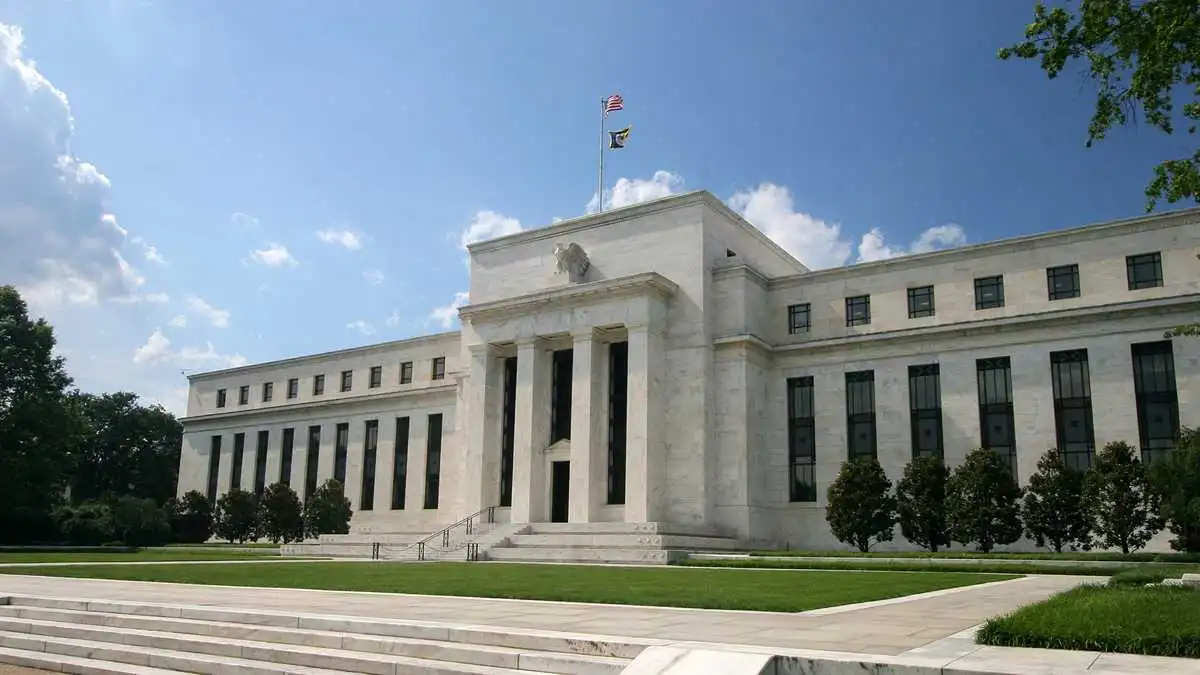
The Warsh Fed makes its debut
The Federal Reserve held its key interest rate exactly where it had been since December, in a range of three and a half to three and three-quarter per cent, and every official on the committee voted for it. For a first meeting under a new chairman, that is about as quiet a headline as the institution can produce.
Yet beneath that calm, Kevin Warsh used his debut to change how the Fed communicates. Short-term government borrowing costs jumped within minutes of the announcement.
The biggest shift came from the dot plot, a chart showing where each Fed official expects interest rates to go. Just three months earlier, not a single one had foreseen a rate rise this year.
Now half of the eighteen did, pushing the committee’s expected year-end rate up to nearly four per cent. The Fed had spent the spring leaning toward cuts; it now leaned, just as firmly, toward the possibility of a hike.
Stubborn inflation, running well above the Fed’s target, had changed the whole picture.
Warsh declined to place his own dot on that chart at all. A long-standing sceptic of the Fed’s forecasting rituals, he left the committee’s hawkish lean to speak for itself rather than stamping it with his personal view.
The new chairman intends to be heard less, not more.
A central bank that says far less
For years, Fed-watching was a craft of close reading. The central bank’s statements ran to more than three hundred words of carefully weighted boilerplate, and investors pored over each comma for hints about the future.
Warsh tore that up. His first statement was barely 130 words — short, plain and stripped of the coded promises markets had come to expect.
More radical still, he abolished forward guidance, the practice by which the Fed signals in advance roughly where it expects to steer. Asked what came next, Warsh simply refused to play the old game, saying he could offer no guidance and that the Fed should not be in the business of providing it.
The message was that the central bank would react to the economy as it unfolds, rather than tie itself to a path and let markets coast on the promise.
He framed all of this as part of a wider project, announcing task-forces to overhaul how the institution operates. Taken together, the moves amount to a doctrine: a quieter, more disciplined Fed that guards its independence by saying less and committing to less.
One veteran bond investor captured the spirit of it by saying the world was going back to a time when markets react to the Fed, rather than the Fed reacting to markets.
Why a less-predictable Fed matters
A central bank that hands out fewer hints is a harder one to trade around. The Dow had touched a fresh record earlier in the day, but once the hawkish forecasts and the press conference landed, the mood turned.
The broad American stock market fell more than one per cent on the day. The real story, though, was in the bond market: the yield on two-year government debt, the part most sensitive to near-term rate expectations, leapt by sixteen-hundredths of a percentage point — its biggest jump on a Fed day since 2008.
There was a subtler note beneath the hawkish headline. Warsh remarked that policy looked restrictive for the housing market but not for financial markets, a comment some read as a quiet acknowledgment that he is watching the strain higher rates are placing on home-buyers.
American housing starts had just fallen to their lowest level since the early-pandemic shock, with mortgage costs biting hard. The picture he painted was of a chairman determined to fight inflation but not blind to where the pain is landing.
The deeper consequence is uncertainty itself. When a central bank guides markets gently along a known path, borrowing costs everywhere stay calmer.
When it withdraws that guidance, every data release becomes a guessing game, and the swings grow larger. A less-predictable Fed is, almost by definition, a more volatile world for anyone whose fortunes depend on the price of money — which is to say, almost everyone.
The dollar, and why the world feels it
For countries far from Washington, the most important number from the meeting was not the interest rate but the dollar. As the Fed signalled it might hold rates high or even raise them, the dollar strengthened by around one per cent against other major currencies.
That single move ripples outward in ways that decide budgets and fortunes across the developing world.
When American rates look attractive and the dollar is strong, global money tends to flow back toward the United States, draining capital out of emerging markets. Countries that borrowed in dollars suddenly find their debts more expensive to repay in their own weaker currencies.
Central banks elsewhere face an unhappy choice: raise their own rates to defend their currency and slow their economy, or let the currency fall and import inflation. A firmer dollar made in Washington becomes a tax paid in dozens of capitals that had no vote in the decision.
The new communication style sharpens the effect. Without forward guidance to lean on, the rest of the world’s policymakers lose the early warning they once relied upon, and must navigate a Fed that reveals its intentions only after the fact.
For finance ministers from Latin America to Southeast Asia, the Warsh doctrine is not an abstract debate about communication theory. It is a more expensive and less predictable cost of money, set thousands of miles away.
What this means for Latin America
Latin America feels the Fed more directly than almost any other region, and the Warsh shift lands at a delicate moment. Several of the region’s central banks have been cautiously lowering their own rates to support growth; a firmer dollar and a higher-for-longer American rate make that path riskier, because cutting too fast while the dollar climbs can send local currencies sliding and reignite the inflation those banks fought so hard to tame.
Governments and companies across the region that raised money in dollars now face a quietly heavier burden, and the loss of the Fed’s old signposting removes a tool they used to plan around. The practical upshot is that borrowing costs in the region are now hostage to a central bank that has chosen to explain itself less.
For finance officials in Brasília, Mexico City and Bogotá, the lesson of the Warsh debut is that the era of reading the Fed’s mind in advance is over — and the cost of guessing wrong has gone up.
Frequently Asked Questions
What did the Warsh Fed actually change at its first meeting?
It held interest rates steady but overhauled how the Fed communicates. The new chairman cut the post-meeting statement to about 130 words, abandoned the practice of forward guidance, declined to submit his own rate forecast, and launched task-forces to remake the institution.
Why did markets fall if rates did not change?
Because the Fed’s forecasts turned sharply more hawkish: half of officials now expect a rate rise this year, having expected none in March. That, combined with the loss of clear guidance, pushed short-term borrowing costs and the dollar higher and sent stocks lower.
How does the Warsh Fed affect emerging markets?
A stronger dollar and higher American rates tend to pull money out of emerging markets and make dollar debts costlier to repay. With the Fed now offering less advance warning of its plans, policymakers in the developing world face higher and less predictable borrowing costs.
This article was produced by The Rio Times’ automated newsroom system. How we use AI · Report an error · Editorial responsibility: Matthias Camenzind, Editor-in-Chief
LatAm Markets: Live Signals → — real-time movers, turnover leaders and FX across Latin America.