US Jobs Blowout: What August’s Strong Payroll Number Means for LatAm Expats and Nomads
Macro: United States
Key Facts
- —US nonfarm payroll employment increased by 162,000 in August 2026, well above the median estimate of 65,000 and July’s revised 89,000. June was revised up by 11,000 to 129,000.
- —The unemployment rate was unchanged at 4.1 percent in August, with the number of unemployed people at 7.0 million. The labor force participation rate edged up to 61.6 percent.
- —Average hourly earnings rose by 10 cents, or 0.3 percent, to $37.75 in August. Over the year, average hourly earnings have increased by 3.1 percent. The average workweek edged up to 34.4 hours.
- —Brazil’s real reversed its midweek rally after the jobs report, with the PTAX jumping from 5.0956 on Wednesday to 5.1247 on Thursday — a 0.6 percent move in one session.
- —The Mexican peso held firmer than most peers at a FIX of 16.8748, supported by the fuel-price pact and carry-trade flows, while the Colombian peso held steady at 3,141.36.
The US jobs report blew past expectations with 162,000 payrolls in August, more than double the consensus. Here is what the blowout means for your rent, your transfers, your travel budget and the Fed decision on 15–16 September.
What the jobs report said
The US Bureau of Labor Statistics reported on Friday 4 September that total nonfarm payroll employment increased by 162,000 in August. That is nearly 100,000 above the median economist estimate of 65,000 and well above July’s revised 89,000. June was revised up by 11,000 to 129,000.
The unemployment rate held steady at 4.1 percent, with 7.0 million unemployed. The labor force participation rate edged up to 61.6 percent. Average hourly earnings for all employees on private nonfarm payrolls rose by 10 cents, or 0.3 percent, to $37.75. Over the year, earnings are up 3.1 percent.
The composition was also strong. Food services and drinking places added 59,000 jobs, local government education added 42,000, and manufacturing continued its upward trend with 16,000 new positions. The only soft spot was information, which lost 23,000 jobs.
Why it moved the dollar
The jobs blowout reversed the narrative that had dominated the week: softer US data, a weak ADP print of 57,000 private payrolls, and positioning for a dovish Fed. Instead, the August number showed a labour market that is still adding jobs at a healthy clip, with wage growth steady at 3.1 percent year-on-year.
For emerging markets, the immediate effect was dollar strength. The DXY dollar index rallied, and LatAm currencies gave back some or all of their midweek gains. Brazil’s real was the biggest mover: the PTAX jumped from 5.0956 on Wednesday to 5.1247 on Thursday, a reversal that cost dollar earners about R$29 per US$1,000 transferred.
Live Market IntelligenceBrazil — Live Market Board
Rio Times · Live Market Intelligence
Brazil — Live Market Board
-0.02%
185,147.15
-0.02%
65,163.64
-0.42%
11,315.26
-1.14%
3,049,121
-0.29%
2,544.56
+0.40%
59,978.22
-0.31%
| Instrument | Last | Change | YoY | Prev. | High | Low | Volume |
|---|---|---|---|---|---|---|---|
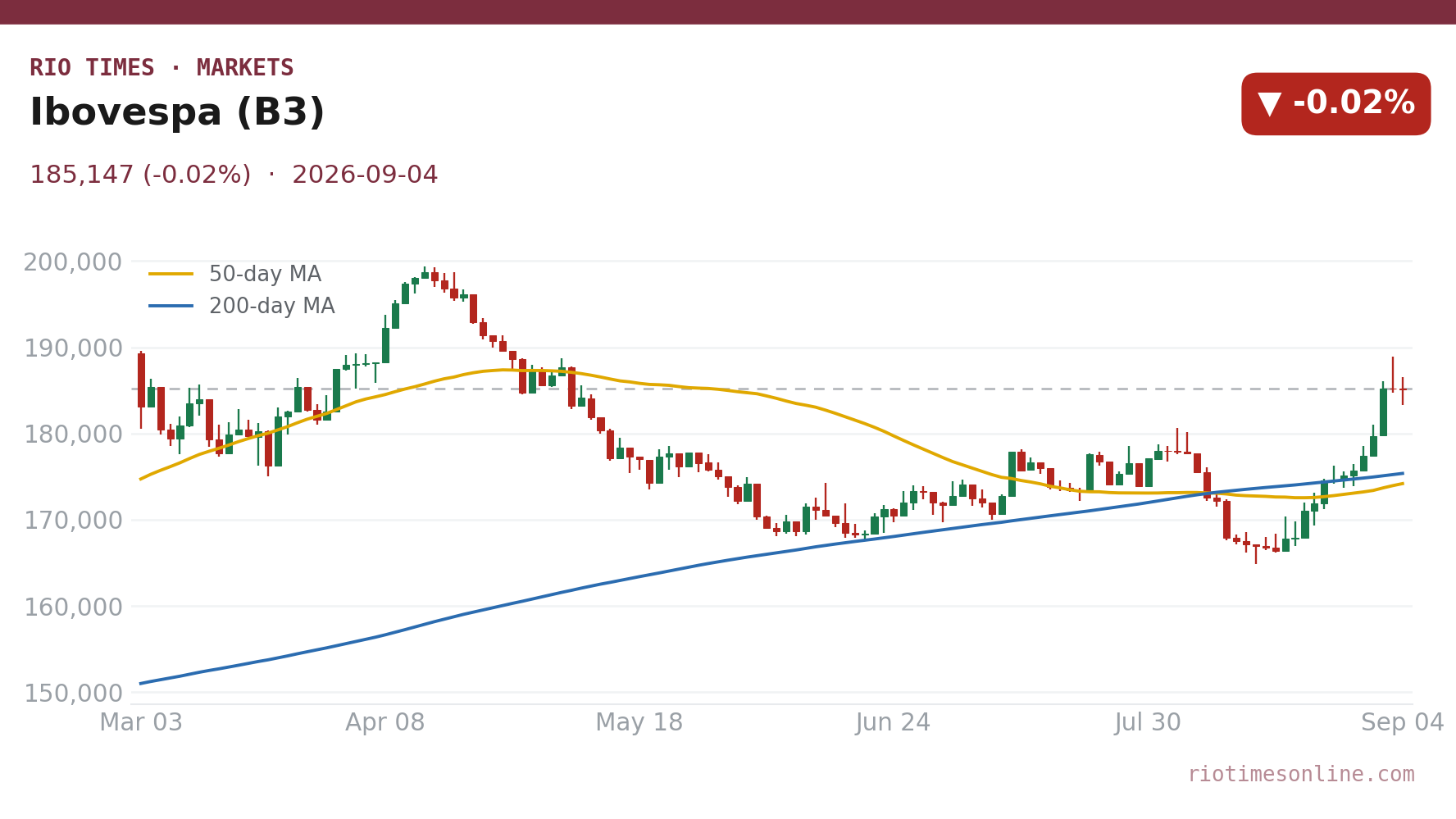
| IBOV | 185,147.15 | -0.02% | +21.85% | 185,188.13 | 168,310 | 167,142 | — |
| USD/BRL | 5.16 | +0.01% | -5.13% | 5.16 | 5.18 | 5.14 | — |
| SELIC | 14.00% | — | — | — | — | — | |
| PETR4 | 41.64 | -0.05% | +35.19% | 41.66 | 41.97 | 41.15 | 41,499,400 |
| VALE3 | 72.97 | +0.83% | +30.75% | 72.37 | 73.54 | 72.66 | 17,658,000 |
| ITUB4 | 38.60 | -1.03% | +4.57% | 39.00 | 39.34 | 38.39 | 29,487,800 |
| BBDC4 | 16.85 | +0.36% | +3.50% | 16.79 | 16.90 | 16.67 | 19,416,900 |
| BBAS3 | 19.37 | +0.47% | +0.73% | 19.28 | 19.44 | 19.16 | 11,069,200 |
| B3SA3 | 14.26 | -0.21% | +12.73% | 14.29 | 14.47 | 14.11 | 33,037,800 |
| ABEV3 | 14.89 | -0.80% | +21.91% | 15.01 | 15.07 | 14.81 | 16,453,100 |
| WEGE3 | 47.59 | +0.49% | +29.99% | 47.36 | 48.08 | 47.36 | 3,364,600 |
| PRIO3 | 59.14 | -0.19% | +50.67% | 59.25 | 59.81 | 58.74 | 3,325,600 |
| SUZB3 | 41.33 | +2.35% | -23.55% | 40.38 | 41.48 | 40.35 | 3,914,900 |
| RENT3 | 34.68 | -0.09% | +0.84% | 34.71 | 34.96 | 34.35 | 7,979,100 |
| AZZA3 | 15.89 | -2.63% | -53.76% | 16.32 | 16.42 | 15.82 | 1,330,300 |
| CSNA3 | 4.30 | +0.47% | -42.65% | 4.28 | 4.41 | 4.26 | 10,076,100 |
| GGBR4 | 24.69 | +2.19% | +51.38% | 24.16 | 24.85 | 24.18 | 7,047,600 |
| ENEV3 | 24.21 | -1.38% | +70.49% | 24.55 | 24.64 | 23.99 | 9,297,000 |
What it means for Brazil
Brazil felt the jobs report most acutely because the real had staged its sharpest three-day rally since July. At Wednesday’s 5.0956, a US$1,000 transfer bought R$5,096. By Thursday’s 5.1247, the same transfer bought only R$5,125 — wait, that is actually R$29 more reais per dollar. The real weakened, meaning dollar earners get more reais per dollar, but the trend reversed from strengthening to weakening.
For rents: a R$5,000 lease costs about US$977 at Thursday’s PTAX, compared to US$981 on Wednesday. The difference is small in dollar terms but the direction matters. If the dollar continues to firm on Fed expectations, the real could test 5.15 again.
The next domestic catalyst is the 15–16 September Copom meeting, held the same days as the FOMC. Markets are split between a hold at 14.00 percent and a 25-basis-point cut. If the Fed signals fewer cuts ahead because of the strong jobs data, Copom may also be more cautious.
What it means for Mexico
Mexico’s peso was the outperformer. The FIX of 16.8748 on Thursday was actually firmer than Wednesday’s 16.9560, meaning the peso strengthened even as the dollar rallied against most EM currencies. The driver is Mexico-specific: the fuel-price pact signed Monday, solid carry-trade flows into the 11 percent policy rate, and relative political stability.
For expats and nomads, the strong peso means MXN 10,000 of monthly spending costs about US$593, up from roughly US$600 a month ago. If you earn in dollars and spend in pesos, your purchasing power in Mexico has improved.
What it means for the Fed and Copom
The jobs report makes a September rate cut less likely but does not rule out a pause. Before the print, markets had priced a high probability of a 25-basis-point cut at the 15–16 September FOMC. After 162,000 payrolls and steady wage growth, a pause is now the base case.
For Brazil’s Copom, which meets the same days, the calculus is similar. The Selic is at 14.00 percent after the August cut. If the Fed pauses, Copom has more room to cut without triggering a currency rout, but the strong US jobs data also means the external environment is less supportive.
Should I convert dollars to local currency now or wait?
The jobs blowout has put the dollar back on the front foot. If you need reais or pesos for immediate expenses, converting now locks in levels that are still favourable compared to early August. If you can wait, the 15–16 September FOMC and Copom meetings are the next big events. The risk is that more strong US data pushes the dollar higher and erases more of this week’s EM gains.
Will the Fed cut rates in September?
A 162,000 payroll print with 4.1 percent unemployment and 3.1 percent wage growth does not scream “cut now.” The base case has shifted from a 25-basis-point reduction to a pause. But the Fed also looks at inflation, and one jobs report does not change the trend. Watch the 11 September CPI print for the final piece of the puzzle.
Which LatAm currency is most exposed to a stronger dollar?
Brazil’s real is the most sensitive because it has the widest interest-rate differential and the deepest local market. When US rates look likely to stay higher for longer, the carry trade unwinds and the real weakens. Colombia’s peso is also exposed because of the current-account deficit and oil-price volatility. Mexico’s peso has been more resilient due to nearshoring flows and the fuel pact.
Sources
- U.S. Bureau of Labor Statistics — Employment Situation Summary, August 2026 (USDL-26-1435)
- Banco Central do Brasil — PTAX reference rates, 3–4 September 2026
- Banco de México — FIX, 4 September 2026
- Superfinanciera de Colombia — TRM fixing, valid through 7 September 2026
- Banco Central de Chile via mindicador.cl — dólar observado, 4 September 2026
- DolarAPI — Argentina rates, 4 September 2026
- Argentina Datos — country risk, 4 September 2026
More: Latin America news in English, every day from The Rio Times. See also: today’s LatAm Expat & Nomad Daily Guide and Mexico’s Peso Holds Strong: What the Firmer Currency Means for Expats and Travelers.
This article was produced by The Rio Times’ automated newsroom system. How we use AI · Report an error
Read More from The Rio Times