Record US$254 Million Revenue for Brazilian Builder Tenda
Markets: São Paulo
Key Facts
—Result. Construtora Tenda (TEND3), a major Brazilian affordable-housing builder, reported second-quarter 2026 net income of R$179.1 million (about US$35 million), down 12.2% from a year earlier.
—Record revenue. Net revenue hit a record R$1.29 billion (about US$254 million), up 30.1% year over year, with a 13.9% net margin.
—Profitability. Adjusted EBITDA jumped 64.9% to R$275.2 million (about US$54 million), and adjusted gross profit set a record of R$481.3 million (about US$95 million), a 37.3% gross margin.
—Guidance. Tenda raised its 2026 outlook, lifting the group net-income range to R$600–660 million (about US$118–130 million) and net sales to R$5.5–6 billion (about US$1.08–1.18 billion).
—Index. The stronger results come as Tenda is set to join Brazil’s benchmark Ibovespa index in September, broadening its investor base.
Tenda posted record revenue of R$1.29 billion (about US$254 million) in the second quarter and raised its 2026 guidance, even as net income slipped 12.2% to R$179.1 million (about US$35 million).
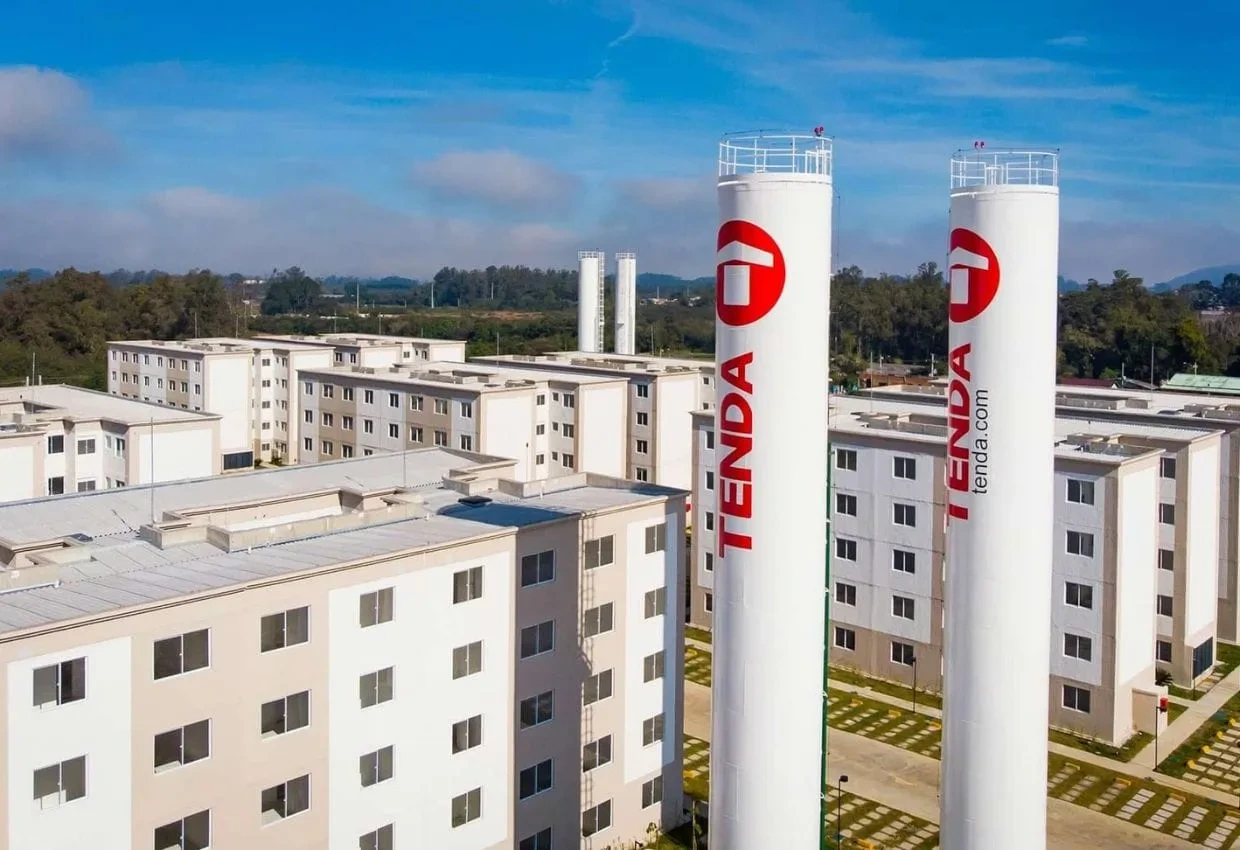
Tenda Posts Record Revenue as Profit Slips
Construtora Tenda, one of Brazil’s largest builders of low-cost housing, said net revenue reached a record R$1.29 billion (about US$254 million) in the April-to-June quarter, a 30.1% jump from a year earlier. Net income, however, eased 12.2% to R$179.1 million (about US$35 million).
The combination captures a company growing fast at the top line while its bottom line normalizes from an unusually strong 2025 quarter. Even after the dip, the net margin held at a healthy 13.9%, and the profit came in above market expectations.
For readers outside Brazil, a net margin of 13.9% means that for every 100 reais Tenda took in as revenue, it kept nearly 14 reais as profit after all expenses. That is a solid figure in the construction industry, where margins are often squeezed by land costs, materials and labor.
Why Profit Fell While the Business Grew
The revenue surge did not translate into higher net income mainly because of the comparison base and the way costs and financial items moved year over year. Operating profitability, in fact, improved sharply: adjusted EBITDA rose 64.9% to R$275.2 million (about US$54 million), and adjusted gross profit hit a record R$481.3 million (about US$95 million), a 37.3% gross margin.
Tenda had moved early to raise prices when construction input costs climbed, protecting its margins as revenue scaled. The softer net line reflects a tough comparison with a strong year-earlier quarter rather than any weakening in the underlying operation.
Adjusted EBITDA is a widely used measure that strips out non-operational items such as interest, taxes, depreciation and amortization, giving investors a clearer view of the core business performance. The 64.9% jump in that metric suggests Tenda’s day-to-day operations are running far more efficiently than a year ago, even if the final net-income number moved in the opposite direction.
Live Market IntelligenceBrazil — Live Market Board
Rio Times · Live Market Intelligence
Brazil — Live Market Board
+0.44%
187,422.92
+0.44%
63,646.88
+0.17%
11,426.83
+0.61%
2,997,659
-0.04%
2,588.64
+0.90%
59,529.36
+1.84%
| Instrument | Last | Change | YoY | Prev. | High | Low | Volume |
|---|---|---|---|---|---|---|---|
| IBOV | 187,422.92 | +0.44% | +21.85% | 186,595.60 | 168,310 | 167,142 | — |
| USD/BRL | 5.16 | +0.01% | -5.13% | 5.16 | 5.18 | 5.14 | — |
| SELIC | 14.00% | — | — | — | — | — | |
| PETR4 | 41.64 | -0.05% | +35.19% | 41.66 | 41.97 | 41.15 | 41,499,400 |
| VALE3 | 72.97 | +0.83% | +30.75% | 72.37 | 73.54 | 72.66 | 17,658,000 |
| ITUB4 | 38.60 | -1.03% | +4.57% | 39.00 | 39.34 | 38.39 | 29,487,800 |
| BBDC4 | 16.85 | +0.36% | +3.50% | 16.79 | 16.90 | 16.67 | 19,416,900 |
| BBAS3 | 19.37 | +0.47% | +0.73% | 19.28 | 19.44 | 19.16 | 11,069,200 |
| B3SA3 | 14.26 | -0.21% | +12.73% | 14.29 | 14.47 | 14.11 | 33,037,800 |
| ABEV3 | 14.89 | -0.80% | +21.91% | 15.01 | 15.07 | 14.81 | 16,453,100 |
| WEGE3 | 47.59 | +0.49% | +29.99% | 47.36 | 48.08 | 47.36 | 3,364,600 |
| PRIO3 | 59.14 | -0.19% | +50.67% | 59.25 | 59.81 | 58.74 | 3,325,600 |
| SUZB3 | 41.33 | +2.35% | -23.55% | 40.38 | 41.48 | 40.35 | 3,914,900 |
| RENT3 | 34.68 | -0.09% | +0.84% | 34.71 | 34.96 | 34.35 | 7,979,100 |
| AZZA3 | 15.89 | -2.63% | -53.76% | 16.32 | 16.42 | 15.82 | 1,330,300 |
| CSNA3 | 4.30 | +0.47% | -42.65% | 4.28 | 4.41 | 4.26 | 10,076,100 |
| GGBR4 | 24.69 | +2.19% | +51.38% | 24.16 | 24.85 | 24.18 | 7,047,600 |
| ENEV3 | 24.21 | -1.38% | +70.49% | 24.55 | 24.64 | 23.99 | 9,297,000 |
Guidance Raised Across the Board
Buoyed by the results, Tenda lifted its 2026 projections. It raised the guidance for the Tenda segment’s adjusted EBITDA to a range of R$1.10–1.20 billion (about US$217–236 million), up from R$950 million–1.05 billion (about US$187–207 million) previously, and pushed its net-sales target to R$5.5–6 billion (about US$1.08–1.18 billion).
The company also raised its expectation for group consolidated net income this year to between R$600 million and R$660 million (about US$118–130 million), from a prior R$520–600 million (about US$102–118 million). Raising guidance mid-year is a confident signal that management sees the momentum holding through 2026.
Guidance is a company’s own public forecast of what it expects to earn or sell over a coming period. When a firm lifts that forecast partway through the year, it is telling the market that business is running ahead of its earlier plan. For Tenda, the upward revision covers both the top line and the bottom line, which suggests the optimism is broad-based rather than tied to a single division.
Affordable Housing Powers the Top Line
Tenda’s growth is anchored in Brazil’s Minha Casa, Minha Vida program, the federal housing initiative that subsidizes home purchases for lower-income families. Robust demand and supportive financing conditions have fueled sales volumes across the sector.
Launches in the quarter totaled R$1.77 billion (about US$348 million) in potential sales value across 17 developments, up 59.1% year over year. The company’s land bank reached R$33.77 billion (about US$6.65 billion) in potential sales value, a 29.3% annual increase that gives Tenda a long runway of future projects.
Minha Casa, Minha Vida — Portuguese for “My House, My Life” — is a cornerstone of Brazilian social policy. The government provides subsidies and below-market financing to help families in lower income brackets buy their first home, and builders such as Tenda compete to deliver units that fit within the program’s price caps. Because the subsidies make the monthly payments more predictable for buyers, the program tends to generate steadier demand than the broader real-estate market, even when the economy slows.
Index Recognition and What Comes Next
The strong quarter follows Tenda’s recent step up in market visibility as it moves toward joining the Ibovespa in September, Brazil’s benchmark stock index. Inclusion tends to widen a company’s investor base by drawing index-tracking funds, though the earnings themselves are the immediate story here.
For the rest of 2026, the key questions are whether Tenda can keep converting record revenue into steady profit and how durable demand for subsidized housing proves as interest rates stay high. The raised guidance suggests management is betting the answer is yes on both counts.
The Ibovespa is the main barometer of the Brazilian stock market, tracking the most actively traded companies on the B3 exchange in São Paulo. Joining the index is a milestone that often brings a wave of automatic buying from exchange-traded funds and institutional portfolios that must mirror the index, though it also subjects the stock to the broader swings of market sentiment.
Looking ahead, one open question is how Tenda will manage the balance between volume growth and margin protection if construction costs rise again. Another is whether the federal government might adjust the subsidy rules or interest-rate caps inside Minha Casa, Minha Vida, which would directly affect the pace of new launches. Finally, with the land bank now valued at nearly R$34 billion, investors will watch how quickly Tenda can convert that pipeline into actual sales without stretching its balance sheet.
Frequently Asked Questions
What were Tenda’s second-quarter 2026 results?
Tenda reported record net revenue of R$1.29 billion (about US$254 million), up 30.1% year over year, while net income slipped 12.2% to R$179.1 million (about US$35 million), with a 13.9% net margin.
Did Tenda raise its guidance?
Yes. Tenda lifted its 2026 outlook, raising the group net-income range to R$600–660 million (about US$118–130 million) and its net-sales target to R$5.5–6 billion (about US$1.08–1.18 billion), along with a higher adjusted EBITDA range for the Tenda segment.
Why did Tenda’s profit fall while revenue hit a record?
The decline reflects a tough comparison with a strong year-earlier quarter and shifts in costs and financial items, not weaker operations. Operating profitability improved, with adjusted EBITDA up 64.9% and gross profit at a record R$481.3 million (about US$95 million).
Sources
Connected Coverage
More Brazilian corporate earnings and market coverage from The Rio Times.
Sources: BPMoney, InfoMoney, Finance News.
This article was produced by The Rio Times’ automated newsroom system. How we use AI · Report an error
Read More from The Rio Times