Stagnation in Latin America Boosts Youth Unemployment to Highest Level in 20 Years
RIO DE JANEIRO, BRAZIL – Latin America’s economic stagnation is rocking the labor market and affecting the youngest segment of the population with particular severity.
Unemployment among the under 25-year-olds – which is, along with informality, the great challenge of countries in the region in recent years – has become “a structural trait of economies,” according to the Panorama of Labor of Latin America and the Caribbean, published on Tuesday by the International Labor Organization (ILO, a UN agency).
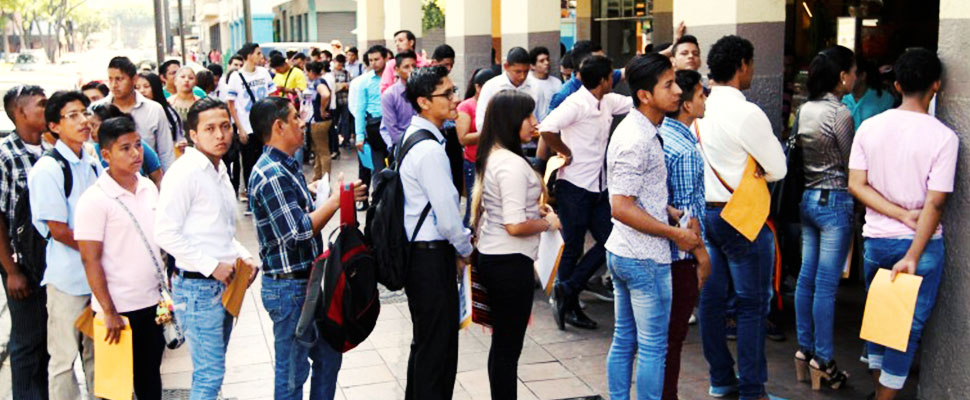
There are several warning signs on this front: the youth unemployment rate grew 0.3 percentage points in 2019, reaching 19.8 percent, three times the average for the adult population (in other words: 1 in every 5 people under 24 years of age who look for work cannot find it) and the highest since 2000, when aggregate data began to be released.

Moreover, most of those who are employed face precarious conditions: informality, low salaries in relation to the living costs, poor job stability and virtually no offer of training programs by employers.
“It is clear from this year’s statistics how difficult it is to be young in Latin America and the Caribbean,” says the organization. In the recently completed year, the increase in youth unemployment dragged down the overall rate, which remained stable for the group aged 25 and over.
“This should be a warning sign as it jeopardizes the present and future of millions of young people who cannot find employment opportunities and whose aspirations for social mobility are trampled […]. In light of the wave of protests in several cities in the region, immediate and inclusive action is required,” stresses the ILO. “The expectations crisis in the region calls for urgent action.”
Youth employment has shrunk in 11 countries that account for nearly 90 percent of the workforce in the region – Brazil, Argentina, Bolivia, Chile, Colombia, Costa Rica, El Salvador, Mexico, Paraguay, Peru and Uruguay.
The high figures help to understand the magnitude of the issue: 110 million people between the ages of 15 and 24 live in the region, a figure that has tripled since the 1950s.
And these youths, despite having been better educated than previous generations – to a good extent because they were born and grew up in a time marked by economic growth, while the raw materials boom lasted – face a market integration marked by “high precarity”. Six out of every ten work informally and 22 percent neither study nor work, “a situation that is even more critical among women”.
Slight increase in general unemployment, which could be higher
With Latin American economic growth leading to downward adjustments month after month – at the end of 2018, the IMF forecast one percent for 2019, and everything suggests that this figure will end up just above the zero percent mark – the unemployment rate did not replicate the 2018 improvement and rose from 8.0 to 8.1 percent.
However, this is a “conservative” estimate, point out the experts of the Geneva-based organization, which could increase “if the impact of the protest movements that erupted in the region in the last months of 2019 and the growing pressure that leads to an economic climate of uncertainty are confirmed”. By the end of last year, 26 million people in the region were unsuccessfully seeking employment.
However, the Latin American labor picture is very different from being homogeneous: the English-speaking Caribbean saw a reduction of half a percentage point in unemployment, the Southern Cone countries (Argentina, Brazil, Chile, Paraguay and Uruguay) also saw a minimal drop, Central America saw a 0.2 percent increase in unemployment and the Andean nations (Colombia, Ecuador and Peru) recorded a 0.5 percent increase.
The year 2019 was poor in terms of labor for the region as a whole, but the future does not point to a much better environment.
In view of the “slow growth” (1.4 percent) projected for the Latin American and Caribbean economy by the average of international organizations, the ILO alerts to a high likelihood that labor demand will be slashed and pushes up the unemployment rate to about 8.4 percent, three tenths more than late last year.
Should this forecast be true – and its experts do not typically overstate pessimism – 2020 would end with 27 million Latin Americans seeking employment.
Informality and rising wages
Although the ILO study does not provide specific data on the growth of informality, its authors link the lower growth of wage-earning employment in relation to the self-employed, recorded last year, with “an upward trend” of employees without employment contracts or labor benefits.
They also point to a remarkable increase in underemployment (people working fewer hours than they would like) in virtually all the countries in the area, “results that translate into relative precariousness of the jobs created in 2019”.
The counterpoint stems from the average wage and the minimum wage. The former grew in 2018 (no data for 2019 are available yet), although with divergences among different groups of workers: it increased more in the public sector and in the case of domestic workers than in that of private sector employees.
By gender, women’s incomes rose faster than men’s, reducing the wage gap, albeit only “gradually”. As for the minimum wage, the recovery policies adopted in 14 of the 16 countries analyzed by the organization – and most notably in Mexico, where Andrés Manuel López Obrador’s government promoted an unprecedented readjustment – resulted in a total increase of nearly four percent in the recently completed year, double that of the five-year period from 2013 to 2018.
This is the crux of the report by the Latin American and Caribbean Labor Panorama taking into account economic stagnation: growth is a crucial condition to generate employment.
More: Latin America news in English, every day from The Rio Times.
This article was produced by The Rio Times’ automated newsroom system. How we use AI · Report an error · Editorial responsibility: Matthias Camenzind, Editor-in-Chief