Rio de Janeiro Stakes Claim as Global Entertainment Capital With Unprecedented 2026 Calendar
Key Points
- Rio de Janeiro will host an unprecedented concentration of global events in 2026 — from the Golden Globes’ first Latin American ceremony to NFL games at legendary Maracanã Stadium
- The strategy has delivered results: Brazil welcomed a record 9 million international tourists in 2025, with Rio seeing a 46% surge in foreign visitors
- The approach divides Brazilians — supporters cite billions in economic returns while critics question public spending on international entertainment amid persistent inequality
Something unusual is happening in Rio de Janeiro. A city long defined by two things — beaches and Carnival — is systematically reinventing itself as a permanent destination for the world’s biggest events.
The 2026 calendar reads like a promoter’s fever dream, and understanding why reveals much about Brazil’s ambitions and contradictions.
Start with the numbers. Brazil shattered tourism records in 2025, welcoming 9 million international visitors — 40% more than the previous year.
Rio state alone received 2.1 million foreigners. These aren’t accidents. They’re the payoff from a deliberate strategy that treats entertainment as economic infrastructure.
The 2026 calendar makes the ambition concrete. Carnival runs February 13-21, expecting 8 million participants and projecting R$12 billion in economic activity.
In March, the Golden Globes holds its first-ever Latin American event at the Copacabana Palace — perfectly timed after Brazilian actors won back-to-back Golden Globes for films about the military dictatorship.
Wagner Moura became the first Brazilian nominated for a Best Actor Oscar. April brings SailGP — essentially Formula 1 on water — to Guanabara Bay for its South American debut.
May delivers another free mega-concert on Copacabana Beach, following Madonna’s 1.6 million attendance in 2024 and Lady Gaga‘s record-breaking 2.5 million in 2025. Shakira, Beyoncé, and Rihanna are rumored candidates.
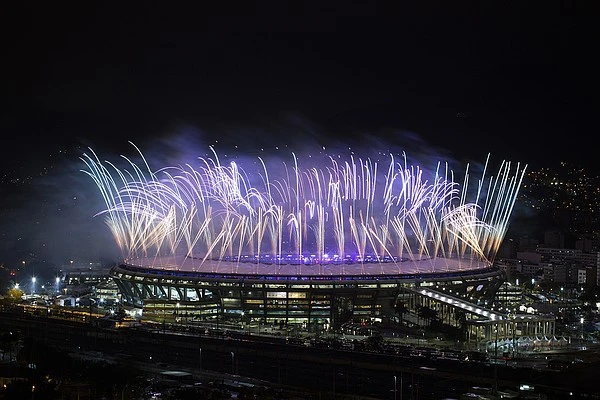
The NFL arrives at Maracanã Stadium — soccer’s cathedral — for a regular-season game, part of a five-year commitment. Brazil has 36 million NFL fans, the league’s second-largest international market.
Rock in Rio returns September 4-13 with Elton John’s only Latin American show and Stray Kids as the festival’s first K-pop headliner.
This concentration of global events in a single city within one year is genuinely rare.
The Political Divide
The strategy exposes familiar Brazilian tensions. Mayor Eduardo Paes defends public investment bluntly: the Lady Gaga concert generated R$600 million in one night, filling every hotel room and restaurant.
Supporters see smart economics — events during traditionally slow tourism months, global media exposure worth millions, and 50,000 jobs from Carnival alone.
Critics see different priorities. Rio remains a city of stark inequality, where favelas overlook luxury beachfront hotels. Public money subsidizing international pop stars while basic services struggle strikes many as misplaced.
The debate echoes broader arguments about development: invest in spectacle that attracts global capital, or address persistent domestic needs first?
Why It Matters Beyond Brazil
The experiment is worth watching for three reasons. First, it tests whether a developing country’s city can genuinely compete with traditional entertainment capitals.
Second, it demonstrates how nations increasingly use culture as soft power — Carnival, Brazilian cinema’s Oscar moment, and global music events all project an image of creative vitality.
Third, the economic model — free concerts generating hundreds of millions through hotel bookings, restaurants, and retail — offers a template other cities might study.
Brazil is betting that becoming indispensable to the global entertainment calendar changes how the world sees it. Whether that proves wise investment or expensive distraction, Rio in 2026 will provide the answer.
Download full report here.
Related coverage: Brazil’s Morning Call | Chile’s Central Bank Holds Rates Steady but Reveals It Nearl This is part of The Rio Times’ daily coverage of Latin American culture and lifestyle.
This article was produced by The Rio Times’ automated newsroom system. How we use AI · Report an error · Editorial responsibility: Matthias Camenzind, Editor-in-Chief
Read More from The Rio Times