Refugee Childhood: 10,000 Venezuelan Children Estimated to Have Entered Brazil
RIO DE JANEIRO, BRAZIL – According to estimates by the United Nations Children’s Fund (UNICEF), among immigrants between years 2015 to 2019 are almost 10,000 children and adolescents in vulnerable circumstances, .
The figure is a projection since there are no official data.

Children are an even greater concern in the context of migration since very basic rights such as adequate food are compromised.
“These people have been displaced from their homes so their arrival at the location has an impact. Sometimes life in a shelter is also very different from the reality that these children were living in Venezuela. All this has led to this process has a very strong impact on children,” said Thais Menezes, head of institutional relations at UNHCR.
Early childhood
Life in the BV8 shelter in Pacaraima, state of Roraima, close to the Venezuelan border, and others provided by Operation Shelter might not be ideal. But there, children have at least three meals a day and a safe place to sleep.
Among the area’s 700 temporary residents – the facility is being extended to accommodate up to 1,000 people – there are about 60 children under the age of 7. Most of them are in so-called early childhood, the period from birth to six years of age.
Early childhood is a decisive phase for children’s development because it is when the brain is shaped from experiences, stimuli and the environment in which the child lives.
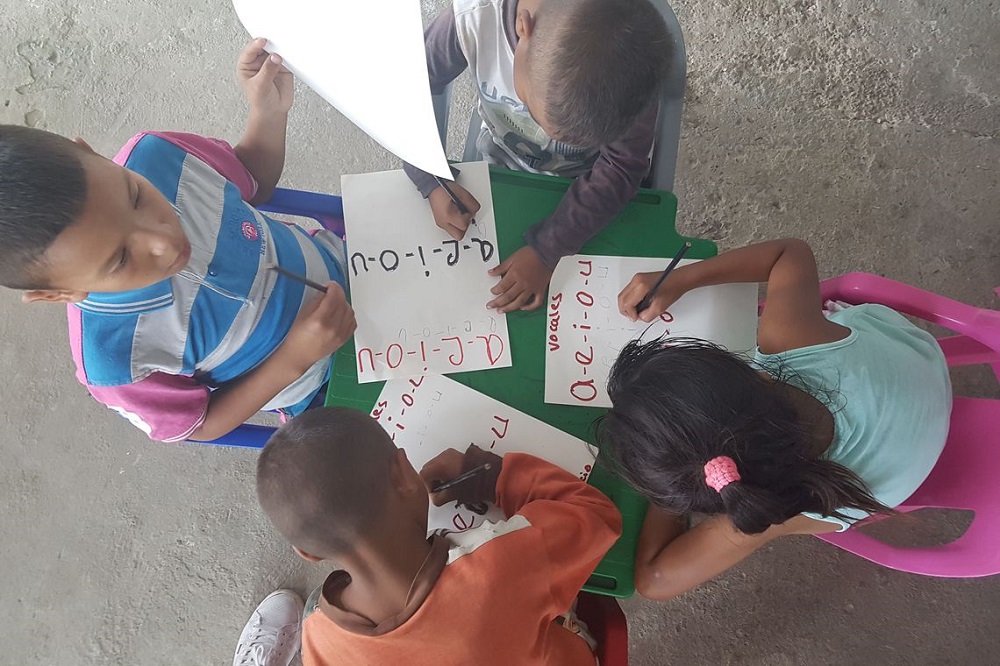
In an attempt to mitigate the negative effects of migration, UNICEF maintains the Child-Friendly Spaces, where children are provided with educational assistance and engage in recreational activities. In all, 23 facilities are in operation in the state of Roraima and more than 15 thousand children and adolescents have already been served.
In Pacaraima, very close to the facilities where adults deal with bureaucratic issues of documentation and identification in order to enter Brazil, dozens of children were singing, dancing and playing under the command of World Vision monitors, an organization that supports UNICEF’s actions.
Despite the negative effects of these hardships on children’s development, Professor Angela Uchoa points out that there is a great power of recovery for children due to the brain’s plasticity.
“Even though we have been through stressful situations, the human being’s recovery potential is immense and we must always bet on this potential. It’s resilience, it’s the ability to resist,” Uchoa says.
At least 400 Venezuelan children came to Brazil unaccompanied
A survey by the Federal Public Defender’s Office (DPU) showed that in the 11-month period from August 2018 to June 2019, almost 400 children arrived in Brazil unaccompanied.
Another 1,499 children were separated from their parents and 1,701 had insufficient documentation.
“These are sad stories of people who are fleeing a dark future. Sometimes parents are killed, sometimes in the migratory flow the contact between family members has been lost, other times the child or adolescent has simply never had contact with the family in Venezuela and remains in a vulnerable situation when arriving in Brazil,” explains federal public defender Thiago Parry.
“There are reports of children walking for more than six or seven days, alone or in the company of people they meet along the way because they just see that there are people on this journey, they hear that it is better in Brazil and they decide to make the crossing,” Parry says.
In these cases, the work of the defender’s office, with the assistance of social workers, is to investigate the child’s situation by means of an interview. The child can receive authorization to enter Brazil with the adult who accompanies them or be referred to a shelter service.
“If children arrive unaccompanied, they will be cared for here as if a Brazilian child were found in the middle of the street, they have the same rights as a Brazilian child”, Uchoa explains.
Source: Agência Brasil
More: Brazil news in English, every day from The Rio Times.
This article was produced by The Rio Times’ automated newsroom system. How we use AI · Report an error · Editorial responsibility: Matthias Camenzind, Editor-in-Chief