Peru: The story of how scientists and fishermen came together to save giant mantas
By Michelle Carere
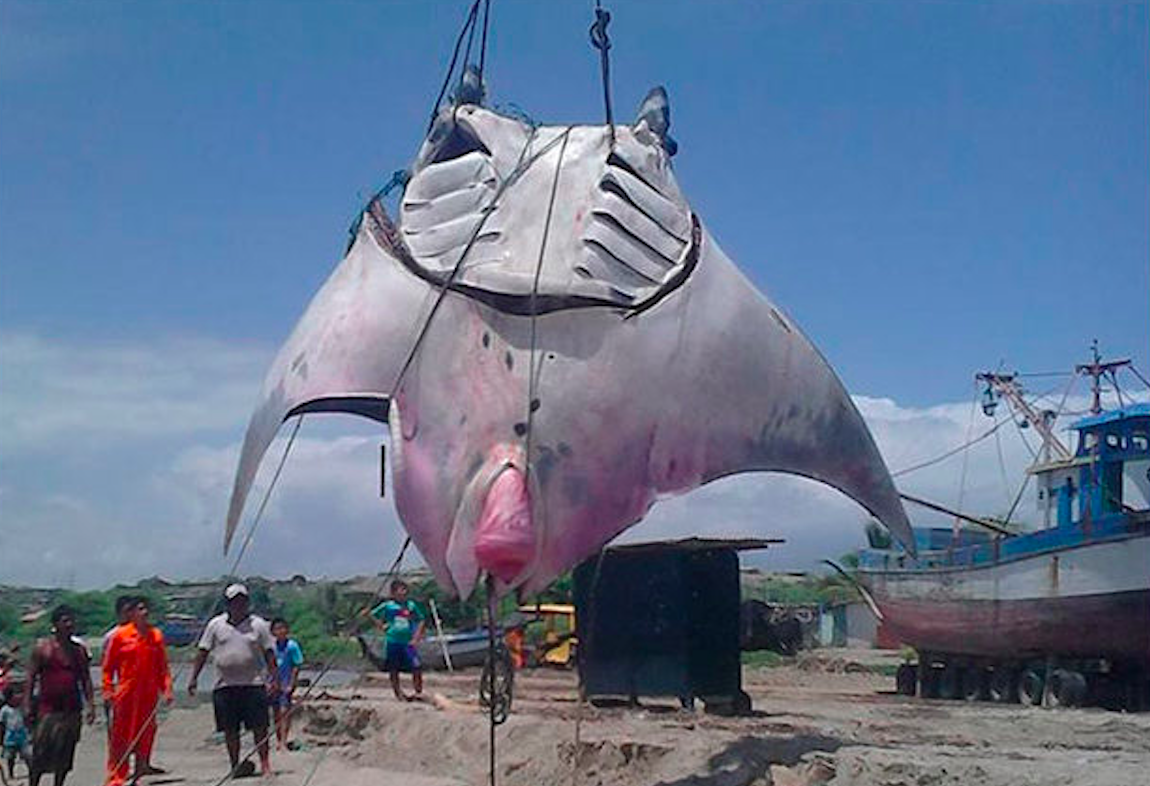
RIO DE JANEIRO, BRAZIL – It was a night in April 2015 when Kerstin Forsberg, sitting in her room in her house in Lima, saw on television that fishermen from Tumbes, in northern Peru, had captured a giant manta. Hanging from a crane, the 1,000-kilogram, seven-meter-wide dead animal “was a monster,” journalists said, Forsberg recalls.
In her eyes, on the other hand, who is a biologist and had already been working to protect this species considered endangered by the International Union for Conservation of Nature (IUCN), it seemed to her that it was a beautiful animal and she felt anguish to see it sacrificed.
Meanwhile, 1,200 kilometers from the capital, near the border with Ecuador, Edgardo Cruz, one of the fishermen who had captured the manta, was scared. “They are going to put you in jail,” he says that some colleagues had told him, because at that time discussions had been taking place about the need to protect these animals that science calls Mobula birostris, although no prohibition had yet been finalized.
Read also: Check out our coverage on Peru
The encounter with the huge manta had been a fluke. Cruz had gone out to sea in his boat with other fishermen to catch sawfish. Finished the task at seven in the evening, they anchored the boat to continue the work the following morning.
But at nine o’clock at night they felt a blow that shook the boat. “Pum, was heard, and the boat moved,” Cruz recalls. One of the fishermen who already had experience knew it right away, “a manta got tangled in the anchor,” he said, and it must have been big because in its eagerness to free itself, the animal made the boat move from one side to the other.

They stayed like that all night until 5 in the morning, as soon as the sun illuminated the tide, the fishermen began to raise the anchor. They pulled, they pulled, until suddenly the huge manta broke the surface. “Let go of that, let go of that thing, it’s going to turn the boat over!” some shouted. “No, you have to take it! Coins are coins, you have to sell it and that’s it, ”opined the others.
“She was gigantic, great,” Cruz recalls, so much so that getting her on the boat was impossible, so they passed a rope through her gills to secure her to the stern of the boat and towed her to the port. “A man came and helped us get it out with a crane,” says the fisherman, and it was at that moment that a tourist took a photo, uploaded it to social networks, and the news spread worldwide.
Edgardo Cruz is sad to remember that story. “I was ignorant of everything,” he says. “To have torn that manta apart, without knowing, without having the knowledge. Now that I know, I’m sorry. I wouldn’t do it anymore,” he confesses. But another thing that Cruz did not know is that his life from that moment would change forever and that that manta hanging from a crane would be the martyr animal that would protect the species.
MANTA HUNTING PROHIBITED
“Edgardo had thrown away his cell phone because everyone was calling him,” recalls Forsberg. They searched tirelessly for him to tell the story of the huge manta captured in the Peruvian sea and Cruz, fearful of going to jail and fed up with so much harassment, refused to speak.
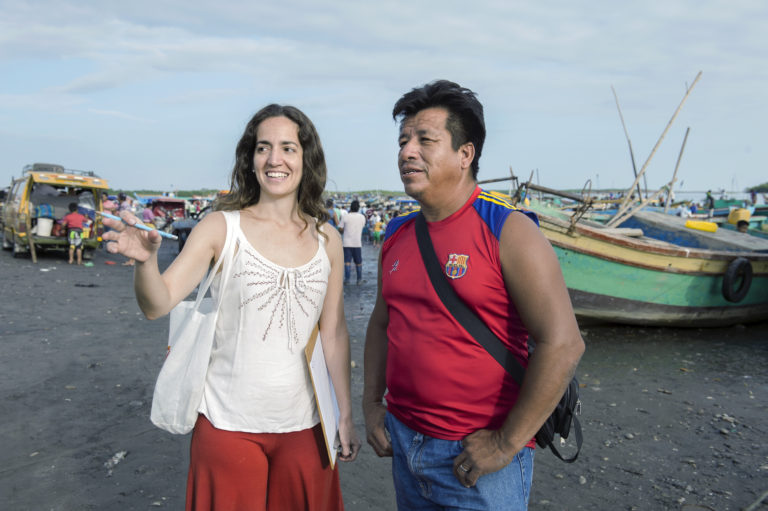
“Go to Edgardo Cruz and knock on his door,” Forsberg told one of the volunteers who lived in Tumbes and worked at Planeta Océano (Planet Ocean), the NGO she had created to protect mantas. “We didn’t want to confront him. We wanted to understand what had happened, listen to him and learn from his experience,” says the biologist, because as a fisherman he knew where the animals were and what was happening to them, she explains.
The strategy worked. “They told me that a workshop was going to be held in Lima, that they were going to pay my tickets, travel expenses, everything. So I went and heard something I didn’t know about,” says Cruz.
The fisherman’s eyes would have gotten bigger and bigger as he learned in that workshop that a live manta could be worth a million dollars a year in tourism. He and his companions, on the other hand, had been given 200 soles (US$53) for the gigantic specimen they had captured. “That was what they gave us and the head was taken by the scavengers, the people who burn the bone, the waste to make flour and food for the animals,” says Cruz.
“I felt sadness,” says the fisherman. “Sadness of realizing what I had done”, of knowing that they are completely harmless animals, that they only have one offspring every 7 years, “that we could not be doing and getting rid of them because this is their home, the sea is their home”, he says today at 56 years of age.
After that workshop in Lima, Edgardo Cruz joined the NGO Planeta Océano to help scientists spread the message of conservation among fishermen and communities in northern Peru.

The first great achievement of this environmental organization was to get the capture of mantas banned in the country.
“This is an endangered species that was being captured legally at the time,” says Forsberg. The hunting was intentional, in fact, “there were fishermen who went and harpooned them,” says Cruz, and also accidental when they got entangled in fishing nets, something that still happens frequently.
“There was this problem and nothing was being done about it,” says the scientist. “And it was there that we began, together with the local communities and a series of national and international allies, to put together a protection proposal,” she adds.
This proposal was presented in 2013, but initially, it did not achieve the expected impact. “We pushed, we pushed, but they didn’t give us much of a ball,” admits Forsberg, until the news of the giant manta captured in Tumbes changed the course of history.
The image of the animal hanging from a crane was unequivocal proof of the need to protect the species and in December 2015 the rule was approved that prohibits its extraction, landing and commercialization.
TOURISM TO LEARN MORE ABOUT MANTAS
Although the approval of the rule that prohibits the capture of mantas in Peruvian waters is an important step in the conservation of the species, “they can still get entangled in fishing nets, because in the area a lot is fished with curtain – which are nets that are placed in the sea like walls- and the manta when passing through it gets entangled”, explains Forsberg and this can end the life of the animal anyway.
That is why scientists and collaborators like Edgardo Cruz continue to work on their protection. “We have to find ways to try to avoid interactions (between mantas and fishing nets) and, on the other hand, we have to try to ensure that if one is captured, it is released,” says the scientist.
To achieve this, Forsberg has established three lines of work. The first is scientific research. “We need to investigate more. Try to better understand the area to reduce these captures”, says the biologist. The second axis is sustainable development, supporting fishermen to promote community ecotourism as an economic activity, and the third is community education and awareness about the importance of conserving mantas.
The objective, moreover, is for these three axes to be interconnected so that, for example, fishermen and the community can also participate in scientific research.
A successful example of this interconnectivity is also one of the memories that Edgardo Cruz treasures the most.
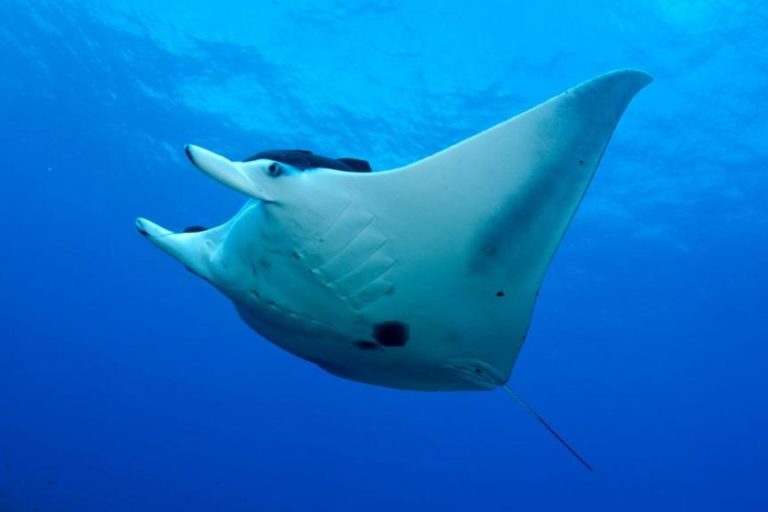
Before the pandemic, some fishermen from Tumbes, including Cruz, managed to form, with the support of Planeta Océano, the Mantas Pacifico Tropical ecotourism association. At the same time, the NGO forged an alliance with the U.S. environmental charity Earthwatch through which foreign volunteers and tourists traveled to Peru to spot mantas and help, on outings to the sea with fishermen and scientists, to collect data to understand the behavior of mantas over time.
Some of these data were, for example, the coordinates where a manta was seen, samples of plankton to better understand the environment where they live, and even in the event of sighting an animal, tourists had the option of diving together with an expert diver, to photograph it and thus help to form a photo-identification bank that allows knowing the size of the manta population found in the area.
It was precisely on one of those outings that Edgardo Cruz swam for the first time with a giant manta. “They paid me to go out with tourists to do a scientific study,” says the fisherman. “The way out was that we had to find the mantas for a specialist diver to throw into the water and record them. The tourists who went there also threw themselves at the foot of the manta and took their photos and invited me”, recalls Cruz.
-“Edgardo, are you going to throw yourself?”, they asked him.
“Of course!” he answered.
“I was ignorant of everything, but when I was there in the sea, I felt that I was five years younger,” says Cruz. “It’s so beautiful what you feel and what you see there,” he says.
The fisherman then showed the photographs to his family and they asked him if he was perhaps crazy, remembers Cruz with a laugh. “Why did you throw yourself with that animal? To see if it eats you!”, they told him and he explained that in reality, the giant mantas do not represent any danger to humans and that they are completely harmless.
Since then, seven years have passed and Edgardo Cruz continues trying to make fishermen aware of the need to protect these animals. “Some laugh, others make fun, others comment on things that are not relevant, but I really feel calm because I am teaching the way they have taught me,” says Cruz, who believes that “it is difficult to conquer peers, but not impossible.”
RESEARCH ADVANCES
The investigations carried out so far by the scientists of Planeta Océano have allowed us to know that the mantas preferentially stay on the surface during the day and that at night they dive to greater depths at intervals. “It’s kind of like a zigzag: They’re down for a while and then they come up again,” says Forsberg. It is as if they were diving to get into a refrigerator and get some food, and then they return upstairs to warm up, which could be an indication that it is an important feeding area for this species”, adds the scientist.
In addition, another thing they have observed is that there are pregnant mantas in the area, says Forsberg. “We started talking with fishermen who told us that when they went out and captured a manta and then opened it, a fetus came out,” says the expert, “and we have documented that within our own research that we have published,” she says. Thus, although information is still lacking to ensure it with certainty, northern Peru could be an important feeding and breeding area for these endangered animals.
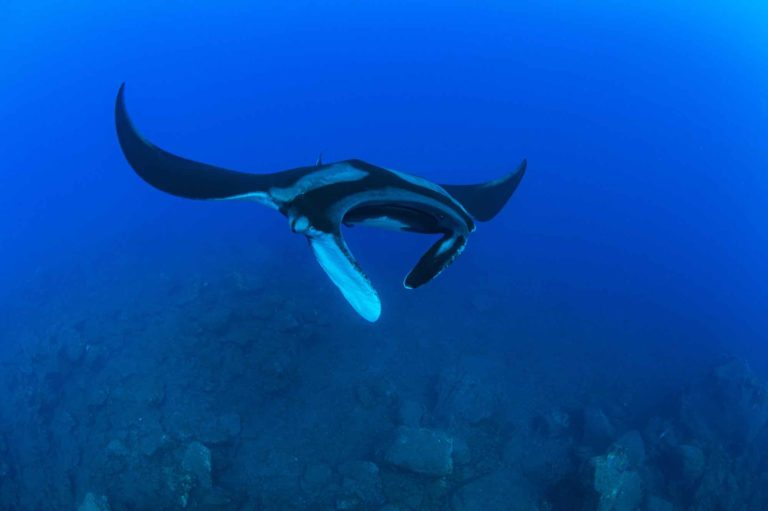
Finally, the satellite tags that have been installed on some mantas show that they migrate to the southern coast of Ecuador, where the largest population of this species in the world reported to date has been identified. That would support the theory that the mantas in Peru belong to the same population as those in Ecuador.
“If we are really sharing this population with Ecuador, which is what seems to be happening, it is probably one of the largest populations of mantas in the world that have been documented so far,” says Forsberg.
But that is not all. One of the mantas that was tagged in Tumbes by Planeta Océano migrated to the Galapagos Islands. “So we know that there is this cross-border connection and with marine protected areas,” says the expert.
“But we also know that when it comes to going to the Galapagos, the mantas pass through an area that is outside the national jurisdiction of any country (international waters) and that they are even more unprotected there,” she explains, which reinforces the need to create marine corridors or migratory paths through which species can transit free of threats.

All this information, in turn, is translated into a simple vocabulary and shared with different schools with the aim of carrying out environmental education and making new generations aware of the importance of mantas and marine species and ecosystems in general.
The Peru Canada Educational Institution, in Tumbes, is one of those schools and for World Oceans Day, high school students prepared an educational tour for the little ones, who were able to learn through videos, games and artistic installations the importance of taking care of the sea. They have also made plays to share information among students regarding the negative impacts that human beings have on the environment and ways to reverse the problem.
“The objective of the program is to incorporate educational institutions to know how to live and interact with the environment,” explains Baltazar Dioses Panta, director of the educational institution 044 José Carlos Mariátegui in the town of La Capitana. With more than 10 years participating in the educational program of Planeta Océano, Dioses Panta assures with certainty that “there is an echo in the students. They make it their own and from them comes the need to integrate more friends, colleagues, so that they can have this multiplier effect of environmental awareness.”
REACTIVATE AFTER THE PANDEMIC
Edgardo Cruz dreams of selling his boat, buying a boat to take tourists and becoming a successful businessman. He knows it is possible because he has seen it. In Ecuador, fishermen who converted to ecotourism “have made a lot of money,” says Cruz, and “they tell me not to give up,” he adds.
If he had a boat, he would decorate it with sea animals. “I would put pictures on it. A dolphin, a turtle, and of course a manta,” he says.
The project to develop ecotourism through the Mantas Pacifico Tropical fishermen’s association had begun to bear its first fruits before the pandemic. “We had been developing a series of workshops with them, training, how to develop this tourist service and even safety on board,” says Forsberg.
In addition, “we already had this travel agency that sent us tourists, we had regular departures and we were looking at the possibility of expanding the idea to the Máncora market, Punta Sal, seeing how it could be done to strengthen the work of the fishermen, promoting tourism services,” says the expert.
But the pandemic came and everything stopped. “It has been two years in which a lot of infrastructure has broken down and there has been no continuous training,” says Forsberg. However, the ecotourism association created by the fishermen of Tumbes already exists and “what is needed now,” says the expert, “is to reactivate and continue promoting and carrying out the project.”
With information from El Desconcierto
More: Brazil news in English, every day from The Rio Times.
Editorial responsibility: Matthias Camenzind, Editor-in-Chief · Editorial standards · Report an error