Peronist labor unions in Argentina call for more jobs in massive mobilization
RIO DE JANEIRO, BRAZIL – The General Confederation of Labor (CGT), Argentina’s largest labor union, held on Monday (18) a massive mobilization in Buenos Aires to advocate the unity of Peronism and to ask for more employment and production to overcome the economic crisis that the country is undergoing.
The march, called to commemorate the traditional “Peronist Loyalty Day”, closed with the reading of a document, in which the unions that make up the CGT, of Peronist roots, vindicated the “banners of development, production and work” of the Justicialist movement founded by the three-time Argentine president Juan Domingo Perón (1895-1974).
Read also: Check out our coverage on Argentina
The central labor union affirmed that its responsibility of “majority representation” of the workers summons the unions to the “defense of the national productive apparatus”, “the demand for economic policies that promote the generation of genuine employment” and “a fair redistribution of wealth”, and the “reconstruction” of a State “present” and “regulator of the economy”.
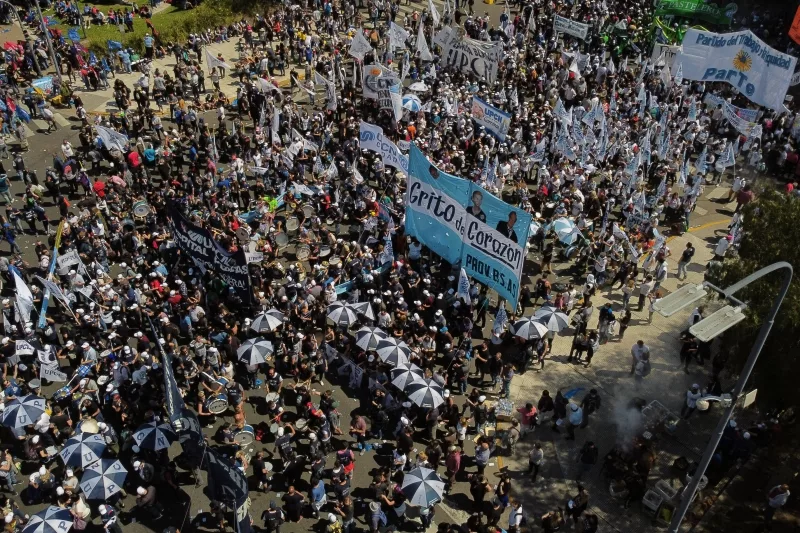
The CGT called for “deepening the social dialogue” to achieve the consensus that will allow “putting productive employment at the center of public policies to overcome the situation that today marginalizes the most unprotected sectors, deepens social inequalities and conditions the uniform and equitable growth of our country.”
“Argentina and our government face a decisive instance to overcome the economic and social crisis inherited and dramatically aggravated by the effects of the pandemic,” said the CGT in its proclamation.
SIGNALS IN THE FACE OF THE CRISIS
Severely affected by the Covid-19 pandemic, Argentina’s economy plummeted 9.9% in 2020, and this year, despite the recovery of activity, severe social problems persist, with a poverty rate of 40.6% in the first semester.
Meanwhile, the unemployment rate fell in the second quarter of the year to 9.6%, its lowest level since the end of 2019, but with high rates of informality and little job creation in the formal sector.
In addition, the high inflation rate – 52.5% year-on-year in September – undermines the purchasing power of wage earners.
This complex economic scenario has unleashed controversies within the government of Peronist Alberto Fernández, which was involved in an internal crisis after the ruling party’s defeat in the legislative primary elections last September and led to changes in the ministerial cabinet.
In this context, the CGT, whose leaders integrate a wing of Peronism different from Kirchnerism’s, maintained this Monday that “the depth of the current crisis requires obvious signals”.
“That is why we march as the expression of the workers’ unity, as a symbol of unity of the organized labor movement and with the vocation of sustaining the unity of Peronism,” said the central workers’ union.
THE OTHER ACT
The sectors of Kirchnerism that respond directly to Vice-President Cristina Fernandez chose to call for another activity for the “day of loyalty”, different from the one organized by the CGT.
In the capital, that event was held this Sunday, coinciding with a new anniversary of the massive workers’ mobilization that, on October 17, 1945, took over Buenos Aires to demand the release of Juan Domingo Perón. He would later be elected president of the country three times.
Neither Alberto Fernández nor Cristina Fernández attended any of the commemorations, which took place less than a month before the legislative elections called for November 14.
More: Argentina news in English, every day from The Rio Times.
This article was produced by The Rio Times’ automated newsroom system. How we use AI · Report an error · Editorial responsibility: Matthias Camenzind, Editor-in-Chief