Key Facts
- WTI crude settled up 19 cents, or 0.2%, at US$92.60 a barrel on Monday, 28 September, after US President Donald Trump rejected an Iranian proposal to reopen the Strait of Hormuz.
- Brent crude settled up 96 cents, or 0.9%, at US$105.28, after jumping more than US$4 in early trade.
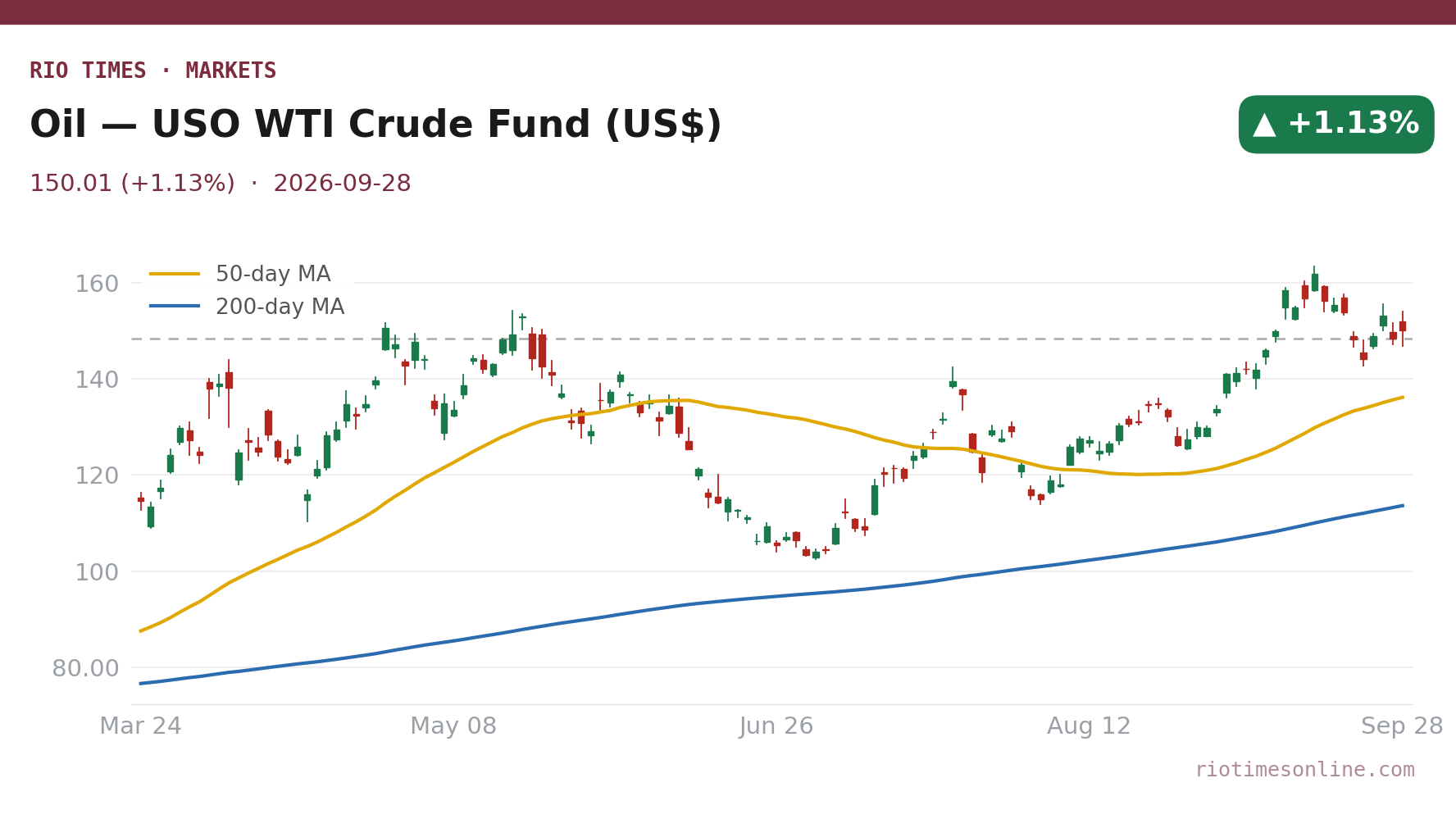
- The USO fund rose 1.13% to US$150.01, moving in the same direction as crude.
- Petrobras rose 1.37% to US$20.65 in New York, and Ecopetrol gained 0.72% to US$16.70.
- Argentina’s YPF fell 1.40% to US$51.37, the only decliner on the board despite firmer crude.
- Guyana’s Stabroek block is producing about 900,000 barrels a day, with Chevron holding a 30% stake after completing its Hess acquisition.
Today’s Focus
Oil prices settled slightly higher on Monday, 28 September, after US President Donald Trump rejected an Iranian proposal that would have reopened the Strait of Hormuz. Prices jumped more than US$4 a barrel in early trade before giving back most of the gain. WTI settled at US$92.60 a barrel, up 0.2%, and Brent at US$105.28, up 0.9%.
Latin American oil shares were mixed. Petrobras rose 1.37% to US$20.65 in New York and Ecopetrol gained 0.72% to US$16.70, while YPF fell 1.40% to US$51.37. The WTI-tracking USO fund rose 1.13% to US$150.01.
The Strait of Hormuz remains the key geopolitical hinge. Gulf supply risk keeps a floor under prices while diplomacy fails to gain traction.
What matters today. The Trump-Iran standoff over the Strait of Hormuz is the central driver, but the intraday spike faded, leaving only modest gains at the settlement.
01 The session in one read
Oil prices rose on Monday, 28 September after US President Donald Trump rejected a proposal from Iran that would have reopened the Strait of Hormuz. WTI touched about US$96.50 and Brent about US$108.80 early on. Both then gave back most of the rise: WTI settled at US$92.60, up 0.2%, and Brent at US$105.28, up 0.9%.
The rejection kept traders focused on the risk of disrupted Middle Eastern supply. Gains were capped by a rebound in Middle East crude exports and by expected Qatar-mediated talks between US and Iranian officials, Reuters reported.
This was a geopolitical session, not a fundamental one. The rejection of Iran’s Hormuz proposal removed a near-term de-escalation hope and lifted both WTI and Brent, while Brazilian pre-salt, Guyanese offshore volumes and Vaca Muerta drilling continue to add Western-hemisphere barrels. The main variable to watch is whether any renewed US-Iran channel emerges before the next US Strategic Petroleum Reserve data, because a further draw from 284.6 million barrels would amplify the supply-risk conversation.
02 The board
The United States Oil Fund, which tracks WTI futures, closed at US$150.01, up 1.13%. Its gain was larger than WTI’s 0.2% because the fund closes at 4 p.m. New York time, after the 2:30 p.m. futures settlement, and holds more than one contract month.
In New York-listed producer shares, Petrobras closed at US$20.65, up 1.37%, and Ecopetrol at US$16.70, up 0.72%. YPF was the exception, down 1.40% at US$51.37.
| Asset | Level | Change |
|---|---|---|
| WTI crude (USO) | US$150.01 | +1.13% |
| Petrobras | US$20.65 | +1.37% |
| Ecopetrol | US$16.70 | +0.72% |
| YPF | US$51.37 | -1.40% |
Source: RT close, 2026-09-28. Where a commodity has no spot feed, an exchange-traded tracker or leading producer is shown as a labelled proxy.
Live Market IntelligenceThe live market board
Rio Times · Live Market Intelligence
Latin America — Cross-Market Board
| Instrument | Last | Change | YoY | Prev. | High | Low | Volume |
|---|---|---|---|---|---|---|---|
| IBOV | 182,991.13 | -0.26% | +21.85% | 183,476.86 | 168,310 | 167,142 | — |
| IPSA | 11,137.59 | -1.06% | — | 11,256.80 | 11,210 | 10,984 | 1,513,213,483 |
| IPC MEX | 64,737.82 | -0.39% | +12.17% | 64,992.23 | 66,121 | 65,405 | 108,886,187 |
| MERVAL | 2,798,925 | -3.28% | +30.51% | 3,022,485 | 3,042,365 | 2,991,150 | — |
| COLCAP | 2,579.33 | -0.21% | — | 9.04 | 9.05 | 9.02 | 4,133 |
| BVL PERÚ | 60,698.35 | -0.79% | — | — | — | — | — |
| USD/BRL | 5.16 | +0.01% | -5.13% | 5.16 | 5.18 | 5.14 | — |
| EUR/BRL | 5.95 | +1.01% | -5.83% | 5.89 | 5.98 | 5.94 | — |
| USD/MXN | 17.06 | -0.24% | -8.58% | 17.10 | 17.08 | 17.01 | — |
| USD/CLP | 913.98 | +0.04% | -5.67% | 913.65 | 915.11 | 906.68 | — |
| USD/COP | 3,140 | +0.03% | -22.04% | 3,139 | 3,141 | 3,105 | — |
| USD/PEN | 3.36 | -0.66% | -4.82% | 3.38 | 3.38 | 3.35 | — |
| USD/ARS | 1,493 | +0.10% | +12.96% | 1,491 | 1,494 | 1,480 | — |
| USD/UYU | 40.27 | +1.24% | +1.80% | 39.77 | 40.27 | 40.23 | — |
| USD/PYG | 5,939 | +1.68% | -19.54% | 5,841 | 5,939 | 5,925 | — |
| USD/BOB | 11.64 | -0.76% | +72.04% | 11.73 | 11.72 | 11.64 | — |
| USD/DOP | 58.34 | +1.25% | -3.44% | 57.62 | 58.34 | 58.04 | — |
| USD/CRC | 445.92 | +0.89% | -9.71% | 441.97 | 448.50 | 445.92 | — |
03 What moved it
The trigger was unmistakably the Strait of Hormuz. President Trump’s rejection of an Iranian proposal to reopen the strait removed hopes for a near-term political fix. Prices jumped more than US$4 a barrel in early trade, then faded.
At the same time, the US Strategic Petroleum Reserve became a quiet secondary driver. With crude stocks in the reserve reported at 284.6 million barrels for the week ending September 18, and further declines expected, the market is watching Washington’s buffer more closely.
Middle East crude exports rebounded to 12.8 million barrels a day in September, the highest since the conflict began in February, Reuters reported. That recovery helped cap Monday’s rally.
04 The Latin American read
Brazil’s Petrobras rose in New York, with firmer crude and deep-water pre-salt output supporting the stock. Its US-traded shares ended at US$20.65, up 1.37%. In São Paulo, the preferred shares rose 1.35% to R$48.72 (about US$9.32).
In Argentina, YPF dropped 1.40% to US$51.37 in New York, and 1.60% to 8,305 pesos (about US$5.45) in Buenos Aires. The fall ran against firmer crude, so it reflected local factors rather than the oil price.
Guyana’s Stabroek offshore block continued to add Atlantic Basin supply, with output of about 900,000 barrels a day. ExxonMobil operates the block with Chevron and CNOOC, and Chevron now holds a 30% stake after completing its acquisition of Hess.
Venezuela remained a watchpoint. It has granted North American Blue Energy Partners 100-year concessions for 17 oil fields, and the Pentagon holds rights to a 35% stake in the company’s parent, according to the White House. The deal raises questions about future production and sanctions exposure.
05 The names to watch
Petrobras is the regional bellwether: its US-listed shares tend to move on Brent and WTI first, with pre-salt output as the longer-term anchor. On Monday they tracked firmer crude.
YPF is the purest Vaca Muerta proxy among the listed names, yet on Monday it fell while crude rose. Ecopetrol sits between oil-price risk and Colombia’s search for new upstream momentum under President Abelardo de la Espriella.
The USO fund is a reminder that listed oil proxies do not mirror the settlement exactly. For foreign investors, it is often cleaner to follow the benchmarks and producer shares together.
06 The outlook
The near-term direction depends heavily on whether the US and Iran reopen any channel over the Strait of Hormuz. If talks stay stalled, price moves will keep swinging on headlines rather than on supply fundamentals.
For Latin America, the key question is whether Brazilian, Guyanese and Argentine volumes can keep growing fast enough to attract capital if a deal eventually reopens Hormuz and prices retreat. The Stabroek offshore block and Vaca Muerta remain the two most scalable stories.
07 What to watch
- US–Iran Hormuz channel: Any renewed diplomatic signal, including the expected Qatar-mediated talks, could quickly push prices lower; an escalation would push them higher.
- US Strategic Petroleum Reserve: Further draws below the latest reported 284.6 million barrels would tighten the supply narrative.
- Guyana Stabroek output: First oil from the Uaru project, expected later this year, would lift output clearly above 900,000 barrels a day.
- YPF and Vaca Muerta pipeline expansion: Progress on evacuation capacity will determine how fast Argentine shale output can grow.
Frequently Asked Questions
How did oil trade on Monday, 28 September?
Oil settled slightly higher after US President Donald Trump rejected an Iranian proposal to reopen the Strait of Hormuz. WTI rose 0.2% to US$92.60 and Brent 0.9% to US$105.28.
Why did USO rise more than WTI?
USO closed at US$150.01, up 1.13%. The fund closes at 4 p.m. New York time, after the 2:30 p.m. futures settlement, and holds more than one contract month, so its move can differ from the settlement.
How did Latin American oil shares move?
Petrobras rose 1.37% to US$20.65 and Ecopetrol 0.72% to US$16.70 in New York, while YPF fell 1.40% to US$51.37.
What is the Strait of Hormuz risk?
It is the narrow waterway carrying much of the Gulf’s crude exports; a standoff there raises the risk of disrupted Middle Eastern supply.
Source: RT live market data, close of Monday 28 September 2026.
This article was produced by The Rio Times’ automated newsroom system. How we use AI · Report an error
LatAm Markets: Live Signals → — real-time movers, turnover leaders and FX across Latin America.
Read More from The Rio Times