Moro Resignation May Halt Corruption Probes Like Lava Jato
SÃO PAULO, BRAZIL – The resignation of Brazil’s Justice Minister, Sergio Moro on Friday opened up possibly one of the greatest political crises faced by the government of Jair Bolsonaro. Moro, known as Brazil’s anti-corruption czar and the main judge in the Lava Jato (Car Wash) corruption scandal, accused the President of trying to interfere politically with the investigations of the Federal Police by substituting the head of the entity.

“It is extremely serious to denounce the President of the Republic’s attempt to choose police officers to interfere in investigations and have access to confidential information. The fight against corruption requires technical investigations, which can be conducted without external pressure,” said prosecutor Deltan Dallagnol, current coordinator of the Lava Jato task force, in his social media account Friday afternoon.
The Lava Jato scandal, one of the world’s biggest anti-corruption investigations, charged hundreds of businessmen and politicians with money-laundering, corruption, and bribery. Its investigators went across borders and continents and found millions hidden in secret bank accounts to be used to bribe hundreds of officials and executives. Now members of the federal police force fear that a change in their commanders may mean interference from the government that could delay or even a halt some on-going operations.
“The attempt to appoint authorities to interfere in certain investigations is an act of the highest gravity and opens space for obstructing work against corruption and other crimes practiced by the powerful, putting the entire Brazilian anti-corruption system at risk,” read the statement issued by the Lava Jato task force.
“It is inconceivable that the President of the Republic has access to confidential information or that he should interfere with investigations” added the task force. The fear, they say, is that the President may try to use the information or weaken on-going operations to obtain political support.
According to Moro, President Jair Bolsonaro said he wanted a Federal Police director with whom he could have a ‘personal contact’.
“The president told me more than once, expressly, that he wanted to have a personal contact person, one he could call…(and) obtain information from, one who could collect intelligence reports. And really it is not the role of the Federal Police to provide this type of information,” said the former cabinet member, who had gained worldwide recognition by presiding over the trial that convicted former President Luis Inacio Lula da Silva of money laundering and corruption.
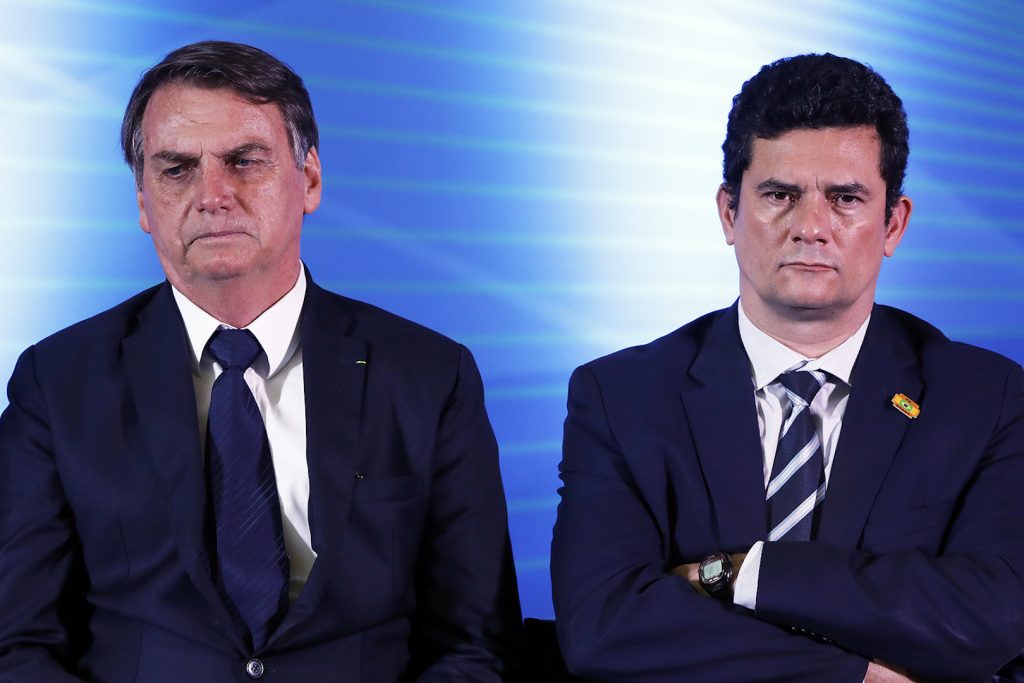
During the press conference, Moro noted that ‘the big problem’ was not who would take the place of director Mauricio Valeixo, but ‘why this person would take over’. Moro said that although the director was not irreplaceable, there had to be a reason for the substitution.
Reaction to Moro’s resignation speech came swiftly, with analysts as well as politicians asking the reason for Valeixo’s dismissal.
“The question by Brazilians remains: why does the president want a director of the Federal Police with whom he can interact?” asked one of the President’s political foes, Rio de Janeiro governor Wilson Witzel.
“The lack of autonomy of the PF causes side effects. This is undesirable in any circumstances, in any organization. In the case of the PF even more, because it is an institution that comes up against political and economic power,” said the president of the National Association of Police Chiefs (ADPF), Edvandir Paiva.
In addition to the Lava Jato inquiries, the federal police are also investigating two cases that may have put Valeixo at odds with Brazil’s President and his family. The cases are being heard by the country’s Supreme Court.
One investigation is related to the source of offenses, threats and ‘fake news’ against Supreme Court justices, while the other involves those who recently organized and financed protests with anti-democratic connotations. Both cases are rumored to have been planned and sponsored by Bolsonaro supporters.
The investigation into attacks on the Supreme Court, known as the ‘fake news investigation’, began in March 2019. Investigators have already identified at least 12 profiles on social networks that act in the dissemination of information, in a standardized way, against STF justices.
The other investigation is in relation to a protest last Sunday in Brasilia where demonstrators defended the closure of Congress and the Supreme Court, and called for the return of military rule, with the re-issuance of the AI-5, (an institutional act that hardened Brazil’s repressive military regime in the 1960s). The investigation is looking to see if federal lawmakers were among the organizers of the event.
To avoid any changes in the rhythm of these two cases, Supreme Court Justice Alexandre de Moraes, prohibited the command of the Federal Police from substituting investigators already working on those operations. In practice, say analysts, Moraes’ decision tries to safeguard investigations, regardless of who takes over the Federal Police and the Justice Ministry.
While in the digital arena public opinion about the political squabble between Moro and Bolsonaro seems to be swaying strongly towards the former Justice Minister, there are many supporters of the President who consider the former cabinet member disloyal and a traitor.
“Listening to President Jair Bolsonaro, I’m sure, Sergio Moro deceived me,” wrote far-right federal deputy Daniel Silveira (PSL-RJ).
“There are amateur traitors. There are professional traitors. Moro is a professional traitor,” said Paulo Eneas, editor of the pro-Bolonaro website Crítica Nacional (National Critic).
Nonetheless, the support received by Sergio Moro after his resignation was tremendous.
“Sergio Moro’s departure is a blow to justice, to democracy in Brazil. I am very sorry that our country has to fight and fight against two viruses: the coronavirus and the other virus that is in the Presidential Palace, in Brasília,” said São Paulo governor, João Doria, another Bolsonaro opponent.
For Supreme Court Justice Luis Roberto Barroso, Moro will always be remembered for his struggle against corruption. “Lava Jato and the fight against corruption symbolized that (Brazilian) society had stopped accepting the unacceptable. There are people who like him more and there are people who like him less, but the fact is that Sergio Moro is a symbol of this historical process.”
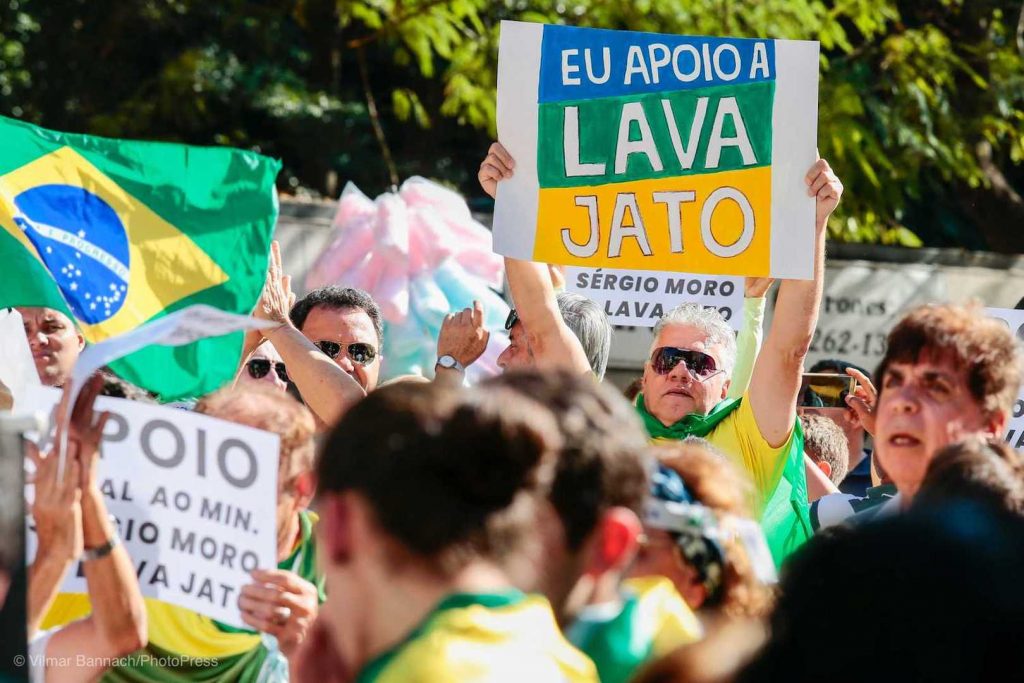
For many analysts, the President loses a big part of his public support with the departure of Sergio Moro because much of that support came from those who applauded Operation Lava Jato Moro’s stance against corruption. With Moro gone, many are now wondering if Bolsonaro’s rhetoric about fighting corruption and doing away with the traditional politics of give-and-take-favors will continue to hold.
More: Brazil news in English, every day from The Rio Times.
Editorial responsibility: Matthias Camenzind, Editor-in-Chief · Editorial standards · Report an error