Milei Government Confidence Matches Term Low in Argentina as Household Arrears Hit 13%
POLITICS · ARGENTINA
Key Facts
- —The country Argentina, South America’s second-largest economy, has been led since December 2023 by Javier Milei, a libertarian economist. The next presidential election is due in October 2027.
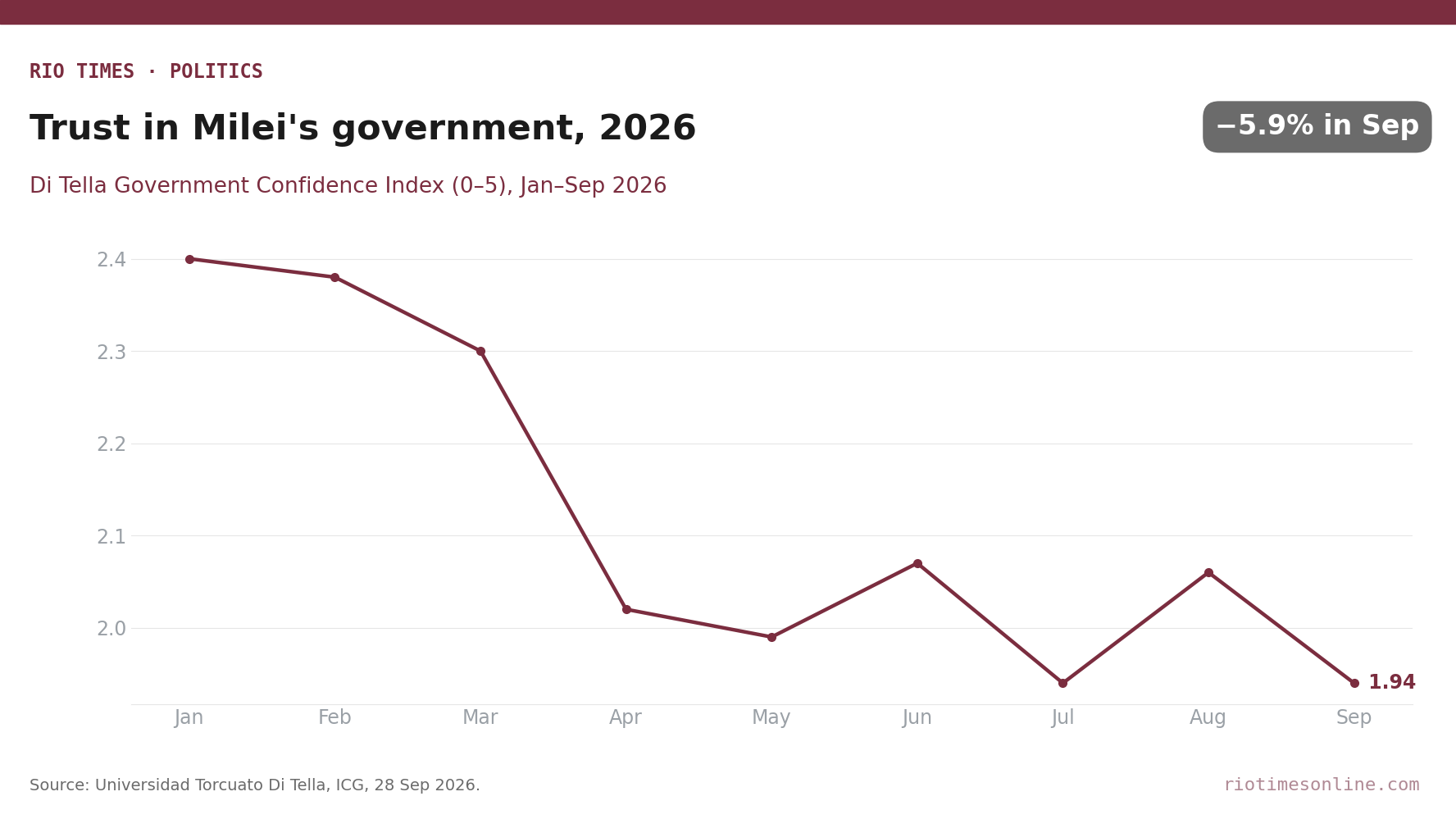
- —What happened On 28 September the Universidad Torcuato Di Tella said its Government Confidence Index fell 5.9% to 1.94 of 5 points. That matches the term lows of September 2025 and July 2026.
- —The numbers Household loan arrears reached 13.0% in July, up from 2.5% in November 2024 (CEPA via Tiempo Argentino). The Treasury still rolled over all peso debt due on 28 September (El Cronista).
- —What it means for you Weaker trust feeds into bond yields and loan costs. Holders of pesos or Argentine bonds face more volatile weeks, though state debt refinancing has not stalled.
- —Still open Whether September starts a new decline or is another sideways month. The October index and fresh activity data will give the first answer.
Milei government confidence fell 5.9% in September to 1.94 points out of 5, matching the lowest reading of Javier Milei’s term. The Universidad Torcuato Di Tella, a private Buenos Aires university, published the figure on 28 September.
The same day, bonds and shares fell and a study showed record household arrears. Taken together, the data show where pressure on the government is building and where it is holding.

What the Di Tella Index Measures
The index runs from 0 to 5 and lets researchers compare Milei with his predecessors at the same point of their terms. Poliarquía Consultores surveyed 1,000 adults in cities of over 10,000 people from 1 to 9 September.
The margin of error is 0.06 points, Infobae reported. All five components fell, led by concern for the general interest, down 12.3% to 1.50.
Honesty held best, at 2.45 points. Trust among women fell 9.2% to 1.62, against 2.19 among men, and those expecting a worse economy gave just 0.38.
A Low Floor, Not Yet a New Slide
The 1.94 reading equals the lows of September 2025 and July 2026. Most of this year’s fall came early, with the sharpest drop from 2.30 in March to 2.02 in April.
Since May the index has hovered around 2 points with smaller monthly swings, the university noted. It still stands above Alberto Fernández’s reading at the same point of his term.
Perfil read the result as Milei edging towards a “defeat zone”. At similar levels, Mauricio Macri lost his re-election bid and Fernández did not run again.
El Destape, an outlet close to the opposition, called the index the poll that best anticipates election results. Other September surveys, including Zuban Córdoba’s, show about six in ten Argentines viewing Milei negatively.
Markets and Households Feel the Strain
Country risk, the extra yield investors demand to hold Argentine dollar bonds over US Treasuries, rose to its highest level in months on 28 September. Outlets reported readings between 628 and 642 points, and the Merval stock index fell again.
Household loan arrears reached 13.0% in July, up from 2.5% in November 2024. The Centro de Economía Política Argentina (CEPA), a research group, compiled the figures, Tiempo Argentino reported.
Among non-bank lenders such as fintech apps, arrears hit 33.9%. That tops the 32.7% banking peak of September 2003, after the 2001 crisis, though the lender types differ.
CEPA links the rise to a 14.3% fall in registered wages since November 2023. Reports citing central bank data put July arrears slightly lower, at 12.9%.
What Is Holding
The Treasury refinanced all peso debt maturing on 28 September, El Cronista and Infobae reported. It awarded 8.62 trillion pesos (about US$5.7 billion) against bids of 9.77 trillion pesos (about US$6.4 billion).
Investors spread their money across fixed-rate, inflation-linked, variable-rate and dollar-linked bills. Dollar-linked demand of 1.83 trillion pesos (about US$1.2 billion) shows many still want insurance against devaluation.
Peso amounts here are converted at 1,524 per US dollar, the rate of 29 September. The rollover means the state is not yet paying out pesos that could pressure the currency.
What It Means for Investors and Residents
For investors, the premium on Argentine debt now carries a political element alongside the economic data, as the government also presses a Falklands oil dispute with Britain. Milei government confidence holding near its floor, rather than sliding further, would ease part of that pressure.
For residents, the practical signals are loan costs, arrears and the peso. Households already behind on payments face the tightest squeeze, while the state keeps meeting its peso obligations.
What Is Not Yet Known
It is unclear whether September marks a new downward leg or another sideways month. Next month’s Di Tella reading will give the first answer.
Nor is it known whether arrears have peaked, or whether coming debt auctions will roll over as smoothly. Argentina has come through similar stretches before, and the next weeks will show which way this one turns.
More: Argentina news in English, every day from The Rio Times.
Sources: Universidad Torcuato Di Tella, ICG September 2026; Infobae, 28 Sep 2026; iProfesional; Perfil; Tiempo Argentino (CEPA data), 28 Sep 2026; El Cronista, Treasury auction; Infobae, Treasury auction; Infobae, country risk; El Destape; exchange rate open.er-api.com, 29 Sep 2026.
This article was produced by The Rio Times’ automated newsroom system. How we use AI · Report an error
In depth
Read More from The Rio Times