Mexico Studies $4 Billion Energy-Financing Plan for Renewables and Grid Expansion
Mexico · Energy
Key Facts
—Structure The umbrella-financing package would use development bank Banobras as the main funder, potentially combined with capital from government, banks, and institutional investors.
—Funding Scope Banobras can provide as much as 80 billion pesos (about US$4.6 billion) to back roughly three dozen recently awarded renewable energy projects, mostly solar.
—Timeline Most of the financing is expected to be arranged within the next 12 months, with a significant portion likely finalized by December this year.
—State Control The plan aligns with recent energy reforms that redefine Pemex and CFE as dominant ‘public enterprises’ and grant CFE at least 54% of electricity generation.
—Budget Priority In 2026, the federal budget allocates 517.4 billion pesos (about US$29.7 billion) to Pemex and 554.6 billion pesos (about US$31.9 billion) to CFE, treating energy spending as a top fiscal priority.
Mexico is studying a roughly US$4 billion energy-financing package centered on renewable power projects and backed by its largest development bank, blending state control with selective private capital to expand power generation and strengthen Pemex and CFE.
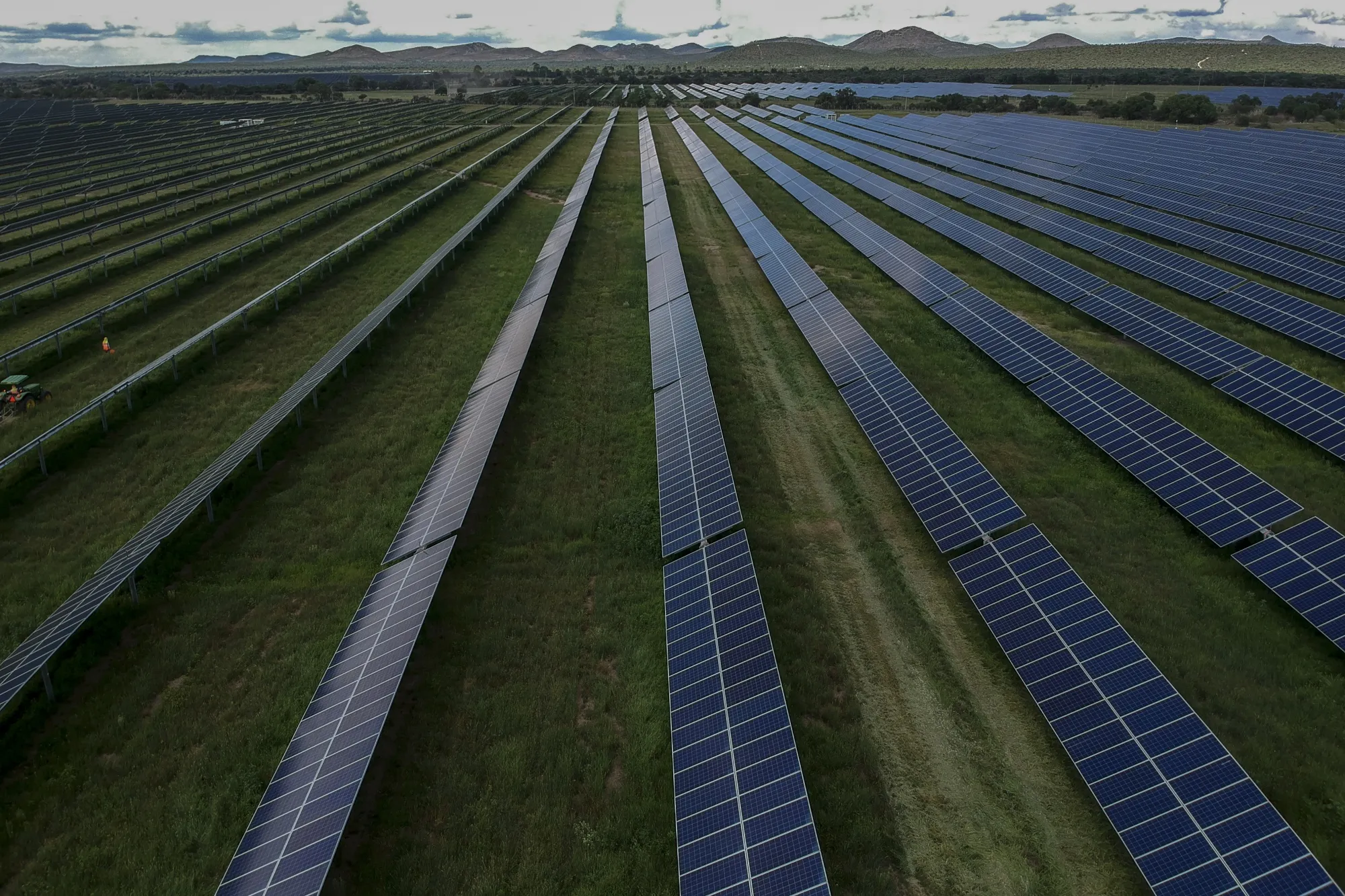
The ~$4 Billion Umbrella Facility
Mexico’s government is exploring a new umbrella-financing package to back renewable energy projects with more than US$4 billion in support. The centerpiece of this initiative is Banco Nacional de Obras y Servicios Públicos (Banobras), the state development bank, whose head Jorge Mendoza stated the institution could fund as much as 80 billion pesos (about US$4.6 billion) to be channeled directly into projects or through a single infrastructure vehicle.
The vehicle is designed to back roughly three dozen projects awarded recently to 18 companies, most of which are solar-energy ventures. By creating a single financing structure, officials aim to reduce costs and streamline due diligence by leveraging the government’s own project evaluation.
The package could combine funds from the government, commercial banks, and institutional investors, with most of the financing expected to be lined up over the next 12 months and a significant portion by December.
Where the Money Comes From
Banobras will serve as the anchor funder for this initiative. However, Mexico’s Finance Ministry and Banobras have confirmed they are also in active talks with Mexican pension funds (Afores), commercial banks, and other institutional investors to put together the blended financing.
This follows a pattern of using trust-like public-private structures for energy assets, such as a previous vehicle funded by development and commercial banks for around 250 billion pesos (roughly US$13.35 billion) to support Pemex’s debt transition.
Another recent model was the near-US$6 billion acquisition of 13 Iberdrola power plants by Mexico Infrastructure Partners (MIP). That deal used a trust combining US$4.2 billion in secured financing and US$2.4 billion in equity from the National Infrastructure Fund (FONADIN), with the plants now operated by the state utility CFE.
The new Banobras-led facility signals a continuation of using this blended-finance playbook to support the government’s energy goals without relying solely on direct federal budget funds.
What the Funds Will Support: Pemex, CFE, and Generation
The immediate focus of the financing package is on 36 new clean-energy power plants, including PV solar and wind, representing about US$4 billion in projects and 8,909 GWh of contracted capacity awarded to 23 bidders. The output from these plants will be sold to the Comisión Federal de Electricidad (CFE) under long-term purchase contracts.
This fits into a broader national plan requiring that no private firm have ‘prevalence’ over CFE in generation and that generation be dispatched with priority for the state utility.
Beyond the renewables package, the government’s 2026 budget proposal underscores the priority given to state energy champions. Pemex is set to receive 517.4 billion pesos (about US$29.7 billion), a 7.7% real increase over 2025, while CFE will receive 554.6 billion pesos (about US$31.9 billion) for its largest allocation since 2019. Significant tax-funded debt-amortization transfers of 263.5 billion pesos (about US$15.1 billion) are also planned for Pemex, conditional on the company matching it with improved financial balance, while CFE’s surplus and federal transfers undergird the National Electric System Strengthening and Expansion Plan 2025–2030.
Fiscal Strategy and State Control
President Claudia Sheinbaum’s administration formalized the dominant role of the state in October 2024 by signing a constitutional decree changing Pemex and CFE from ‘productive enterprises’ to ‘public enterprises.’ This was followed in March 2025 by a package of 10 energy laws that guarantee CFE at least 54% of total power generation and bars private participation in transmission and distribution. The new roughly US$4 billion financing plan is a direct counterpart to this strategy, using development-bank firepower to attract private capital on terms defined by the state.
While the policy re-centralizes control, it does not entirely exclude private money. Sheinbaum’s Plan México aims to add 22 GW of new power capacity by 2030, with 46% coming from private investment.
Reports indicate that European, US., and domestic developers—including BlackRock Inc, Copenhagen Infrastructure Partners, and Grupo México—have already signed deals totaling about US$4 billion to reinforce the grid. For the state, the model aims for a leverage ratio where every US$1 of public money attracts almost US$1.40 in additional private-sector investment.
Why This Matters for Investors and Residents
For expats and investors in Mexico, the financing package signals both opportunity and structural constraint. The government is creating a regulated pathway for renewable-energy investment where the state-owned utility CFE is the guaranteed offtaker through long-term contracts, reducing offtake risk for solar and wind developers.
At the same time, the legal reforms enacted in 2024 and 2025 mean private firms operate under a priority-dispatch framework that permanently advantages the state utility, a factor that shapes long-term returns.
For residents and consumers, the significant public investment directed to Pemex and CFE—which in recent budgets reached as much as 4.8% of GDP—means that energy policy remains a central pillar of fiscal spending, potentially influencing electricity subsidies and service stability. The plan to add 27 GW of new generation capacity by 2030, combined with over US$15.5 billion in public power-generation investment and US$2.2 billion for transmission and distribution between 2025 and 2030, aims to modernize a strained grid confronted by growing national demand.
Frequently Asked Questions
How much financing is Mexico studying for its energy sector?
Mexico is studying a roughly US$4 billion umbrella-financing package, with the state development bank Banobras able to provide as much as 80 billion pesos (about US$4.6 billion), backed by government funds, commercial banks, and institutional investors.
What kind of projects will the financing package support?
The package is designed to finance roughly three dozen renewable energy projects recently awarded to 18 companies, primarily solar-energy ventures, which will sell their power to the state utility CFE under long-term contracts.
How does this financing fit Mexico’s policy for Pemex and CFE?
The plan aligns with reforms that define Pemex and CFE as dominant ‘public enterprises’ and guarantee CFE at least 54% of generation, while using blended public-private financing to expand the grid without fully relying on the federal budget.
Sources: Mexico readies $4 billion in financing to back energy projects, Mexico’s 2026 budget boosts Pemex; CFE sees largest allocation, Mexico reform establishes CFE, Pemex as dominant energy players, Mexico selects 23 bidders for $4 billion renewable energy auction, Sheinbaum leans on private investors to fix beleaguered grid, 2025 Mexico Investment Climate Statement
Read More from The Rio Times