Olinia Car: Mexico’s First Homegrown EV Arrives in 2027

MEXICO · BUSINESS
Key Facts
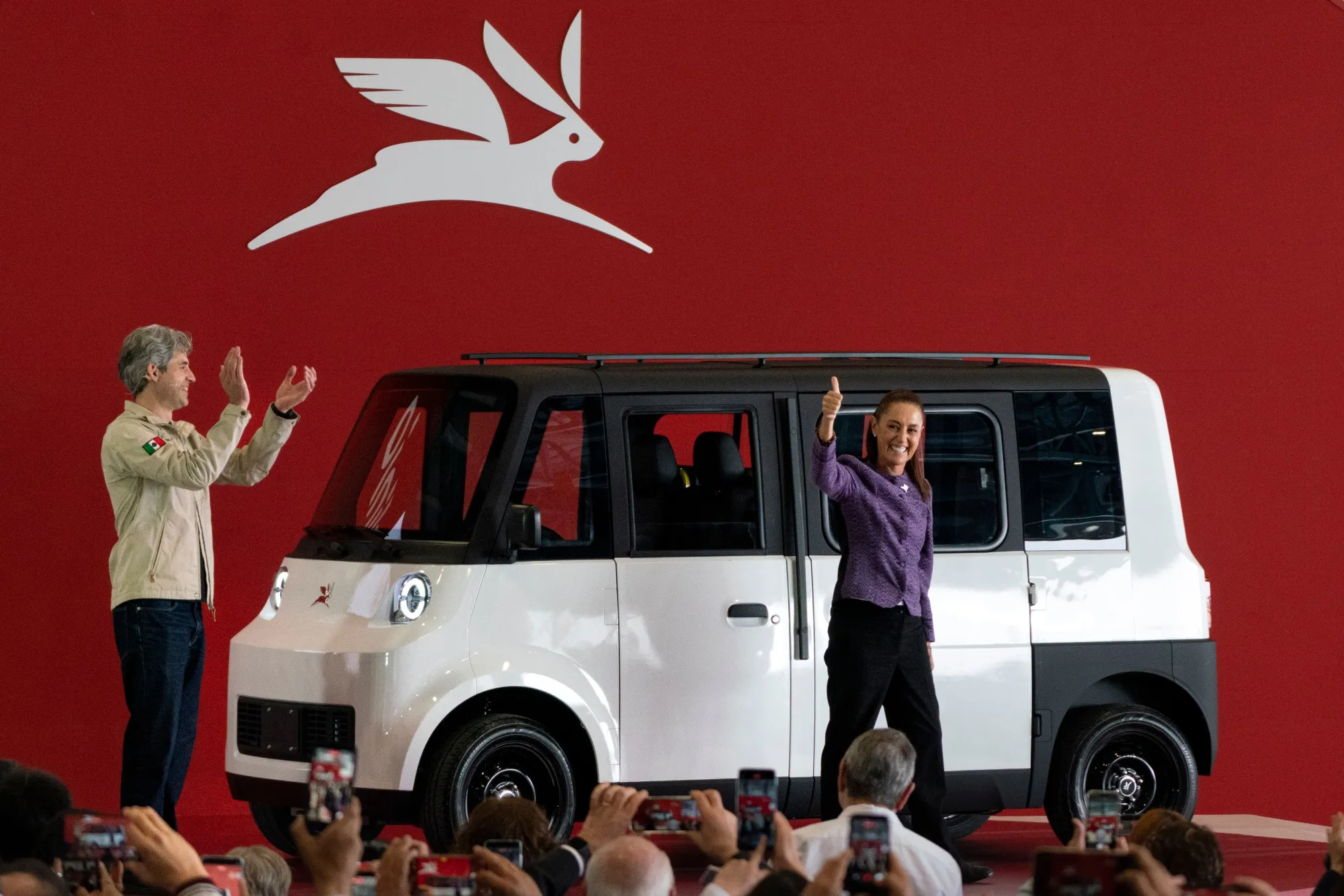
—The reveal. Mexico unveiled Olinia Uno, its first homegrown electric car, on June 7 at the Santa Lucia air base near Mexico City.
—The price. The compact city car is set to start at about 150,000 pesos, roughly $7,900.
—The specs. A small battery gives a range of around 125 kilometers, charged from a normal household socket.
—The timeline. Series production is planned in Puebla, with mass-market sales targeted for 2027.
—The backers. It is a state-led project built by Mexican public universities and research institutes.
—The context. Mexico is a giant assembler of foreign-brand cars but has never had a carmaker of its own.
Mexico has unveiled Olinia, a small, low-cost electric car designed and built at home, a symbolic bid to turn one of the world’s biggest car-assembly hubs into a country with a brand of its own.
What Olinia actually is
The car made its debut in a hangar at the Santa Lucia military air base north of Mexico City, where President Claudia Sheinbaum drove the prototype onto the stage herself.
The name comes from a Nahuatl word meaning to move. The government has cast the project as both an industrial milestone and a point of national pride.
In practical terms it is a compact urban vehicle, not a highway cruiser. It is built for short city trips, with a modest top speed and a range of around 125 kilometers on a charge.
It charges from an ordinary household socket, sidestepping the need for special infrastructure. Officials say running it will cost a fraction of what a petrol car burns through.
The design is deliberately humble. The car is small enough to thread the narrow streets of dense Mexican neighbourhoods, and officials have stressed practicality over performance at every turn.
The price is the point
The headline figure is the sticker price. Olinia is expected to start at about 150,000 pesos, roughly $7,900, far below the cost of most new cars on the Mexican market.
That positions it less as a rival to premium electric brands and more as a step up from a motorcycle, aimed at families and small businesses who have been priced out of a new car entirely.
The pitch is affordability and ownership rather than luxury or speed. In a country where most urban journeys are short, a cheap, simple electric runabout could find a real market.
Developers have also framed the running costs as a selling point in themselves, arguing the fuel savings over time help offset the purchase price. The idea is a car that effectively pays for part of itself.
Why a homegrown car matters here
The deeper significance lies in what Mexico’s car industry has always been. The country is one of the world’s largest vehicle producers, but almost entirely as an assembler for foreign brands.
Plants across the country build cars for American, European and Asian manufacturers, who own the designs, the brands and the bulk of the profit. Mexico has supplied the labour, not the nameplate.
Olinia is an attempt to change that balance, however modestly. The government frames it as a move up the value chain, from assembling other people’s cars to designing and owning one outright.
It was developed by teams from Mexican public universities and research institutes rather than a private carmaker, which is central to the political message of homegrown engineering.
Sheinbaum has presented the car as the work of young Mexican engineers, a talent showcase as much as a product. The framing ties the vehicle to a broader push for technological self-reliance.
The hard part comes next
A prototype that a president can drive onto a stage is one thing; a car people can buy is another. The plan is to build an assembly plant in Puebla and begin series production ahead of mass-market sales in 2027.
That gap between prototype and showroom is where many ambitious vehicle projects stall. Supply chains, certification, quality control and financing all have to line up before the first paying customer drives away.
There is also competition. Low-cost Chinese electric models are already pushing into Latin America, and Olinia will have to prove it can match them on price and reliability.
Scale is the other open question. Building a handful of prototypes is far easier than producing tens of thousands of identical cars at a price that still makes sense for buyers and for the state.
For now, though, the unveiling is a statement of intent. Whether Olinia becomes a genuine carmaker or stays a showcase will be decided not on a stage but on the production line.
The symbolism, at least, has already landed. A country that has spent decades building the world’s cars has now put its own badge on one, and the rest is a question of execution.
The coming months will show whether the badge can travel from the hangar to the street.
Background: Latin America’s auto market.
More: Latin America news in English, every day from The Rio Times.
Frequently Asked Questions
What is Olinia?
It is Mexico’s first homegrown electric car, a compact, low-cost city vehicle unveiled on June 7 and developed by Mexican public universities and research institutes.
How much will it cost?
It is expected to start at about 150,000 pesos, roughly $7,900, positioning it as an affordable step up from a motorcycle rather than a premium electric car.
When can people buy one?
The current model is a prototype. The plan is to build it in Puebla and reach mass-market sales in 2027, after production, testing and certification.
Why is it significant for Mexico?
Mexico is one of the world’s biggest car producers but only as an assembler for foreign brands. Olinia is a bid to own a vehicle design and brand of its own.
Connected Coverage
For more on Mexico, see our coverage of how World Cup ticket prices are squeezing local fans and the free fan festivals across the host cities.
This article was produced by The Rio Times’ automated newsroom system. How we use AI · Report an error · Editorial responsibility: Matthias Camenzind, Editor-in-Chief