Latin America’s Auto Market in 2026: Record Sales, Chinese Dominance, and a Trade War on the Horizon
Key Facts
— — Mexico posted an all-time Q1 record of 381,632 new vehicle sales (+3.7% YoY), surpassing the 2017 peak — while Brazil registered 257,801 units in March alone (+46% MoM), confirming its position as the world’s sixth-largest auto market
— — Chinese automakers are reshaping the competitive landscape across the region: BYD sold 37,637 vehicles in Brazil in Q1 (+73.7% YoY), Chinese brands command 35% of Chile’s market, and MG jumped to seventh place in Mexico with 54% growth — while BYD’s Dolphin Mini became the first Chinese vehicle to top Brazil’s monthly retail chart
— — The industry faces a collision of trade policy deadlines: the USMCA mandatory review in July, Brazil’s EV import tariff rising to 35% by mid-year, and Mexico’s new 50% tariff on vehicles from countries without free trade agreements — all while the Hormuz crisis pushes fuel costs higher and complicates the economics of both combustion and electric vehicles
Two records in one week. Mexico hit its highest Q1 vehicle sales ever. Brazil posted its strongest March in years. And behind both numbers, the same story: Chinese automakers are rewriting the rules of a $181 billion regional market — and the tariff walls going up may not be enough to stop them.
The Latin America auto market entered 2026 with momentum that few predicted. Mexico’s INEGI reported 381,632 new vehicles sold in Q1, a 3.7% increase that eclipsed the 2017 record of 378,885 units — a remarkable performance for an economy growing at just 1.49%. In Brazil, Fenabrave data showed 257,801 registrations in March alone, continuing a year in which the region’s largest market has consolidated its position as the world’s sixth-largest by volume.
The Chinese Offensive
The most consequential force in the Latin America auto market is no longer a Detroit boardroom or a Wolfsburg design studio. It is Shenzhen. BYD sold 37,637 vehicles in Brazil in Q1 2026, a 73.7% surge over the same period in 2025, making it the country’s fifth-largest brand. The Dolphin Mini — a $20,000 electric hatchback — became the first Chinese vehicle to top Brazil’s monthly retail sales chart, outselling every gasoline and ethanol model. Chinese brands collectively now command over 80% of Brazil’s EV sales.
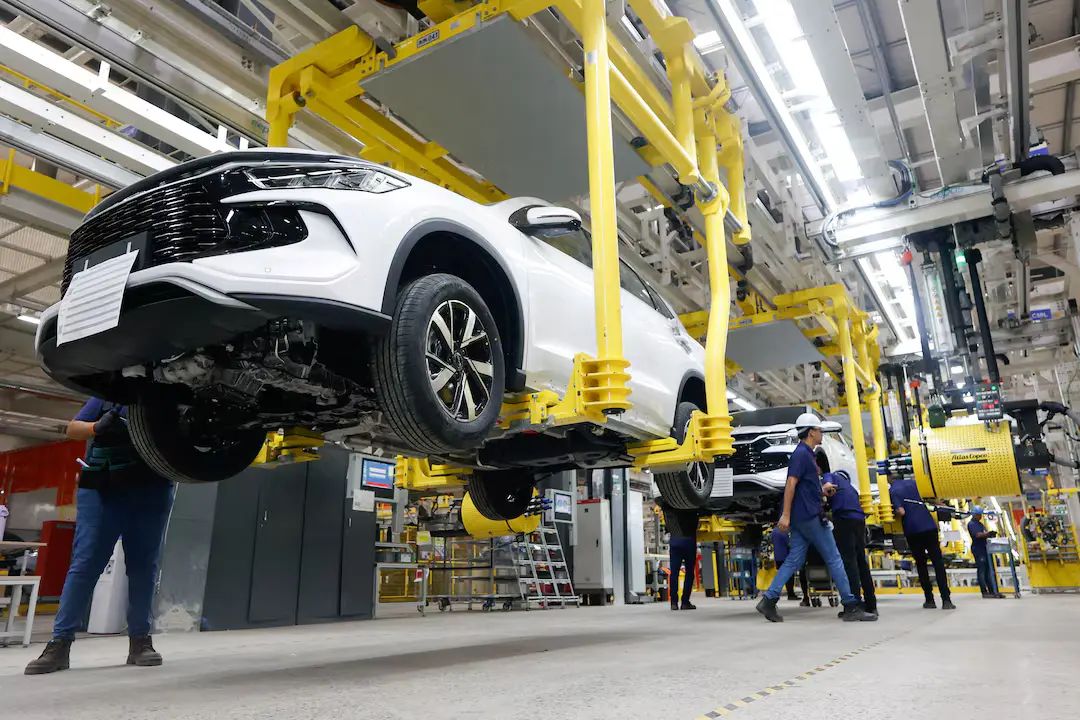
In Chile, the penetration is even deeper. Chinese brands sold nearly 8,000 vehicles in February, capturing 35% of the market and leading Japanese brands by nine percentage points. In Mexico, MG jumped to seventh place with 6,100 units in January (+54% YoY), and BYD accounted for roughly 70% of all plug-in hybrid and electric sales. The pattern is continent-wide: from Colombia, where BYD assembled the first electric articulated bus chassis for Bogotá’s TransMilenio, to Argentina, where Great Wall Motor is expanding dealership networks.
The Tariff Walls Rising
Governments are responding with barriers — but unevenly. Brazil’s EV import tariff is rising to 35% by July 2026, which favours brands with local production. BYD’s R$5.5 billion ($1.04 billion) factory in Bahia, built on a former Ford site with capacity for 300,000 vehicles per year, is already ramping. Great Wall Motor repurposed a former Mercedes-Benz facility. Changan began operations at its own plant. For these companies, the tariff wall is a moat they have already crossed.
Mexico took a harder line: a 50% tariff on vehicles from countries without free trade agreements — principally China — took effect in January 2026. BYD responded by cancelling its planned Mexican assembly plant, citing US trade security concerns over a China-based EV factory operating within USMCA territory. The result is a paradox: the cheapest EVs driving adoption are now the most expensive to import. General Motors sold only 1,540 EVs in Mexico in 2025 despite local production capability — legacy manufacturers have been slow to fill the gap.
The USMCA Clock
Hanging over Mexico’s record quarter is the USMCA mandatory review, due by July 1. Trump has called the deal “irrelevant.” About 92% of Mexican auto parts qualify for USMCA exemptions, but if the agreement is weakened or abandoned, the estimated cost would be $3,000 per vehicle crossing the border. Mexico produced over 3.3 million vehicles in 2025, with more than 80% exported to the US and Canada — the highest manufacturing output in Latin America by far.
The Energy Wildcard
The Strait of Hormuz crisis adds a final layer of complexity. Brent crude above $100 per barrel makes combustion vehicles more expensive to operate — theoretically boosting EV demand. But it also raises input costs for manufacturing, shipping, and the electricity generation that powers EV charging in countries still dependent on thermal generation. The region’s $181 billion auto market is caught between two transitions: the shift from combustion to electric, and the shift from Western to Chinese dominance. Both are accelerating. The question for Stellantis, Volkswagen, Toyota, and the legacy manufacturers that have dominated Latin America’s consumer economy for decades is whether the tariff walls they lobbied for will hold — or whether Chinese manufacturers, now building factories inside the walls, have already won.
More: Latin America news in English, every day from The Rio Times.
This article was produced by The Rio Times’ automated newsroom system. How we use AI · Report an error · Editorial responsibility: Matthias Camenzind, Editor-in-Chief
In depth