Key Facts
- The IPC closed at 66,107, down 0.75% on the day and 7.7% below its 52-week high, leaving the benchmark consolidating inside a 60,216–71,601 yearly band
- América Móvil led the heavyweights lower, sliding 2.3% on $42m of turnover as the telecom giant dragged the blue-chip tape into the red
- June inflation cooled to 3.37%, a five-year low and below the 3.5% consensus, yet core inflation stuck at 4.03%, still above Banxico’s 4% tolerance ceiling
- the peso held firm at 17.52 per dollar, down 0.14% and 6.9% stronger than its yearly weak point, confirming the equity dip was a stock-desk story, not a currency event
- Cemex swamped turnover at $1,282m, closing flat while its CPO line rose 1.6%, dwarfing every other name on the board
Today’s Focus
Mexico’s stock market edged lower on July 9, with the S&P/BMV IPC — the Bolsa’s benchmark of the country’s largest listed companies — closing at 66,107, down 0.75%.
The day’s macro anchor was a softer-than-expected June inflation print, which cooled to 3.37% year-on-year, the slowest since 2020 and below the 3.5% consensus. Read one line further, though, and the disinflation story frays: core inflation ticked up to 4.03%, still above the top of Banxico’s tolerance band.
The heavyweights did the damage. América Móvil fell 2.3% on $42m of turnover, Grupo Carso slid 2.3% and Femsa eased 1.0%, while Cemex — the day’s turnover king at $1,282m — closed flat.
The peso, by contrast, barely moved: USD/MXN settled at 17.52, down 0.14% and hugging the strong end of its 17.13–18.83 range.
What matters today. A benign headline print with a sticky core kept the peso firm but gave equities little to rally on — a stock-desk pullback, not a Mexico exit.

01 The session in one read
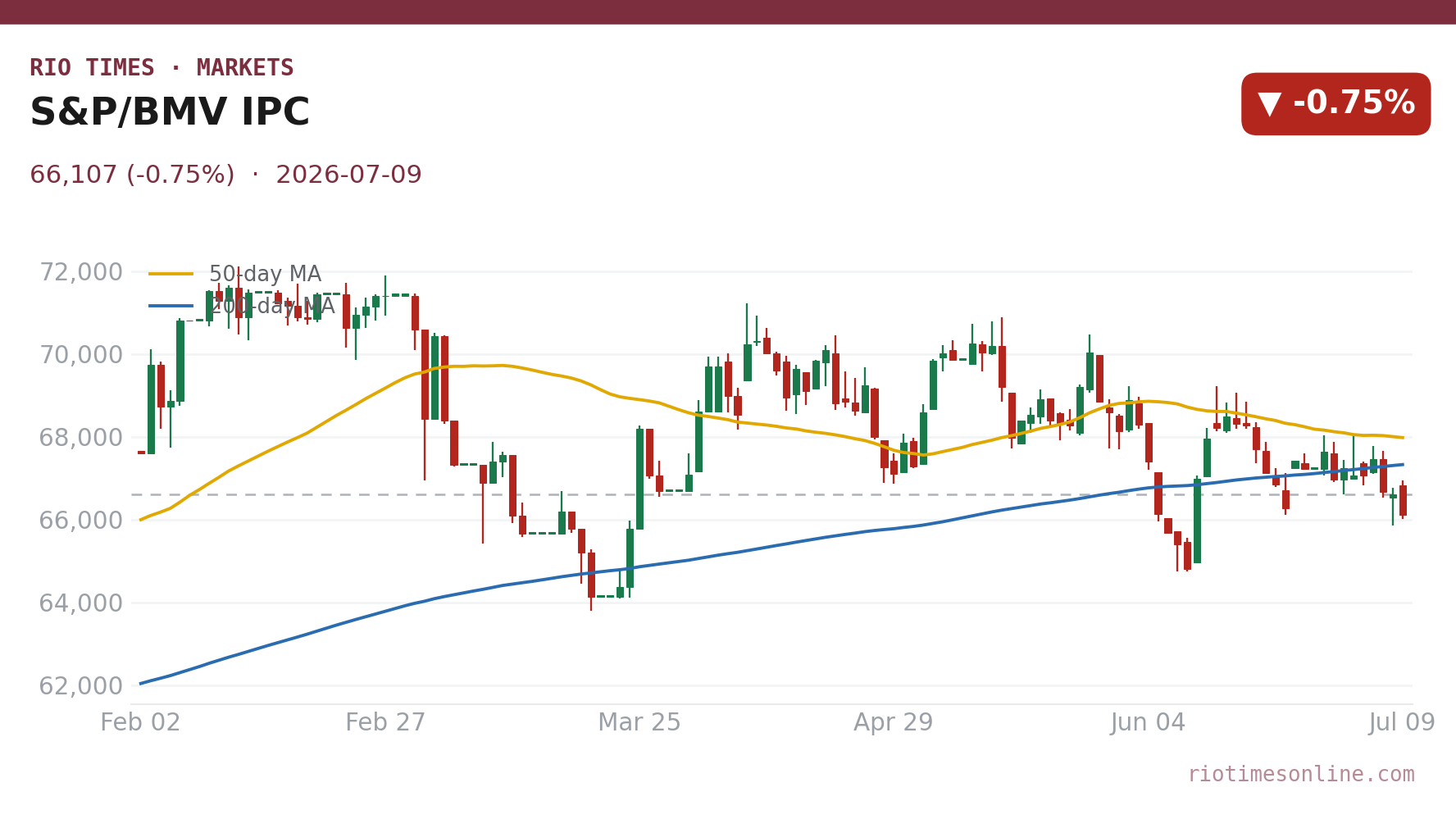
Mexico’s equity market gave back a little ground on July 9, and the day belonged to its heavyweights — the S&P/BMV IPC, the Bolsa’s gauge of the country’s biggest listed companies, closed at 66,107, down 0.75%.
The trigger was the morning’s June inflation report, which on the surface looked like a gift. Consumer prices slowed to 3.37% year-on-year, the softest reading since 2020 and comfortably under the 3.5% the market had penciled in.
Yet the tape did not celebrate, because the print’s composition undercut the headline. The all-items index fell on the month largely on tumbling fruit and vegetable prices, while core inflation — the part Banxico actually watches — nudged up to 4.03%, still above the 4% ceiling of its tolerance band.
For an offshore desk the read was measured rather than alarmed: the peso held firm, the losses clustered in a handful of names, and the benchmark stayed comfortably above 66,000.
The evidence points to a narrow, heavyweight-led pullback rather than a macro rupture: América Móvil and Grupo Carso led the losses, Cemex closed flat on the heaviest cash, and the peso barely twitched at 17.52. The disinflation headline was real but hollow — perishable food, not core prices, carried it down, so Banxico gets little clean cover to accelerate cuts. The variable to watch is whether core inflation, stuck at 4.03%, resumes its descent or hardens the case for a cautious hold.
02 The day’s numbers
| Measure | Level | Change | Read |
|---|---|---|---|
| S&P/BMV IPC | 66,107 | −0.75% | Heavyweight-led dip; consolidating below the highs |
| Session positioning | — | −7.7% | Below the 52-week high of 71,601 |
| 52-week range | 60,216–71,601 | — | Upper-middle of the yearly band |
| USD/MXN (peso) | 17.52 | −0.14% | Firm; 6.9% stronger than its weak point |
| Key technical level | 66,000 | — | First shelf below on any follow-through selling |
The two headline numbers pulled apart, and that gap is the story — the index fell three-quarters of a percent while the currency barely moved.
At 66,107 the IPC sits in the upper-middle of its 60,216–71,601 yearly band but 7.7% shy of the high, a market that has done its rallying and is now consolidating. The round 66,000 mark is the first shelf below: a hold there would frame the recent run of soft closes as a base rather than a top. Rio Times · Live Market Intelligence
Live Market IntelligenceMexico — Live Market Board
Mexico — Live Market Board
Instrument Last Change YoY Prev. High Low Volume
IPC MEX
68,929.72
+1.87%
+12.17%
67,663.29
66,121
65,405
108,886,187
USD/MXN
17.06
-0.24%
-8.58%
17.10
17.08
17.01
—
WALMEX
48.07
-0.62%
-14.38%
48.37
48.65
48.02
10,781,446
GMEXICO
223.28
+0.35%
+73.59%
222.50
226.18
222.17
1,325,556
FEMSA
201.19
-0.24%
+25.67%
201.67
206.71
199.56
750,706
CEMEX
19.32
+0.89%
+19.10%
19.15
19.35
19.04
14,327,054
GFNORTE
193.98
+1.18%
+14.36%
191.71
195.79
191.83
1,579,115
BIMBO
60.98
-0.96%
+11.89%
61.57
61.46
60.29
1,048,115
TELEVISA
9.71
+0.21%
+12.78%
9.69
9.75
9.60
577,851
AMX
19.80
-0.95%
+12.53%
19.99
20.05
19.70
58,058,525
GAP
366.23
+0.43%
-21.21%
364.68
370.85
362.82
226,946
ASUR
275.04
+1.25%
-15.28%
271.64
275.08
271.31
15,451
OMA
233.50
+0.62%
-6.48%
232.06
235.00
230.62
555,693
KOF
188.04
+0.86%
+18.94%
186.44
188.56
185.52
425,273
GRUMA
252.90
+0.11%
-21.85%
252.61
254.74
250.36
90,048
KIMBER
39.74
+0.43%
+8.85%
39.57
40.09
39.33
490,551
AMX ADR
23.38
-0.23%
+22.25%
23.43
23.49
23.06
1,347,445
Live Company IntelligenceAmerica Movil SAB de CV ADR — the full investor dossier
Wall Street view
Valuation & profitability
Price & risk
$19.4752-wk high
$28.12
Revenue trend · 6y
Ownership
Dividend
03 Why it moved — a benign headline masking sticky core inflation
The proximate cause was the June inflation print, released before the open. Headline inflation eased to 3.37%, its second month inside Banxico’s target band and its best reading of the year.
But the improvement was narrow. Fruit and vegetable prices fell nearly 9% in a single month, dragging the non-core basket — and with it the headline — lower, while core inflation actually rose to 4.03% annually.
That divergence matters for the rate path. A soft headline built on perishable food gives the central bank little clean room to accelerate easing, so equity investors got no fresh cut-cycle catalyst to bid the heavyweights.
The peso read it differently — with core prices still firm and the Fed leaning hawkish, the rate gap keeps carry into the peso attractive, and USD/MXN held at 17.52.
04 The day’s movers
| Driver | Level / Move | Change | Note |
|---|---|---|---|
| América Móvil (AMXB) | $42m turnover | −2.3% | Telecom heavyweight led the blue-chips lower |
| Cemex (CX / CEMEXCPO) | $1,282m turnover | +0.0% / +1.6% | Turnover king; ADR-line flat, CPO up 1.6% |
| Grupo Carso (GCARSOA1) | — | −2.3% | Slim tied with AMXB as biggest loser |
| Banorte (GFNORTEO) | $78m turnover | −1.2% | Lender among the drags |
| Femsa (FEMSAUBD) | $50m turnover | −1.0% | Consumer heavyweight eased |
| Vesta (VESTA) / Arca (AC) | — | −2.2% / −2.0% | Industrial and bottler among the fallers |
| Gentera (GENTERA) | — | +1.3% | Top verified domestic gainer |
The turnover picture and the price picture told different tales. Cemex, the Monterrey cement giant, once again swamped the tape at $1,282m of cash — dwarfing every other name — yet its main line closed flat, a sign of index positioning rather than fresh conviction.
The declines were concentrated in the heavyweights: América Móvil off 2.3%, Grupo Carso down 2.3%, Bajío bank BBAJIO −2.2%, Vesta −2.2% and Arca Continental −2.0%. Against them, Cemex’s CPO line rose 1.6%, Gentera added 1.3% and restaurant operator Alsea gained 0.8% — thin offsets on a soft board.
05 The regional scoreboard
| Index | Country | Change |
|---|---|---|
| S&P/BMV IPC | Mexico | −0.75% |
| Ibovespa | Brazil | — |
| S&P IPSA | Chile | — |
| S&P MERVAL | Argentina | — |
| MSCI COLCAP | Colombia | — |
Only the Mexico move is verified from the scan here; Brazil, Chile, Argentina and Colombia are shown as ‘—’. The live market board above carries each index’s closing level in full.
Mexico’s three-quarter-point slip left it a middling regional performer — softer than the commodity-lifted Andes but far from a rout, with the peso’s calm the differentiator versus more volatile neighbours.
06 The technical picture
At 66,107 the IPC remains 7.7% below its 71,601 high and sits in the upper-middle of its 60,216–71,601 yearly band — consolidation, not a trend break.
A single 0.75% session does not disturb the medium-term picture, but it does extend a run of soft closes. The round 66,000 mark is the first level to watch: a hold there frames July 9 as a heavyweight-driven dip rather than the start of a broader de-rating.
The peso is the steadier signal. With USD/MXN at 17.52 and pinned near the strong end of its 17.13–18.83 range, the currency shows none of the stress that would turn an equity pause into something larger.
That divergence — a soft index over a firm peso — is what keeps the technical read constructive, with the 17.13 floor the level that would confirm the ‘superpeso’ as more than carry noise.
07 What to watch
- Core inflation: Whether the 4.03% core rate resumes falling or hardens — it, not the perishable-food-driven headline, decides Banxico’s room to cut
- The peso floor: A clean break of 17.13 would confirm the superpeso as more than carry noise; any Fed-driven dollar bid tests the 18.83 weak end
- América Móvil: The telecom heavyweight reports earnings on 14 July; whether its 2.3% slide stabilises will shape the blue-chip tape
- The 66,000 shelf: A hold frames the soft run as a base; a decisive break opens the lower half of the yearly band
Background: Mexico’s Prices Fell Again in June. Core Inflation Rose Again..
Background: TotalEnergies Ships Mexican LNG to Asia, Skipping Panama.
More: Mexico news in English, every day from The Rio Times.
Frequently Asked Questions
Why did the Mexican stock market fall if inflation came in soft?
Because the disinflation was hollow — headline inflation eased to 3.37% mainly on a near-9% monthly drop in fruit and vegetable prices, while core inflation rose to 4.03%, still above Banxico’s 4% ceiling, giving equity investors no fresh rate-cut catalyst.
How far did the IPC fall and where did it close?
The S&P/BMV IPC closed at 66,107, down 0.75% on the day and 7.7% below its 52-week high of 71,601, keeping it in the upper-middle of a 60,216–71,601 yearly range.
What drove the losses?
Heavyweights led the decline — América Móvil fell 2.3% on $42m of turnover, Grupo Carso −2.3%, Banorte −1.2% and Femsa −1.0% — while Cemex dominated turnover at $1,282m but closed flat.
What did the peso do?
USD/MXN settled at 17.52, down 0.14% and 6.9% stronger than its yearly weak point, hugging the strong end of its 17.13–18.83 range — a sign the equity dip was a stock-desk story, not capital flight.
This article was produced by The Rio Times’ automated newsroom system. How we use AI · Report an error · Editorial responsibility: Matthias Camenzind, Editor-in-Chief
In depth
LatAm Markets: Live Signals → — real-time movers, turnover leaders and FX across Latin America.