Key Facts
- The S&P 500 fell 0.79% on Monday, dragging Latin American markets into a synchronised retreat ahead of today’s US producer price report, the week’s first big inflation test.
- Oil markets are jittery after OPEC revised down 2026 global demand growth to 780,000 b/d, keeping crude prices under pressure and weighing on LatAm energy names.
- Argentina publishes June inflation before the open with consensus forecasting a slight acceleration to 33.6% year-on-year, a level that would keep the central bank on high alert.
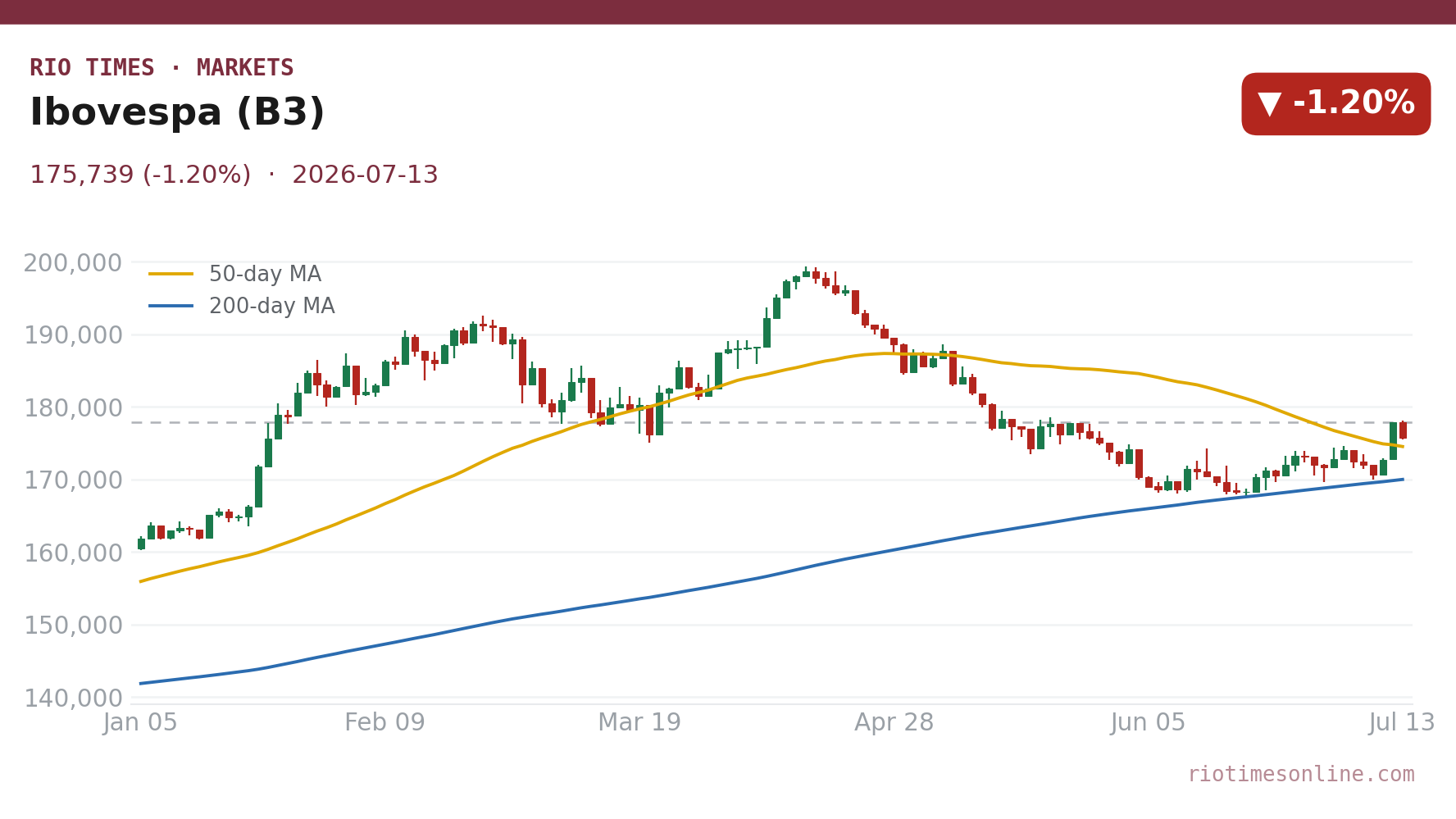
- Brazil’s Ibovespa lost 1.20% on Monday, exactly tracking the S&P 500’s move, but remains 11.5% below its 52-week high, trapped in a broad value-rotation correction.
- Mexico’s IPC shed 0.79% on light turnover while Chile’s IPSA edged closer to its all-time highs, keeping the Andean bloc the region’s relative safe haven.
Today’s Focus
Asian equities drifted sideways overnight with no significant directional impulse for emerging markets. Japanese foreign investment data due later holds little immediate relevance for LatAm positioning.
European futures are pointing to a flat open as Bundesbank President Nagel speaks later today, though his tone is unlikely to shift before the ECB’s summer break.
The macro pivot lands squarely on US PPI at 12:30 GMT — a hot core print above the 0.3% estimate would harden the higher-for-longer narrative that has already priced Latin American rate-sensitive stocks for pain.
Argentina’s own CPI, released pre-market, will set the regional tone early: a figure that overshoots 33.6% would rattle Argentine assets already consolidating after a historic rally.
What matters today. US producer prices and Argentine inflation form a twin data point that will set the risk appetite for every Latin American bourse today.

01 The overnight tape in one read
Asian markets held their breath overnight with major benchmarks stuck in narrow ranges. Japan’s Nikkei traded flat as investors awaited foreign bond and stock investment data due after the close, while Chinese indices edged lower on thin volumes with no fresh stimulus signals.
European futures are pointing to an open near the flatline. Bundesbank President Nagel speaks at 16:00 GMT but markets expect little new guidance — the ECB is firmly in summer pause mode and the next policy debate will wait until September.
The dollar is broadly steady against major peers, though USD/JPY remains elevated near 162.60, its highest level in over a year. The greenback’s calm is deceptive — it masks positioning ahead of the US PPI release that will either validate or challenge the inflation narrative.
Oil is the quiet worry. OPEC’s latest monthly report cut 2026 global demand growth by 190,000 b/d to 780,000 b/d, enough to keep Brent and WTI below their recent ranges. For Latin America’s oil exporters — Colombia, Brazil and Mexico — the demand-side caution is a headwind that compounds the broader risk-off mood.
Monday’s synchronised selling across the five major LatAm indices mirrored the S&P 500 almost tick for tick, signalling the region is fully in lockstep with global macro anxiety rather than trading on local fundamentals. The Ibovespa’s 1.20% drop and the IPC’s 0.79% decline were almost carbon copies of Wall Street, while Argentina’s Merval gave back 0.87% after its blistering run. The overnight tape is thin — Asia offered no lead and European futures are flat — so the entire session will pivot on the PPI print and Argentina’s CPI. The variable to watch is whether dollar-denominated LatAm ETFs attract flows if US data cools rate fears, or whether the carry trade unwinds further if inflation surprises to the upside.
02 The board before the open
| Instrument | Level | Change | Read |
|---|---|---|---|
| Ibovespa | 175,739 | −1.20% | Tracking the S&P 500; 11.5% below its 52-week high |
| Mexbol (IPC) | 65,973 | −0.79% | Mirroring Wall Street; financials under pressure |
| S&P IPSA | — | — | Pressing near record territory; less than 8% from its high |
| S&P Merval | 3,251,740 | −0.87% | Profit-taking after the 3-million pivot; EMBI at 406bp |
| COLCAP | 2,307.67 | +0.65% | Friday’s close; the Andean outlier still constructive |
| S&P 500 | 7,515 | −0.79% | Within 1.2% of its all-time high but momentum fading |
| WTI Crude | — | — | Under pressure after OPEC’s demand downgrade |
| USD/BRL | 5.1370 | +0.58% | Real still 8.1% stronger than its 52-week worst level |
The board reflects a synchronised pause rather than a panic. Every major LatAm index declined on Monday, but the moves were measured and tightly correlated with the S&P 500’s 0.79% drop.
The Ibovespa’s 1.20% fall was the sharpest of the group, a reminder that Brazil’s commodity-heavy index suffers disproportionately when global risk appetite wanes. Meanwhile, Colombia’s COLCAP held onto Friday’s 0.65% gain — the only green number on the regional board — though it will be tested by today’s retail sales and industrial production data. Rio Times · Live Market Intelligence
Live Market IntelligenceLatin America — Cross-Market Board
Latin America — Cross-Market Board
Instrument Last Change YoY Prev. High Low Volume
IBOV
205,430.33
+0.54%
+21.85%
204,324.26
168,310
167,142
—
IPSA
10,969.16
-0.02%
—
10,971.88
11,210
10,984
1,513,213,483
IPC MEX
68,929.72
+1.87%
+12.17%
67,663.29
66,121
65,405
108,886,187
MERVAL
2,848,945
-0.35%
+30.51%
3,022,485
3,042,365
2,991,150
—
COLCAP
2,566.28
-0.55%
—
9.04
9.05
9.02
4,133
BVL PERÚ
60,210.69
-0.91%
—
—
—
—
—
USD/BRL
5.16
+0.01%
-5.13%
5.16
5.18
5.14
—
EUR/BRL
5.95
+1.01%
-5.83%
5.89
5.98
5.94
—
USD/MXN
17.06
-0.24%
-8.58%
17.10
17.08
17.01
—
USD/CLP
913.98
+0.04%
-5.67%
913.65
915.11
906.68
—
USD/COP
3,140
+0.03%
-22.04%
3,139
3,141
3,105
—
USD/PEN
3.36
-0.66%
-4.82%
3.38
3.38
3.35
—
USD/ARS
1,493
+0.10%
+12.96%
1,491
1,494
1,480
—
USD/UYU
40.27
+1.24%
+1.80%
39.77
40.27
40.23
—
USD/PYG
5,939
+1.68%
-19.54%
5,841
5,939
5,925
—
USD/BOB
11.64
-0.76%
+72.04%
11.73
11.72
11.64
—
USD/DOP
58.34
+1.25%
-3.44%
57.62
58.34
58.04
—
USD/CRC
445.92
+0.89%
-9.71%
441.97
448.50
445.92
—
03 What the data shows — oil names dominate the B3 tape
| Stock | Move | Turnover | Note |
|---|---|---|---|
| PETR4 (Petrobras PN) | +2.5% | R$1,744m | Turnover leader by far; crude sensitivity driving the session |
| VALE3 | — | R$1,179m | Second in turnover; iron-ore sentiment mixed |
| ITUB4 (Itaú) | — | R$770m | Heavyweight bank defending amid financials weakness |
| PRIO3 | +3.2% | R$533m | Junior oil rallying with Petrobras on sector rotation |
| PETR3 (Petrobras ON) | +3.4% | R$515m | Voting shares outpacing preferreds |
| BRKM5 (Braskem) | +4.7% | R$54m | Top gainer on the day; petrochemicals riding oil strength |
| WEGE3 (Weg) | −4.6% | R$451m | Worst blue-chip loser; rate-sensitive industrial under pressure |
| MRVE3 (MRV) | −5.4% | R$44m | Homebuilder hit by higher-for-longer Selic fears |
Monday’s B3 tape told a clear story: oil was the only game in town. Petrobras common and preferred shares, plus junior oil name PRIO3, soaked up over R$2.7 billion in combined turnover as crude’s demand-side worries paradoxically drew buyers to energy names beaten down in recent sessions.
The loser board was dominated by rate-sensitive domestic names — Weg’s 4.6% drop on R$451 million in volume was the clearest signal that higher-for-longer Selic fears are still biting, while homebuilder MRV’s 5.4% plunge underscored the pain in real estate. Braskem’s 4.7% surge was the standout, the petrochemical producer riding oil’s coat-tails on relatively thin R$54 million turnover.
04 Brazil and the currencies
The real weakened to 5.1370 per dollar on Monday, a 0.58% move that reversed some of the currency’s recent strength. The pair is still 8.1% off its 52-week worst level of 5.5901, keeping the real in a medium-term appreciation channel.
Carry demand remains the real’s structural support. With the Selic at 14.25% and the Focus survey pencilling 14.0% by year-end, the rate differential continues to attract foreign inflows even on days when risk appetite sours. The 5 August Copom meeting is the next catalyst.
Argentina’s peso faces a different test. The country’s CPI prints before the open — consensus expects 33.6% year-on-year, a nudge higher from 33.2% — and a hot number would test the EMBI compression that has driven the Merval’s historic surge above 3 million points.
Mexico’s peso firmed fractionally on Monday despite the IPC’s decline, suggesting the currency market is pricing the rate differential more than the equity story. Colombia’s peso, by contrast, is in wait-and-see mode ahead of retail sales and industrial production data due at 15:00 GMT — both expected to show sharp deceleration from the prior month.
05 The regional setup
| Index | Country | Change |
|---|---|---|
| Ibovespa | Brazil | −1.20% |
| S&P/BMV IPC | Mexico | −0.79% |
| S&P Merval | Argentina | −0.87% |
| S&P IPSA | Chile | — |
| COLCAP | Colombia | +0.65% (Friday) |
The regional board shows a uniform pullback with only Colombia carrying forward a positive print from the prior session. Brazil’s 1.20% drop was the heaviest, consistent with the Ibovespa’s higher beta to global macro swings and its 11.5% gap below the 52-week high.
Argentina’s 0.87% decline was modest by Merval standards — the index has been consolidating near 3.25 million after its historic rally — and the real test comes with today’s CPI release. Chile’s IPSA, sitting within 8% of record territory, remains the region’s quiet outperformer, supported by banks and retailers rather than commodities.
06 The technical picture
The Ibovespa’s 175,739 close is dangerously close to testing the psychological 175,000 floor. The index has now posted one straight down day and is 11.5% below its 198,657 52-week high — technically in correction territory and showing no divergence from Wall Street.
Mexico’s IPC at 65,973 is 7.9% below its 71,601 peak, a shallower correction that reflects the index’s lower commodity sensitivity. The 60,216 52-week low is far enough away to keep the medium-term trend intact, but a break below 65,000 would trigger stop-losses.
The Merval’s 3.25 million level is a consolidation pivot after clearing 3 million. Argentine equities have been the region’s best performers in 2026, driven by country-risk compression to 406bp, and a hot CPI print would be the first real test of that rally’s durability.
Colombia’s COLCAP grinding below the 2,320 post-election ceiling keeps the Andean complex constructive but capped. Today’s retail sales and industrial production data — expected at 11% and 0.8% respectively, both sharply down from prior readings — will either validate or puncture the Andean calm.
07 What to watch
- US PPI (12:30 GMT): A core print above the 0.3% consensus would harden higher-for-longer and hit rate-sensitive LatAm names hard.
- Argentina CPI (pre-open): A reading above 33.6% year-on-year tests the EMBI compression story that has driven the Merval’s rally.
- Colombia retail sales and industrial production (15:00 GMT): Sharp deceleration expected in both prints; the data will set the tone for Andean assets into the close.
- Fed Beige Book (18:00 GMT): A late-day read on US economic conditions could either reinforce or soften the PPI narrative heading into Wednesday.
Frequently Asked Questions
Why did Latin American markets fall on Monday?
Every major LatAm index tracked the S&P 500’s 0.79% drop — there was no local catalyst. The synchronised retreat suggests the region is fully in step with global macro anxiety ahead of US PPI data.
What is the key data to watch today?
US producer prices at 12:30 GMT and Argentina’s inflation before the open are the twin pivots. A hot PPI print would harden rate fears; a hot Argentine CPI would test the Merval rally.
Why did Petrobras rise while most of Brazil fell?
Oil stocks were the exception on B3 — Petrobras ON and PN shares rose 3.4% and 2.5% respectively on heavy volume, with investors rotating into beaten-down energy names despite OPEC’s demand downgrade.
Is the real still a carry trade favourite?
Yes. The Selic at 14.25% and the real’s 8.1% cushion above its 52-week worst level keep the carry trade attractive. Foreign inflows have held up even on risk-off days.
This article was produced by The Rio Times’ automated newsroom system. How we use AI · Report an error · Editorial responsibility: Matthias Camenzind, Editor-in-Chief
LatAm Markets: Live Signals → — real-time movers, turnover leaders and FX across Latin America.