Key Facts
- A memory-chip rebound on Wall Street, led by a heavily oversubscribed SK Hynix US share offering, set the risk tone for Latin America, with the S&P 500 closing at 7544 (+0.81%), just −0.9% off its 52-week high.
- Oil rolled over into the open, with WTI slipping below $73 and eventual signs that tankers kept crossing the Strait of Hormuz, a relief for importers Chile and Mexico but a drag on Petrobras-heavy Brazil.
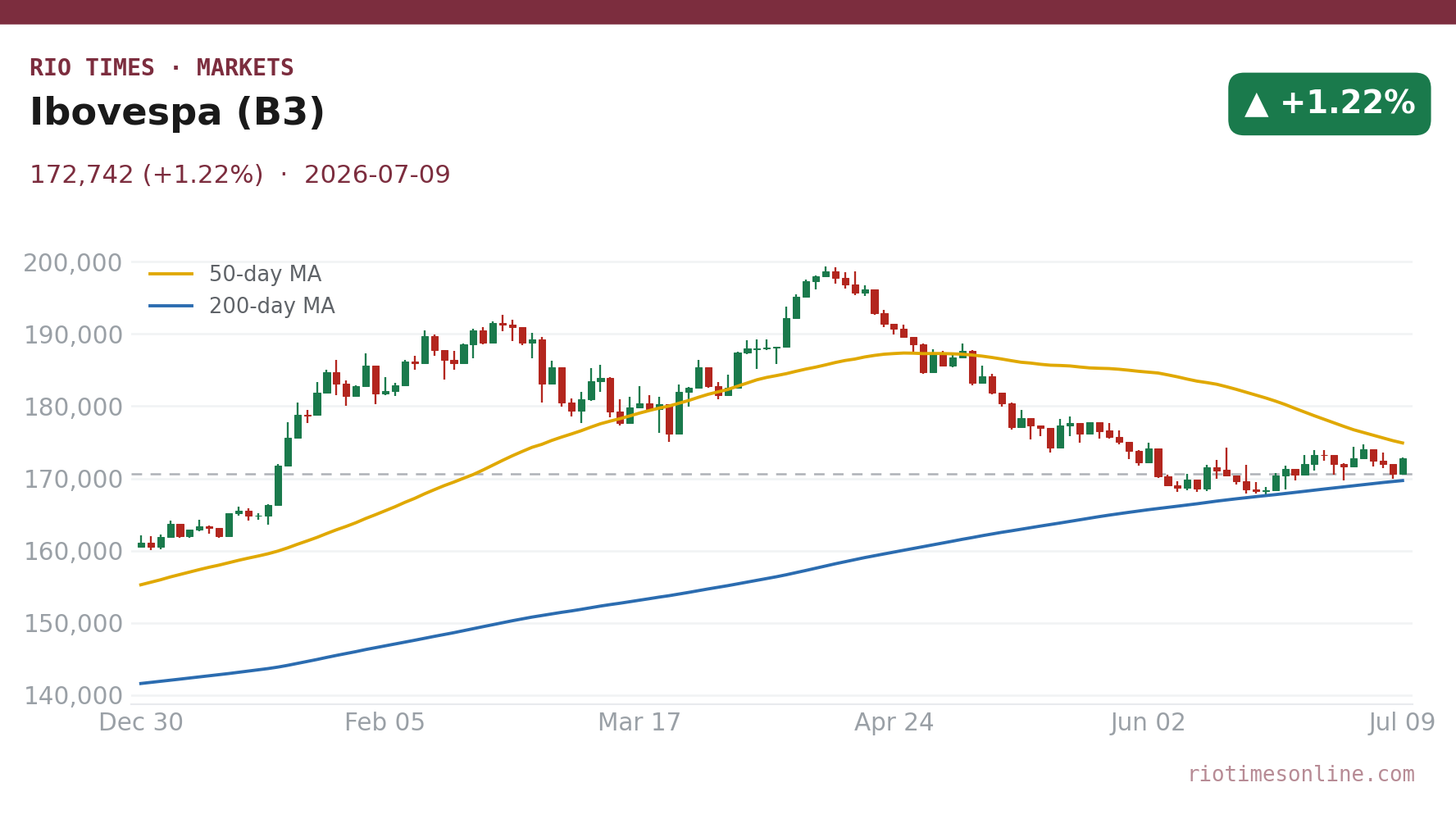
- The board splits at the open, with Ibovespa at 172742 (+1.22%) leading the region while Mexbol lagged at 66107 (−0.75%, −7.7% off its 52-week high).
- The dollar stayed on the back foot regionally, with USD/BRL at 5.1161 (−0.67%), −8.5% below its 52-week high, and USD/COP near 3,372 after a roughly 15% one-year fall.
- Brazil’s IPCA is the region’s swing factor today, with the June inflation rate seen at 0.31% m/m and about 4.8% y/y, a soft print would harden August Selic-cut bets already priced by rate futures.
Today’s Focus
The overnight tape leaves Latin America opening on the front foot, but for two very different reasons — a rebound in US chip names lifts risk broadly, while a cooler oil price splits the commodity complex.
That split matters here: cheaper crude eases the inflation math for importers Mexico and Chile, yet weighs on Brazil, where energy names dominate turnover and the state oil champion sets the tone.
The regional board is not uniform — Brazil’s Ibovespa has been the leader, closing +1.22%, while Mexico’s Mexbol slid −0.75% and sits well off its highs, a reminder that the region trades on local stories as much as the global tape.
The one shared catalyst is timing: Brazil’s June IPCA lands midday, and with rate futures already leaning toward an August cut, the print can move the real, local rates and the whole regional risk mood.
What matters today. Whether Brazil’s IPCA confirms the disinflation momentum that has markets pricing an August Selic cut — the single release that can steer the regional tape today.
01 The overnight tape in one read
Wall Street set the mood, closing higher as memory-chip names rebounded — US stocks closed higher on Thursday, with the S&P 500 rising 0.8%, and renewed strength in chipmakers helped offset uncertainty over the economic outlook.
The catalyst was corporate, not macro — demand for SK Hynix’s US share offering was more than seven times oversubscribed, and Micron and Sandisk gained 5.2% and 7.6% respectively.
Asia mostly followed through overnight, extending a bounce off a jittery start to the week for the region’s tech-heavy indices. The bid had already begun on Wednesday, when South Korea’s Kospi jumped 2.88% after entering bear market territory a day earlier.
The relief extended to energy — oil prices and bond yields eased amid signs of continued tanker traffic through the Strait of Hormuz despite renewed US-Iran hostilities, which is the single most important read-through for Latin America’s commodity currencies today.
The global backdrop is supportive — chips are rebounding, oil is cooling and the dollar is soft against the region’s majors — yet the drivers are not evenly distributed, and Mexico’s underperformance shows the region will not move as one bloc. The variable to watch is Brazil’s midday IPCA: a soft reading validates the August-cut trade and can pull the whole regional board higher, while an upside surprise revives the fiscal-and-carry worry that has shadowed the real all year.
02 The board before the open
| Instrument | Level | Change | Read |
|---|---|---|---|
| S&P 500 | 7544 | +0.81% | Chip rebound; −0.9% off 52-week high |
| WTI crude | ~$72 | − | Rolled over below $73; Hormuz flows held |
| USD/BRL | 5.1161 | −0.67% | Real firm; −8.5% off 52-week high |
| USD/COP | ~3,372 | − | Down ~15% over one year |
| Ibovespa | 172742 | +1.22% | Regional leader; −13.0% off 52w high |
| Mexbol | 66107 | −0.75% | Laggard; −7.7% off 52w high |
The table frames the open as constructive but uneven — the US benchmark sits near record ground while the two big regional indices point in opposite directions.
The currency lines carry the real story: a soft dollar against both the real and the Colombian peso keeps carry trades intact and cushions the local tapes against any wobble in equities.
Crude below $73 is the swing variable — it lightens the import bill for Mexico and Chile while trimming the energy weight that has powered Brazil’s board. Rio Times · Live Market Intelligence
Live Market IntelligenceLatin America — Cross-Market Board
Latin America — Cross-Market Board
Instrument Last Change YoY Prev. High Low Volume
IBOV
209,066.90
+1.38%
+21.85%
206,220.24
168,310
167,142
—
IPSA
11,044.42
+0.18%
—
11,024.22
11,210
10,984
1,513,213,483
IPC MEX
66,048.57
+1.63%
+12.17%
64,986.91
66,121
65,405
108,886,187
MERVAL
2,828,027
-0.16%
+30.51%
3,022,485
3,042,365
2,991,150
—
COLCAP
2,531.15
+0.21%
—
9.04
9.05
9.02
4,133
BVL PERÚ
59,610.00
+2.26%
—
—
—
—
—
USD/BRL
5.16
+0.01%
-5.13%
5.16
5.18
5.14
—
EUR/BRL
5.95
+1.01%
-5.83%
5.89
5.98
5.94
—
USD/MXN
17.06
-0.24%
-8.58%
17.10
17.08
17.01
—
USD/CLP
913.98
+0.04%
-5.67%
913.65
915.11
906.68
—
USD/COP
3,140
+0.03%
-22.04%
3,139
3,141
3,105
—
USD/PEN
3.36
-0.66%
-4.82%
3.38
3.38
3.35
—
USD/ARS
1,493
+0.10%
+12.96%
1,491
1,494
1,480
—
USD/UYU
40.27
+1.24%
+1.80%
39.77
40.27
40.23
—
USD/PYG
5,939
+1.68%
-19.54%
5,841
5,939
5,925
—
USD/BOB
11.64
-0.76%
+72.04%
11.73
11.72
11.64
—
USD/DOP
58.34
+1.25%
-3.44%
57.62
58.34
58.04
—
USD/CRC
445.92
+0.89%
-9.71%
441.97
448.50
445.92
—
03 What the data shows — retail and consumer names led B3 as energy lagged
| Stock | Move | Turnover | Note |
|---|---|---|---|
| MGLU3 | +7.8% | R$133m | Retailer led B3 gainers on rate-cut hopes |
| VAMO3 | +5.3% | R$25m | Fleet-leasing; rate-sensitive |
| SMTO3 | +5.2% | R$24m | Sugar-and-ethanol producer |
| RADL3 | +4.7% | R$211m | Drugstore chain; heavy turnover |
| PETR3 | −1.4% | R$474m | Petrobras ord.; tracked oil lower |
| PRIO3 | −1.4% | R$364m | Oil independent; crude drag |
The B3 tape tells a clean rotation story — rate-sensitive retail and consumer names led as investors leaned into the prospect of a softer Selic, while the oil complex lagged with crude.
Retailer Magazine Luiza and its peers rallied as short-dated yields fell and the local index rose more than one percent on repriced policy expectations.
The money, though, went elsewhere — turnover concentrated in the heavyweights, with VALE3 at R$1386m and PETR4 at R$1306m dwarfing the day’s biggest movers. That divergence — big flows in the miners and oil majors, big moves in the smaller consumer names — is the signature of a rate-driven session rather than a commodity one.
04 Brazil and the currencies
Brazil owns the regional calendar today — the June IPCA lands midday, with the inflation rate seen at 0.31% month-on-month and roughly 4.8% year-on-year, just above the target ceiling.
The context is a central bank already easing but wary — the benchmark sits at 14.25% after three straight quarter-point cuts, still among the highest real yields of any large economy, while twelve-month inflation near 4.6% still sits above the 4.5% ceiling.
The preview data has already tilted the odds — traders now put higher odds on a Selic cut than on a hold at the August meeting, reversing the data-dependent caution the central bank left in place a week earlier.
For the currencies, the real’s firmness rests on that carry — with USD/BRL at 5.1161, a soft IPCA that keeps the easing gradual protects the yield gap, while an upside surprise revives the fiscal worry that shadows an election year.
05 The regional setup
| Index | Country | Change |
|---|---|---|
| Ibovespa | Brazil | +1.22% |
| Mexbol | Mexico | −0.75% |
| IPSA | Chile | — |
| COLCAP | Colombia | — |
| Merval | Argentina | — |
The regional split is the story — Brazil leads on rate-cut optimism while Mexico lags, its index sitting −7.7% below its 52-week high even as the peso holds firm.
Mexico also faces its own data today, with industrial production expected to contract, a soft read that argues against the resilience its currency implies. The chip-led global bid should support the region broadly, but Colombia and Chile trade more on the oil and copper tape than on Wall Street’s memory names.
For Chile and Colombia, cheaper crude is a double-edged sword — it eases imported inflation but can drag Colombian fiscal sentiment given the country’s oil-linked revenues.
06 The technical picture
Positioning matters into the open — the S&P 500 sits just −0.9% off its 52-week high, leaving little cushion if the chip rebound stalls or oil re-accelerates.
Brazil, by contrast, has room — the Ibovespa at 172742 is still −13.0% below its 52-week peak of 198657, so a confirming IPCA could extend the advance without stretching valuations.
The real is the cleaner technical — at 5.1161 and −8.5% off its 52-week high, USD/BRL has trended lower all year on the carry, and a soft print would test support toward the lower end of its 4.8909–5.5901 range.
The risk is a reversal in the two overnight tailwinds — a chip pullback or an oil spike on fresh Hormuz headlines would hit Latin America’s tech-adjacent and importer names first.
07 What to watch
- Brazil IPCA: The midday June print (est ~0.31% m/m, ~4.8% y/y) is the region’s swing factor — a soft read hardens August Selic-cut bets and supports the real.
- Oil and Hormuz: WTI below $73 relieves importers but pressures Petrobras and PRIO; any fresh US-Iran escalation would flip the trade for Brazil’s energy-heavy board.
- Mexico industrial output: An expected contraction tests the peso’s firmness and Mexbol’s already-lagging tape against the regional risk-on mood.
- Chip momentum: The SK Hynix-driven memory rebound is the global tailwind — a stall on Wall Street would cool the risk-on impulse feeding LATAM at the open.
Frequently Asked Questions
Why is Brazil leading the region today?
A memory-chip rebound lifted global risk while softer inflation data pushed local rate-cut bets higher, sending rate-sensitive B3 names like MGLU3 (+7.8%) sharply up.
What does cheaper oil mean for Latin America?
It eases imported inflation for Mexico and Chile but drags Brazil’s energy-heavy index, where PETR3 and PRIO3 fell about 1.4% tracking crude lower.
Why does the IPCA print matter for foreign investors?
It steers the August Selic decision and thus the carry trade — Brazil’s benchmark sits at 14.25%, among the highest real yields of any large economy.
Is the real still strong?
USD/BRL trades at 5.1161, down 0.67% on the day and about 8.5% below its 52-week high, held up by the wide interest-rate gap with the US.
This article was produced by The Rio Times’ automated newsroom system. How we use AI · Report an error · Editorial responsibility: Matthias Camenzind, Editor-in-Chief
LatAm Markets: Live Signals → — real-time movers, turnover leaders and FX across Latin America.