
HEALTH · KENYA
Key Facts
- —The country Kenya, which the US State Department calls a longstanding American ally, was the first African country to negotiate a health pact under Washington’s America First Global Health Strategy.
- —Why it matters The framework funds HIV, tuberculosis and malaria programmes that the Kenyan government says about 1.4 million people rely on.
- —Why now A Court of Appeal ruling reported on Tuesday 13 October lifted High Court orders that had frozen the deal since Friday 19 December 2025.
- —What happened A three-judge Court of Appeal bench set aside the conservatory orders, so the deal can be implemented while the government’s appeal is heard.
- —The numbers The US plans up to US$1.6 billion over five years, and Kenya pledges US$850 million in extra domestic health spending.
- —What it means for US readers US health money can again flow under the first of the bilateral deals Washington calls a model for dozens of countries.
- —Still open The court did not rule on whether the deal is constitutional, including objections over patient data and Parliament’s role.
Kenya’s Court of Appeal has let the Kenya US health deal go ahead, lifting orders that had frozen it since December. The ruling, reported in Nairobi on Tuesday 13 October, revives a five-year plan under which Washington pledged up to US$1.6 billion.
For American readers, the case decides whether the first of Washington’s new government-to-government health pacts can actually be used. A senior State Department adviser called the Kenya agreement a model for deals with dozens of other countries.
Kenyan media value the US share at Sh208 billion (about US$1.6 billion). That conversion uses the Central Bank of Kenya’s official rate of 129.71 shillings to the dollar on 13 October.
What the Court of Appeal Decided
A three-judge bench set aside conservatory orders that the High Court issued on Friday 19 December 2025. Those orders had stopped the government from implementing the framework, signed in the United States on Thursday 4 December 2025.
The application came from the Attorney General and the Cabinet Secretary for Health, who want the High Court ruling overturned on appeal. The judges found that they had raised arguable grounds and that public interest favoured letting the programme run in the meantime.
The court said patients relying on HIV, tuberculosis and malaria treatment risked being “negatively and irredeemably impacted” by a continued freeze. The judges wrote: “Some even risk losing their lives, which is an irreversible consequence.”
The bench also accepted that resources could be redirected elsewhere if the suspension dragged on. “If the applicants succeed on appeal, there will be no Framework to implement which will render the appeal nugatory,” the court stated.
The ruling does not decide whether the framework is lawful under Kenya’s constitution. The judges stressed that “there has not been any declaration of unconstitutionality of the said Framework.”
The government also argued that the High Court heard the application on a day set only for directions, without proper notice. It added that similar issues were already pending in another case, Petition No. E806 of 2025.
Running two cases on the same dispute can breach the sub judice rule, which bars hearing matters pending elsewhere. The Court of Appeal found both procedural points arguable and left them for the full appeal.
What the Framework Covers
The State Department says the United States plans to provide up to US$1.6 billion over five years. The money supports HIV/AIDS, tuberculosis, malaria, maternal and child health, polio eradication, disease surveillance and outbreak response.
Kenya, in turn, pledged to raise its own health spending by US$850 million over the same period. The aim is for Nairobi to take on more of the cost as US support declines during the framework.
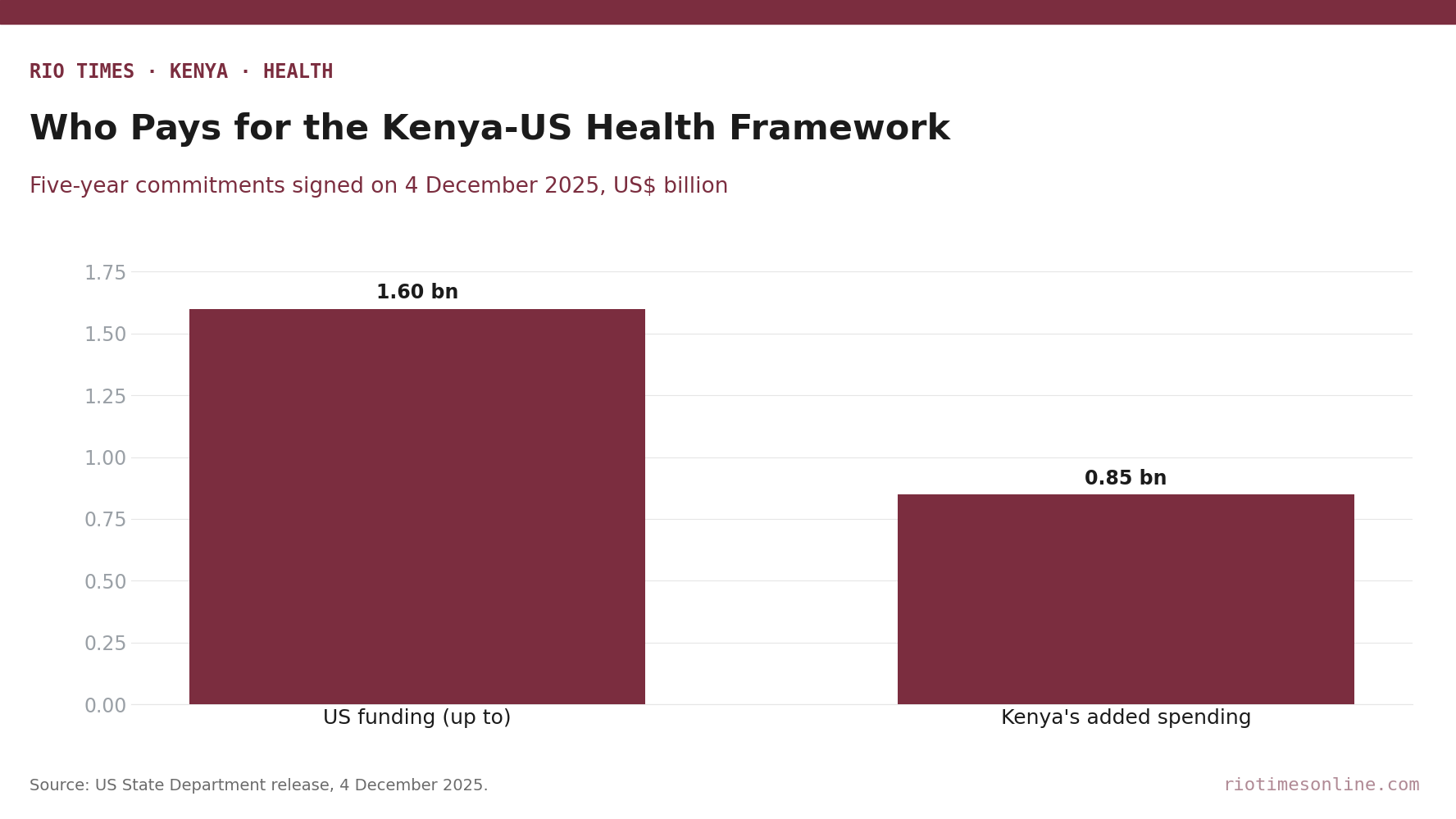
Together the two commitments make up the US$2.5 billion headline figure the State Department used at the signing. President William Ruto said Kenya was already expanding services and funding through the Social Health Authority (SHA), the national health insurer.
The government told the court that about 1.4 million Kenyans receive HIV, tuberculosis, malaria and other treatment under the framework. It warned that interrupted HIV and tuberculosis medication could breed drug resistance, and that immunisation services could also suffer.
Who Challenged the Deal and Why
The main challenger is Okiya Omtatah Okoiti, Busia County senator and a constitutional activist who often sues the government. He argues the deal creates financial commitments and obligations that Parliament should have scrutinised and approved.
Omtatah also questions whether a data protection impact assessment was carried out before the deal was signed. He cites Articles 1, 2, 10, 31, 43, 201 and 220, covering sovereignty, privacy, health and public finance.
Katiba Institute, a Nairobi-based constitutional research and litigation group, also opposed lifting the orders. It argued that constitutional safeguards and parliamentary oversight should not be sacrificed for speed in health delivery.
Critics including the Consumer Federation of Kenya (COFEK) allege the deal could give Washington access to Kenyan health records. Those claims remain untested in court, and the appeal ruling did not settle them.
Omtatah’s petitions often target public spending, as in Omtatah Sues to Halt US$875,000 Tender Payments in Kenya. Appeal judges also backed the state in Kenya Court Upholds 1.5% Housing Levy on Salaries, Foreign Staff Included.
What It Means for US Readers
The framework is the first test of the America First Global Health Strategy, which shifts US health aid to direct government deals. A State Department official said dozens of similar agreements would follow, so Kenya’s courts became an early test.
For US taxpayers, money pledged for HIV, tuberculosis and malaria care in Kenya can again move under the agreed terms. For US health planners, the deal also covers disease surveillance and outbreak response in a major East African travel hub.
Investors following Kenya’s public finances should note the US$850 million co-funding pledge, which must come from Kenya’s own budget. The stabiliser is that the pledge is phased over five years, as US support tapers.
What Is Not Known
It is not clear when the full appeal will be heard. The constitutional petition before the High Court also remains pending, so the deal could still be struck down later.
It is also unclear whether orders in Petition No. E806 of 2025 still restrict any part of the deal. The judges noted that orders appeared to have been issued there, but reports do not say whether they still apply.
The exact data-sharing terms and how patient records will be protected have not been tested in court. How quickly implementation will now proceed has not been announced by either government.
Frequently Asked Questions
Is the Kenya US health deal now in force?
Yes, for now. The Court of Appeal lifted the High Court’s conservatory orders, so the government can implement the framework while its appeal is heard.
Did the court rule that the deal is constitutional?
No. The judges said there had been no declaration of unconstitutionality and left the constitutional questions to the appeal and the High Court petition.
How much money is involved?
The United States plans to provide up to US$1.6 billion over five years, and Kenya pledged to raise its own health spending by US$850 million.
Who challenged the deal?
Busia Senator Okiya Omtatah Okoiti and Katiba Institute opposed the government’s application, raising concerns about data protection, public finance, devolution and Parliament’s oversight.
Why does it matter to Americans?
Kenya was the first African country to sign a health pact under the America First Global Health Strategy, which Washington says will serve as a model for dozens of countries.
Sources: Court of Appeal ruling as reported by The Star, Capital FM, Citizen Digital and Kenyans.co.ke, 13 October 2026; US State Department release on the five-year health cooperation framework, 4 December 2025 (text); Central Bank of Kenya exchange rate, 13 October 2026.
Editorial responsibility: Matthias Camenzind, Editor-in-Chief · Editorial standards · Report an error