Key Facts
- Iron ore benchmark settled near US$99.57 per tonne for 62% Fe delivery into China on Friday, September 4, 2026, essentially flat on the day.
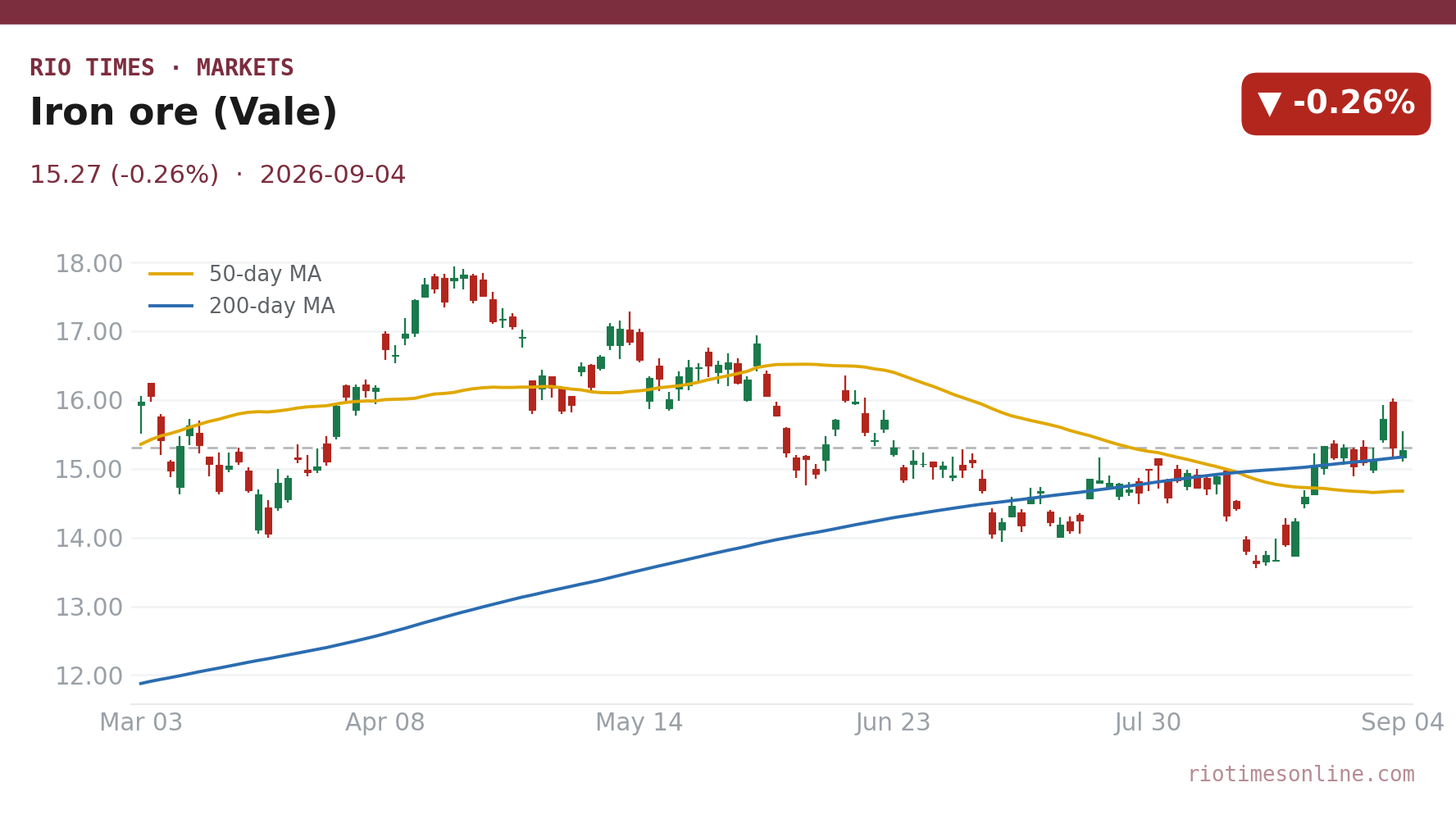
- Vale’s New York shares closed at US$15.27 down 0.26% on the session, underperforming Rio Tinto as investors read China steel jitters negatively for Brazilian export earnings.
- China’s July crude steel output fell 3.6% from a year earlier to 76.93 million metric tons, with cumulative January-to-July production down 3.1% to 577.04 million tons.
- CSN Mineração closed at R$6.59 a decline of -1.05%, matching the weaker tone across Brazilian mining equities on Friday.
- Rio Tinto finished at US$103.27 up 0.42%, the only gainer among the three iron ore proxies tracked by The Rio Times.
- China buys roughly 75% of global seaborne iron ore so the cooling Chinese steel cycle keeps the benchmark pinned below the US$100 round number.
Today’s Focus
Iron ore prices pushed to a nine-week high just under US$100 per tonne on Friday, September 4, 2026, even with Chinese steel output still running below last year’s pace. The 62% Fe benchmark delivered into China settled near US$99.57 per tonne, while the following month futures contract printed about US$99.67 per tonne.
Equity proxies for the ore trade diverged. Vale’s New York shares dropped 0.26% to US$15.27, and CSN Mineração lost -1.05% to R$6.59. Rio Tinto bucked the trend, adding 0.42% to US$103.27.
The underlying problem is China’s steel cycle. July crude steel production slid 3.6% year-on-year to 76.93 million metric tons, while mills restocked iron ore mainly to rebuild inventories, not to feed a construction recovery.
Freight costs and raw-material inputs are providing a cost-driven floor, but downstream demand remains too soft for a decisive break above US$100. The market is balanced between that floor and muted steel demand.
What matters today. China buys three-quarters of seaborne iron ore, so every dip in its steel output caps the benchmark unless restocking turns into genuine construction demand.
01 The session in one read
Iron ore finished Friday, September 4, 2026, at a nine-week high just below US$100 per tonne, after breaking out of the US$95 range it had held through August. The 62% iron ore fines price for delivery into China settled near US$99.57 per tonne, while the nearby futures contract printed about US$99.67 per tonne.
The modest moves hide a cooling Chinese steel market. China’s crude steel output fell 3.6% year-on-year in July to 76.93 million metric tons, and total output for the first seven months of 2026 is down 3.1% at 577.04 million tons.
Investors are treating the US$99-to-US$100 band as a short-term ceiling because Chinese steel demand is cooling rather than rebounding. Brazilian miners underperformed Australian peer Rio Tinto on Friday, suggesting traders see the South American names as more leveraged to a stalled reflation story. The variable to watch is any upward revision in China’s construction steel orders during the traditional September peak season.
02 The board
The three mining proxies showed no single direction on Friday. Vale’s New York shares, the most widely traded iron-ore proxy for foreign investors, closed at US$15.27, down 0.26%. CSN Mineração, the Brazilian pure-play iron ore miner, dropped -1.05% to R$6.59.
Rio Tinto, the Anglo-Australian giant with more diversified revenue, added 0.42% to close at US$103.27.
| Asset | Level | Change |
|---|---|---|
| Vale (iron ore proxy) | US$15.27 | -0.26% |
| CSN Mineração | R$6.59 | -1.05% |
| Rio Tinto | US$103.27 | +0.42% |
Source: RT close, 2026-09-04. Where a commodity has no spot feed, an exchange-traded tracker or leading producer is shown as a labelled proxy.
Live Market IntelligenceThe live market board
Rio Times · Live Market Intelligence
Latin America — Cross-Market Board
| Instrument | Last | Change | YoY | Prev. | High | Low | Volume |
|---|---|---|---|---|---|---|---|
| IBOV | 205,082.56 | +0.47% | +21.85% | 204,120.12 | 168,310 | 167,142 | — |
| IPSA | 10,746.36 | -0.31% | — | 10,780.31 | 11,210 | 10,984 | 1,513,213,483 |
| IPC MEX | 69,678.08 | -0.30% | +12.17% | 69,889.73 | 66,121 | 65,405 | 108,886,187 |
| MERVAL | 3,017,221 | — | +30.51% | 3,022,485 | 3,042,365 | 2,991,150 | — |
| COLCAP | 2,540.10 | +0.46% | — | 9.04 | 9.05 | 9.02 | 4,133 |
| BVL PERÚ | 57,021.19 | +0.13% | — | — | — | — | — |
| USD/BRL | 5.16 | +0.01% | -5.13% | 5.16 | 5.18 | 5.14 | — |
| EUR/BRL | 5.95 | +1.01% | -5.83% | 5.89 | 5.98 | 5.94 | — |
| USD/MXN | 17.06 | -0.24% | -8.58% | 17.10 | 17.08 | 17.01 | — |
| USD/CLP | 913.98 | +0.04% | -5.67% | 913.65 | 915.11 | 906.68 | — |
| USD/COP | 3,140 | +0.03% | -22.04% | 3,139 | 3,141 | 3,105 | — |
| USD/PEN | 3.36 | -0.66% | -4.82% | 3.38 | 3.38 | 3.35 | — |
| USD/ARS | 1,493 | +0.10% | +12.96% | 1,491 | 1,494 | 1,480 | — |
| USD/UYU | 40.27 | +1.24% | +1.80% | 39.77 | 40.27 | 40.23 | — |
| USD/PYG | 5,939 | +1.68% | -19.54% | 5,841 | 5,939 | 5,925 | — |
| USD/BOB | 11.64 | -0.76% | +72.04% | 11.73 | 11.72 | 11.64 | — |
| USD/DOP | 58.34 | +1.25% | -3.44% | 57.62 | 58.34 | 58.04 | — |
| USD/CRC | 445.92 | +0.89% | -9.71% | 441.97 | 448.50 | 445.92 | — |
03 What moved it
The dominant force is China’s steel arithmetic. China buys about 75% of global seaborne iron ore, so its monthly steel production figures effectively set the global benchmark. July’s 3.6% year-on-year decline tells traders that mills are not converting ore into finished steel at last year’s pace.
Yet there is a floor. Chinese mills have been restocking ore, with Dalian iron ore futures closing up 1.04% at 727 yuan per tonne (about US$108), and port-side spot prices firming by about 1 yuan per tonne.
The move continued into the new week. New York and São Paulo were shut on Monday, September 7, for Labour Day and Brazilian Independence Day, but Dalian traded and the front-month contract closed at 734.50 yuan per tonne (about US$109), up 1.03%.
The Singapore benchmark passed US$100 a tonne the same day, its highest since mid-July, and added a further 0.8% to about US$101.10 on Tuesday, September 8. Imported ore prices into China edged up in the week of August 31 to September 4, though mills bought only as needed, with some scheduling maintenance on tight coke supply.
04 The Latin American read
For Brazil, the iron ore market is a macro indicator as much as a commodity story. Vale is the world’s second-largest exporter and the anchor of the B3 exchange, so when its New York shares slip on China steel jitters, Brazilian investors read it as a warning about export earnings and fiscal revenue.
CSN Mineração’s sharper decline on Friday, at -1.05%, reflects its status as a leveraged, single-commodity equity. Rio Tinto’s modest gain shows that diversified miners are less exposed to the day-to-day Chinese steel equation, even though iron ore is their largest profit centre.
05 The names to watch
Vale is the headline name. Its New York listing remains the most liquid vehicle for global investors who want iron ore exposure without trading Dalian futures.
CSN Mineração is the domestic purity play. In reais, it is the cleanest Brazilian listed exposure to seaborne iron ore demand. Rio Tinto, while Australian-listed, still sets the tone for sector valuations and is watched closely by Brazilian fund managers.
06 The outlook
The range is likely to hold in the short term. Cost-driven support from freight and raw materials keeps a floor under prices, while Chinese steel output declines cap the upside near US$100. A genuine construction recovery in China would be needed to break the range.
07 What to watch
- Chinese port stockpiles: Confirmation that mill restocking is replacing cargoes rather than building a demand surge would keep prices pinned below US$100.
- September peak season steel orders: China’s traditional Golden September construction push is the next chance for a demand-led breakout.
- Vale dividend commentary: Any signal from Vale management on cash returns would signal confidence in the ore price holding near current levels.
Frequently Asked Questions
Why is China so important for iron ore?
China buys about 75% of global seaborne iron ore, so its monthly steel output and mill restocking behaviour effectively set the international benchmark.
How can investors track iron ore without a spot feed?
Mining shares act as proxies. Vale’s New York listing, CSN Mineração in São Paulo, and Rio Tinto all move with the ore price, though each has company-specific factors.
Why did Vale fall while Rio Tinto rose on the same day?
Brazilian miners are viewed as more leveraged to a weak Chinese steel cycle, while Rio Tinto’s diversified revenue streams cushioned the impact on Friday, September 4, 2026.
What is the near-term price range for iron ore?
The benchmark has traded between roughly US$93 and US$100 per tonne since June, and Friday’s close near US$99.57 sits at the upper edge of that band.
Market data: RT
This article was produced by The Rio Times’ automated newsroom system. How we use AI · Report an error · Editorial responsibility: Matthias Camenzind, Editor-in-Chief
LatAm Markets: Live Signals → — real-time movers, turnover leaders and FX across Latin America.