Gold Slips, Silver Steadies as Rate Fears Grip Metals
Key Facts
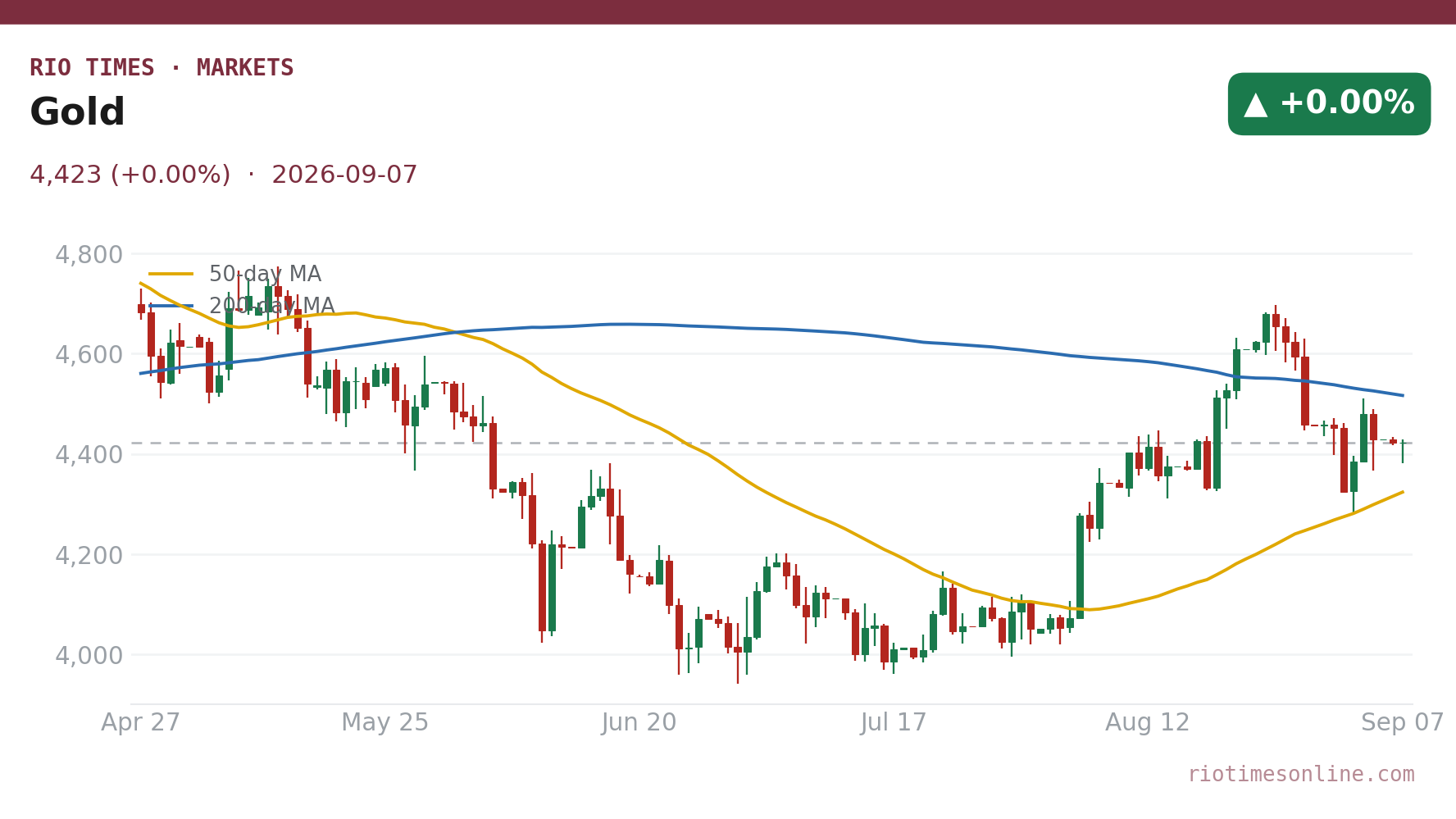
- Gold proxy slipped the gold-tracking price settled at US$4,405 an ounce, down 0.52% on Monday, September 7, 2026.
- Silver proxy eased the silver-tracking price settled at US$66.05 an ounce, down 0.07%, tracking gold’s decline.
- Fed rate bets dominated strong US jobs data pushed real yields up, making interest-bearing assets more attractive than bullion.
- Dollar pressure was visible a firmer US dollar reduced gold’s appeal for non-US investors despite resilient local-currency prices.
- Mexico leads silver output Mexico is the world’s largest silver producer, with about 185 million ounces in 2024, some 70% more than China.
- Peru holds third place Peru produced just over 108 million ounces of silver in 2024, anchoring the region’s supply role.
Today’s Focus
Gold slipped on Monday, September 7, 2026, as rising US real yields and a firmer dollar made the non-yielding metal less attractive. The gold-tracking proxy settled at US$4,405 an ounce, a decline of 0.52%.
Silver moved with gold, the silver-tracking proxy settling at US$66.05 an ounce, down 0.07%. The shallow loss came as investors weighed industrial demand against the same rate pressures hitting gold.
Strong US jobs data lifted expectations of further Federal Reserve tightening, pushing bond returns after inflation above gold’s zero coupon.
For Latin America, the session matters most in Mexico, the top silver producer, and Peru, the third-largest. Both countries depend on silver revenues for mining jobs and fiscal receipts.
What matters today. The direction of US real yields will decide whether gold’s decline extends or silver’s industrial appeal wins out.
01 The session in one read
Gold eased on Monday, September 7, 2026, with the gold-tracking proxy settling at US$4,405 an ounce, down 0.52%. The fall tracked a broader move out of non-yielding assets as US real yields climbed.
Silver held its ground, with the silver-tracking proxy settling at US$66.05 an ounce, down 0.07%. That near-flat close came as investors trimmed exposure to more volatile precious metals.
The session reflected two forces: rate-hike fears pressing on gold, and steady industrial demand cushioning silver. Latin American producers were watching both.
Gold’s decline despite global uncertainty shows that higher real yields are now the dominant force, not fear. Silver’s far smaller loss suggests industrial demand, especially from solar and electronics, is providing a floor. The variable to watch is the next US inflation print, which could either confirm the rate-hike path or revive gold’s appeal.
02 The board
The gold-tracking proxy closed at US$4,405 an ounce, a modest 0.52% retreat. That left the yellow metal nursing a decline driven by a firmer dollar and rising bond returns after inflation.
The silver-tracking proxy ended at US$66.05 an ounce, down 0.07% on the day. Silver’s industrial uses, from solar panels to electronics, helped it resist the drag that hit gold.
| Asset | Level | Change |
|---|---|---|
| Gold | US$4,405/oz | -0.52% |
| Silver | US$66.05/oz | -0.07% |
Source: RT close, 2026-09-07. Where a commodity has no spot feed, an exchange-traded tracker or leading producer is shown as a labelled proxy.
Live Market IntelligenceThe live market board
Rio Times · Live Market Intelligence
Latin America — Cross-Market Board
| Instrument | Last | Change | YoY | Prev. | High | Low | Volume |
|---|---|---|---|---|---|---|---|
| IBOV | 185,147.15 | -0.02% | +21.85% | 185,188.13 | 168,310 | 167,142 | — |
| IPSA | 11,315.26 | -1.14% | — | 11,445.90 | 11,210 | 10,984 | 1,513,213,483 |
| IPC MEX | 64,639.55 | -0.35% | +12.17% | 64,866.61 | 66,121 | 65,405 | 108,886,187 |
| MERVAL | 3,034,599 | -0.48% | +30.51% | 3,022,485 | 3,042,365 | 2,991,150 | — |
| COLCAP | 2,565.50 | +0.82% | — | 9.04 | 9.05 | 9.02 | 4,133 |
| BVL PERÚ | 59,789.81 | -0.28% | — | — | — | — | — |
| USD/BRL | 5.16 | +0.01% | -5.13% | 5.16 | 5.18 | 5.14 | — |
| EUR/BRL | 5.95 | +1.01% | -5.83% | 5.89 | 5.98 | 5.94 | — |
| USD/MXN | 17.06 | -0.24% | -8.58% | 17.10 | 17.08 | 17.01 | — |
| USD/CLP | 913.98 | +0.04% | -5.67% | 913.65 | 915.11 | 906.68 | — |
| USD/COP | 3,140 | +0.03% | -22.04% | 3,139 | 3,141 | 3,105 | — |
| USD/PEN | 3.36 | -0.66% | -4.82% | 3.38 | 3.38 | 3.35 | — |
| USD/ARS | 1,493 | +0.10% | +12.96% | 1,491 | 1,494 | 1,480 | — |
| USD/UYU | 40.27 | +1.24% | +1.80% | 39.77 | 40.27 | 40.23 | — |
| USD/PYG | 5,939 | +1.68% | -19.54% | 5,841 | 5,939 | 5,925 | — |
| USD/BOB | 11.64 | -0.76% | +72.04% | 11.73 | 11.72 | 11.64 | — |
| USD/DOP | 58.34 | +1.25% | -3.44% | 57.62 | 58.34 | 58.04 | — |
| USD/CRC | 445.92 | +0.89% | -9.71% | 441.97 | 448.50 | 445.92 | — |
03 What moved it
Strong US jobs data boosted bets on further Federal Reserve rate hikes, lifting real yields. Gold pays no coupon, so higher returns on government debt made bullion look less attractive.
That currency pressure was a key driver behind gold’s slip.
Silver’s shallow loss came as traders weighed its dual role. While rate fears hit the precious-metals complex, silver’s industrial demand provided support that gold lacks.
04 The Latin American read
Mexico, the world’s largest silver producer, mined about 185 million ounces in 2024, some 70% more than China. A resilient silver price cushions fiscal receipts and mining employment.
Peru, the third-largest producer, generated just over 108 million ounces in 2024. The country’s mines depend heavily on silver revenues to fund operations and regional jobs.
For both nations, Monday’s divergence matters. Silver’s resilience offers some relief, while gold’s decline signals tighter global liquidity that could eventually pressure mining investment.
05 The names to watch
Investors tracking this trade should watch the gold-tracking proxy for signs of further weakness if real yields keep rising. A break below recent levels could accelerate selling.
On the silver side, the silver-tracking proxy’s 0.07% dip suggests industrial buyers are still stepping in. Mexico’s mining-heavy economy and Peru’s producers stand to benefit if that holds.
The next US inflation read will be crucial. A hot print would strengthen the case for higher rates, hitting gold harder, while silver’s industrial demand may cushion the blow.
06 The outlook
Gold faces a tough path while real yields climb and the dollar stays firm. Silver may hold up better, supported by industrial consumption that does not depend on rate expectations.
For Latin America, the key is whether silver’s resilience translates into sustained revenue. Mexico and Peru both need stable prices to keep output and employment on track.
07 What to watch
- US real yields: Further rises would keep gold under pressure and could eventually drag silver lower.
- Dollar index: A stronger dollar raises local hedging costs for LatAm miners and dampens metal prices.
- Mexico silver output: Any disruption at top mines would tighten supply and support silver prices globally.
- Peru mining policy: Regulatory shifts could affect production and alter the regional supply outlook.
Frequently Asked Questions
Why did gold fall on Monday?
Strong US jobs data lifted real yields and the dollar, making non-yielding gold less attractive, with the proxy settling at US$4,405 an ounce, down 0.52%.
Why did silver hold up better than gold?
Silver has industrial demand from solar and electronics, which limited its loss to 0.07% at US$66.05 an ounce despite rate-hike pressure.
Which Latin American countries matter most for silver?
Mexico is the world’s top producer with about 185 million ounces in 2024, and Peru is third with just over 108 million ounces.
What should investors watch next?
The next US inflation report will signal whether real yields keep rising, which would pressure gold and possibly test silver’s industrial support.
Market data: RT
This article was produced by The Rio Times’ automated newsroom system. How we use AI · Report an error
LatAm Markets: Live Signals → — real-time movers, turnover leaders and FX across Latin America.
Read More from The Rio Times