Iron Ore Wrap: Vale Rises as Rio Tinto Jumps 2.52%
Key Facts
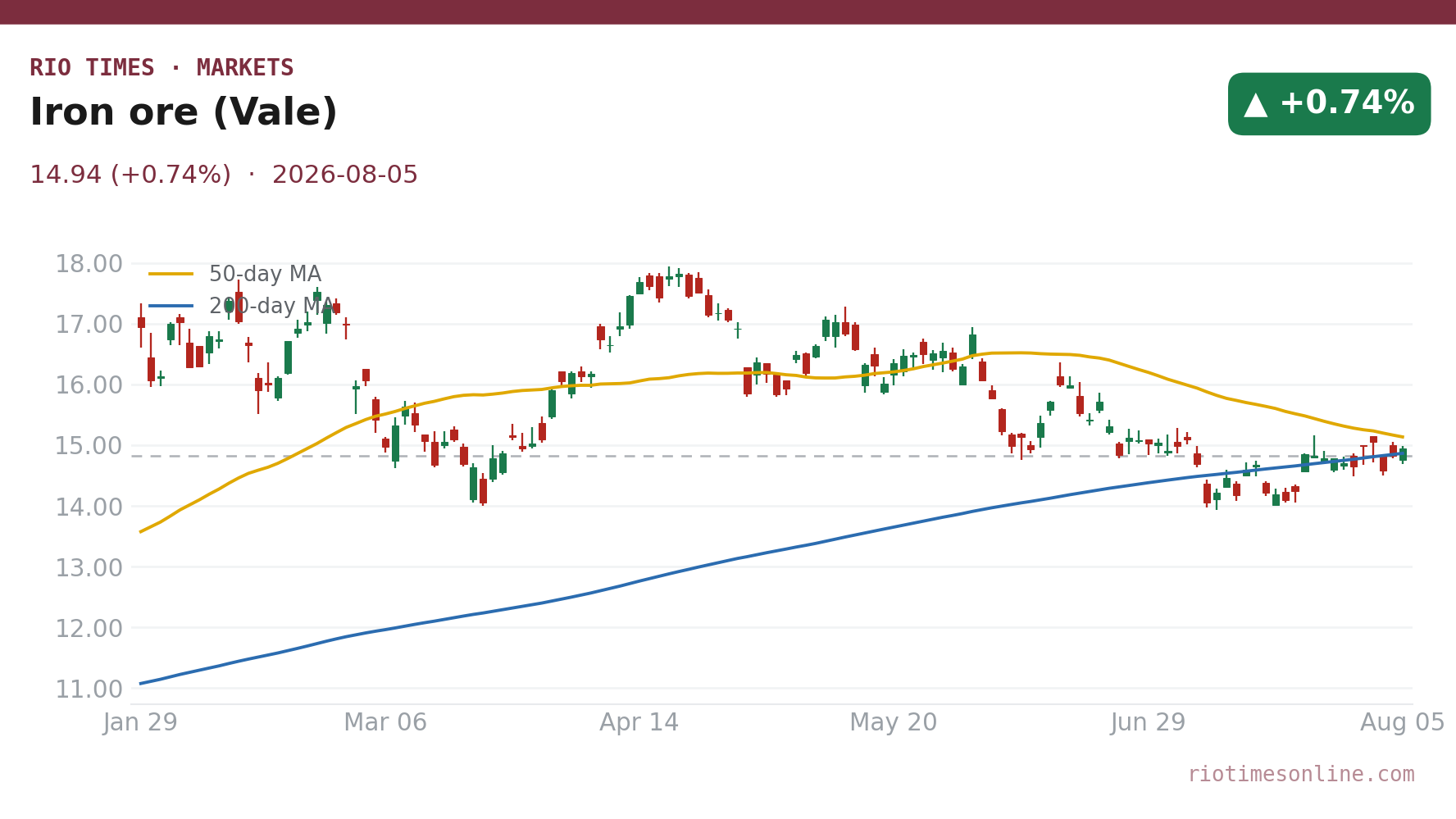
- Vale’s New York-listed shares closed at US$14.94, a gain of 0.74% on the session, acting as a direct proxy for seaborne iron ore sentiment.
- Global mining giant Rio Tinto surged 2.52% to settle at US$101.51, outperforming the broader materials complex and signalling robust institutional demand for the sector.
- Brazil’s CSN Mineração edged down 0.17% to R$5.90, bucking the upward trend in a minor rotation that left the domestic steel-linked miner slightly weaker on the B3 exchange.
- China’s steel-intensive construction cycle remains the single largest demand driver, though no verified tonnage figures were released for the Wednesday session to quantify the intake.
- Foreign investors have poured R$36.7 billion into Brazilian stocks year-to-date, with overseas flows turning decisively positive in July, directly lifting Vale’s liquidity.
- A softer US dollar index, quoted below the 100 handle at 99.68, provided a supportive macro tailwind for dollar-priced commodities and their producer equities globally.
Today’s Focus
Iron ore proxies rallied decisively on Wednesday, August 5, 2026, with Rio Tinto leading the charge. The Anglo-Australian miner’s New York-listed shares jumped 2.52% to settle at US$101.51, reflecting a powerful wave of buying in globally exposed materials stocks.
Vale’s own New York shares moved in lockstep, advancing 0.74% to end the session at US$14.94. The Brazilian export champion, which ships vast tonnages of high-grade ore to China’s steel mills, served as a liquid proxy for investors unable to access direct seaborne price benchmarks.
Domestically, CSN Mineração slipped a marginal 0.17% to R$5.90 on the B3 exchange. The slight divergence from the positive international trend underscored a quiet session for local steelmaking-linked equities, even as the macro backdrop turned friendlier for commodities.
The push higher was fuelled by a confluence of a weaker dollar and renewed confidence in cyclical assets. A sustained appetite from foreign investors for Brazilian mining names reinforced the move, with the Ibovespa recently hitting 177,999 points in late July amid a rally that saw miners lead the gains.
What matters today. The 2.52% surge in Rio Tinto shows that global capital is rotating into the iron ore complex, betting on sustained Chinese steel intensity despite the absence of fresh spot price quotes.
01 The session in one read
A broad rally swept through the world’s largest publicly traded iron ore miners on Wednesday, August 5, 2026, lifting Vale’s New York shares by 0.74% to US$14.94. The move was dwarfed by Rio Tinto, whose stock rocketed 2.52% to settle at US$101.51, making it the standout performer among global mining proxies.
The gains reflected a clear bet on sustained demand for raw materials, even without a fresh iron ore benchmark price to point to. Investors instead channelled conviction through the equities of the companies that dig, ship, and sell the steelmaking ingredient to China, the world’s largest consumer.
The sharp upward move in the two largest seaborne iron ore exporters — Rio Tinto and Vale — suggests that institutional investors are pricing in resilient steel demand from China. A softer dollar and the heavy foreign inflow into Brazilian equities provide a constructive backdrop, but the session lacked a concrete catalyst such as a new Chinese stimulus package or a supply disruption in the Pilbara or Carajás. The divergence of CSN Mineração, which closed slightly lower, indicates that the rally was driven by global rather than local factors. The variable to watch is whether the US dollar sustains its break below the 100 threshold on the DXY, as any reversal in the greenback could quickly unwind the commodity bid.
02 The board
The three proxy instruments tracked by The Rio Times painted a mostly green picture. Vale’s US-traded American depositary receipts closed at US$14.94, securing a 0.74% daily advance that reinforced the stock’s role as a liquid bellwether for seaborne ore sentiment.
Rio Tinto’s New York shares surged to US$101.51, a rise of 2.52% that outpaced the broader commodity complex. In contrast, CSN Mineração bucked the trend on the Brazilian exchange, edging down 0.17% to R$5.90 in a session where local steel-equity dynamics diverged from the global mining trade.
| Asset | Level | Change |
|---|---|---|
| Iron ore (Vale) | US$14.94 | +0.74% |
| CSN Mineração | R$5.9 | -0.17% |
| Rio Tinto | US$101.51 | +2.52% |
Source: RT close, 2026-08-05. Where a commodity has no spot feed, an exchange-traded tracker or leading producer is shown as a labelled proxy.
Live Market IntelligenceThe live market board
Rio Times · Live Market Intelligence
Latin America — Cross-Market Board
| Instrument | Last | Change | YoY | Prev. | High | Low | Volume |
|---|---|---|---|---|---|---|---|
| IBOV | 183,476.86 | -0.27% | +21.85% | 183,965.91 | 168,310 | 167,142 | — |
| IPSA | 11,255.90 | -0.39% | — | 11,299.82 | 11,210 | 10,984 | 1,513,213,483 |
| IPC MEX | 64,651.92 | +0.60% | +12.17% | 64,264.16 | 66,121 | 65,405 | 108,886,187 |
| MERVAL | 2,893,751 | -1.57% | +30.51% | 3,022,485 | 3,042,365 | 2,991,150 | — |
| COLCAP | 2,584.72 | -0.95% | — | 9.04 | 9.05 | 9.02 | 4,133 |
| BVL PERÚ | 59,934.37 | +1.27% | — | — | — | — | — |
| USD/BRL | 5.16 | +0.01% | -5.13% | 5.16 | 5.18 | 5.14 | — |
| EUR/BRL | 5.95 | +1.01% | -5.83% | 5.89 | 5.98 | 5.94 | — |
| USD/MXN | 17.06 | -0.24% | -8.58% | 17.10 | 17.08 | 17.01 | — |
| USD/CLP | 913.98 | +0.04% | -5.67% | 913.65 | 915.11 | 906.68 | — |
| USD/COP | 3,140 | +0.03% | -22.04% | 3,139 | 3,141 | 3,105 | — |
| USD/PEN | 3.36 | -0.66% | -4.82% | 3.38 | 3.38 | 3.35 | — |
| USD/ARS | 1,493 | +0.10% | +12.96% | 1,491 | 1,494 | 1,480 | — |
| USD/UYU | 40.27 | +1.24% | +1.80% | 39.77 | 40.27 | 40.23 | — |
| USD/PYG | 5,939 | +1.68% | -19.54% | 5,841 | 5,939 | 5,925 | — |
| USD/BOB | 11.64 | -0.76% | +72.04% | 11.73 | 11.72 | 11.64 | — |
| USD/DOP | 58.34 | +1.25% | -3.44% | 57.62 | 58.34 | 58.04 | — |
| USD/CRC | 445.92 | +0.89% | -9.71% | 441.97 | 448.50 | 445.92 | — |
Live Company IntelligenceVale SA ADR — the full investor dossier
Wall Street view
Valuation & profitability
Price & risk
$9.8852-wk high
$17.44
Revenue trend · 6y
Ownership
Dividend
03 What moved it
A softer US dollar acted as the primary accelerant. The Dollar Index (DXY) slipped to 99.68, a decline of 0.94%, making dollar-denominated commodities cheaper for holders of other currencies and boosting the earnings outlook for global exporters like Vale and Rio Tinto.
The macro risk backdrop also contributed, with the S&P 500 rising 0.81% to 7,543.64 and European indices such as the DAX adding 0.60% to 25,612.03. This general risk-on mood encouraged a rotation into cyclical sectors, lifting mining shares, which had already been supported by strong recent foreign inflows into Brazilian equities.
04 The Latin American read
For Latin America, Vale’s 0.74% advance is a direct pulse-check on the health of Brazil’s largest export industry. The company, the world’s second-biggest iron ore exporter, generates the vast majority of its revenue from seaborne sales to China, making its share price a real-time gauge of the region’s commodity-linked economic fortunes.
The broader Brazilian market has been buoyed by a decisive return of foreign capital. Overseas investors bought a net R$4.2 billion in Brazilian stocks in the first three weeks of July alone, pulling year-to-date inflows to R$36.7 billion, a wall of money that has consistently lifted large-cap miners like Vale and validated the bullish thesis for the country’s raw-material champions.
05 The names to watch
Vale remains the primary name for any investor seeking exposure to high-grade iron ore and the China steel cycle. The company’s extensive logistics network in the Carajás region and its portfolio of pelletising operations make it uniquely leveraged to any uptick in Chinese blast-furnace utilisation rates.
Rio Tinto’s 2.52% jump highlights how Australian-linked production, centred on the Pilbara, serves as a faster-moving proxy for marginal shifts in seaborne supply. CSN Mineração, while slightly negative on the session at R$5.90, provides a domestic alternative for investors wanting exposure to Brazil’s own steelmaking and mining integration without the pure-play scale of Vale.
06 The outlook
The immediate trajectory for the iron ore proxies hinges on whether the dollar’s decline below the DXY 100 level proves durable. A sustained lower greenback would underwrite further gains for Vale and Rio Tinto by supporting the purchasing power of Chinese steel mills and other major commodity importers. Any fresh data point from Beijing on infrastructure spending or property-sector activity will be the catalyst that either cements or cracks this week’s constructive price action.
07 What to watch
- US Dollar Index (DXY): Monitor whether DXY holds below the 99.68 level; a rebound would pressure dollar-priced iron ore and erase the valuation tailwind that lifted Vale and Rio Tinto on Wednesday.
- Chinese steel demand signals: Any announcement from Beijing regarding infrastructure quotas or property-market support will move the mining proxies instantly, given China’s dominance as the world’s steel producer.
- Vale New York volumes: Watch for an uptick in Vale’s US trading volumes as a sign that global funds are increasing their exposure; Wednesday’s 0.74% rise was modest, but a break above US$15 could draw momentum traders.
- Foreign flow data into B3: The R$36.7 billion net inflow year-to-date is a powerful prop for Vale’s domestic shares; any reversal in the next B3 flow report would warn of a broader risk-off shift in Latin America.
Frequently Asked Questions
Why doesn’t The Rio Times quote a spot iron-ore price?
Real-time iron-ore benchmarks are proprietary feeds not carried on our public boards. We use Vale, Rio Tinto and CSN Mineração shares as liquid, transparent proxies that track the underlying commodity.
What does Vale’s US$14.94 close mean for the iron-ore price?
A 0.74% daily gain in Vale’s New York shares suggests that market participants believe seaborne iron-ore prices moved higher during the Wednesday session, driven by a weaker dollar and steady China demand.
Why did Rio Tinto jump 2.52% while Vale rose only 0.74%?
Rio Tinto often exhibits higher beta to global cyclical shifts because of its pure-play exposure to Pilbara ore and heavy liquidity in New York. Wednesday’s outsized move likely reflected concentrated institutional buying in the larger, more globally diversified miner.
How are Latin American investors affected by the moves?
Brazil’s Ibovespa is heavily weighted towards Vale and other commodity exporters. A sustained rally in iron-ore proxies boosts the wider index and has already attracted R$36.7 billion in foreign equity inflows this year, supporting the real and local asset prices.
This article was produced by The Rio Times’ automated newsroom system. How we use AI · Report an error
LatAm Markets: Live Signals → — real-time movers, turnover leaders and FX across Latin America.
Read More from The Rio Times