Iron Ore Wrap: Vale Falls Despite Firmer China Steel Data
Key Facts
- Global iron ore benchmark rose to US$95.17 per metric ton on Friday, a daily gain of 0.13%.
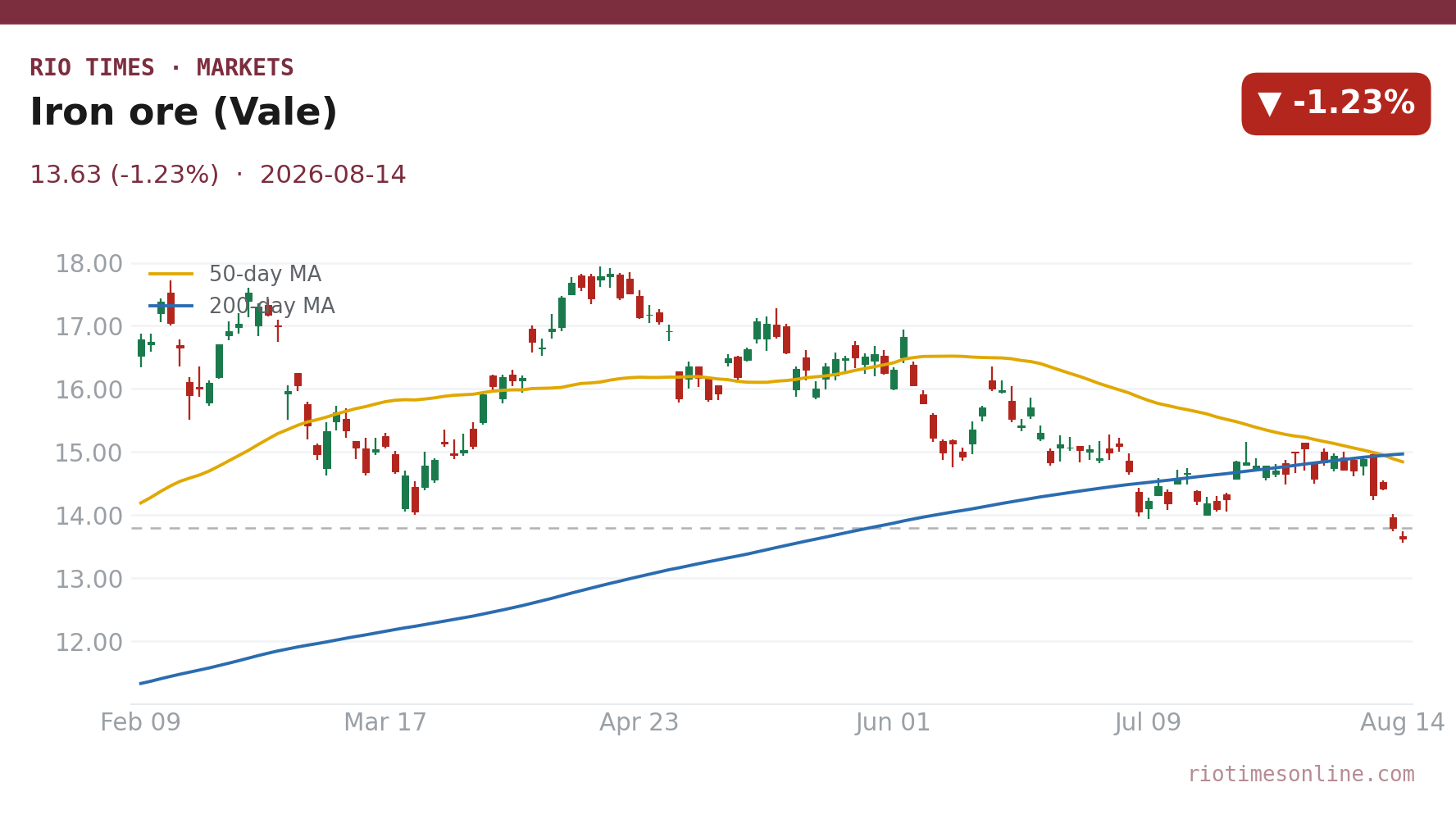
- Vale’s New York shares slipped by 1.23% to US$13.63, underperforming the modestly firmer commodity.
- Rio Tinto ADR closed at US$95.68, down 2.57% on Friday, August 14, 2026.
- CSN Mineração bucked the trend rising 0.91% to R$5.54 on Brazil’s B3 exchange.
- Dalian iron ore futures settled up 0.42% at RMB 710.5 per metric ton on Friday.
- Chinese June imports hit a six-month high at 112.69 million tonnes, up 6.4% year-on-year.
Today’s Focus
Iron ore’s global benchmark firmed 0.13% to US$95.17 per metric ton on Friday, August 14, 2026, but the equity proxies told a different story. Vale’s New York shares fell 1.23% to US$13.63, extending the prior day’s 4.30% drop, while Rio Tinto slumped 2.57% to US$95.68.
The commodity’s resilience came from China, where the most-active Dalian futures contract rose 0.42% to RMB 710.5 per ton and Qingdao spot prices gained RMB 5-9. Underpinning that firmness: June Chinese crude steel output rose 0.4% year-on-year to 83.67 million tonnes, and iron ore imports jumped 6.4% to 112.69 million tonnes, the highest monthly level in six months.
But the medium-term structure is heavy. Analysts estimate a 2026 seaborne surplus of 30-75 million tonnes, driven by rising supply from Australia, Brazil and Africa against Chinese demand that is drifting lower from its 2020-2021 peak. A base-case range of US$95-115 per ton for 62% fines keeps upside capped.
For Latin American investors, the signal is clear: short-term Chinese restocking is supporting the spot benchmark, but miners’ shares are already pricing in the structural surplus. Vale remains the world’s second-largest iron ore exporter and a key barometer for regional capital flows.
What matters today. Chinese short-term demand is firming the commodity, but equity investors are already discounting next year’s surplus; watch whether Vale’s discount to the spot benchmark widens further.

01 The session in one read
The global iron ore benchmark was quoted at US$95.17 per metric ton on Friday, August 14, 2026, a marginal 0.13% gain from the prior session’s US$95.05 level. That modest firmness contrasted with sharp declines among the mining equities that investors use as liquid proxies for the commodity.
Vale’s New York shares dropped 1.23% to US$13.63, following a 4.30% slide on Thursday. Rio Tinto’s screen price fell 2.57%, but that is a dividend artefact to US$95.68, while Brazil-listed CSN Mineração was the lone gainer, rising 0.91% to R$5.54.
The divergence between the modestly firmer iron ore benchmark and falling producer shares is the session’s most important signal. Vale’s 1.23% drop to US$13.63 and Rio Tinto’s 2.57% tumble to US$95.68 suggest equity markets are focused on the medium-term supply glut, not Friday’s marginal Chinese demand support. With analysts projecting a 30-75 million tonne seaborne surplus in 2026 and Chinese steel output drifting lower, investors are treating any spot-firmness as an opportunity to reduce miner exposure. The variable to watch is whether Dalian futures can hold above RMB 700 per ton into September, as a break below that level would likely accelerate the equity sell-off.
02 The board
The price board reflects that unusual split: the underlying commodity grinding higher while the companies that produce it sold off. Vale’s US$13.63 New York close marked a continued retreat from the US$14.42 level recorded on August 12.
Rio Tinto’s US$95.68 close reflects Friday’s ex-dividend date rather than a market move. Adjusted for the payout, Rio Tinto was the mildest decliner of the three proxies, not the steepest. Vale went ex-dividend on Thursday, so its 4.30 per cent screen move that day was 2.08 per cent on an adjusted basis. CSN Mineração’s rise to R$5.54 was the outlier, perhaps reflecting domestic Brazilian positioning tied to the company’s local cash generation rather than the seaborne benchmark.
| Asset | Level | Change |
|---|---|---|
| Iron ore (Vale) | US$13.63 | -1.23% |
| CSN Mineração | R$5.54 | +0.91% |
| Rio Tinto | US$95.68 | -2.57% |
Source: RT close, 2026-08-14. Where a commodity has no spot feed, an exchange-traded tracker or leading producer is shown as a labelled proxy.
Live Market IntelligenceThe live market board
Rio Times · Live Market Intelligence
Latin America — Cross-Market Board
| Instrument | Last | Change | YoY | Prev. | High | Low | Volume |
|---|---|---|---|---|---|---|---|
| IBOV | 182,991.13 | -0.26% | +21.85% | 183,476.86 | 168,310 | 167,142 | — |
| IPSA | 11,137.59 | -1.06% | — | 11,256.80 | 11,210 | 10,984 | 1,513,213,483 |
| IPC MEX | 64,944.41 | -0.07% | +12.17% | 64,992.23 | 66,121 | 65,405 | 108,886,187 |
| MERVAL | 2,798,925 | +0.00% | +30.51% | 3,022,485 | 3,042,365 | 2,991,150 | — |
| COLCAP | 2,579.33 | -0.21% | — | 9.04 | 9.05 | 9.02 | 4,133 |
| BVL PERÚ | 60,698.35 | -0.79% | — | — | — | — | — |
| USD/BRL | 5.16 | +0.01% | -5.13% | 5.16 | 5.18 | 5.14 | — |
| EUR/BRL | 5.95 | +1.01% | -5.83% | 5.89 | 5.98 | 5.94 | — |
| USD/MXN | 17.06 | -0.24% | -8.58% | 17.10 | 17.08 | 17.01 | — |
| USD/CLP | 913.98 | +0.04% | -5.67% | 913.65 | 915.11 | 906.68 | — |
| USD/COP | 3,140 | +0.03% | -22.04% | 3,139 | 3,141 | 3,105 | — |
| USD/PEN | 3.36 | -0.66% | -4.82% | 3.38 | 3.38 | 3.35 | — |
| USD/ARS | 1,493 | +0.10% | +12.96% | 1,491 | 1,494 | 1,480 | — |
| USD/UYU | 40.27 | +1.24% | +1.80% | 39.77 | 40.27 | 40.23 | — |
| USD/PYG | 5,939 | +1.68% | -19.54% | 5,841 | 5,939 | 5,925 | — |
| USD/BOB | 11.64 | -0.76% | +72.04% | 11.73 | 11.72 | 11.64 | — |
| USD/DOP | 58.34 | +1.25% | -3.44% | 57.62 | 58.34 | 58.04 | — |
| USD/CRC | 445.92 | +0.89% | -9.71% | 441.97 | 448.50 | 445.92 | — |
Live Company IntelligenceVale SA ADR — the full investor dossier
Wall Street view
Valuation & profitability
Price & risk
$9.8852-wk high
$17.44
Revenue trend · 6y
Ownership
Dividend
03 What moved it
Friday’s spot firmness was anchored by China. The most-active Dalian Commodity Exchange contract, I2701, settled up 0.42% at RMB 710.5 per metric ton, and spot offers at Qingdao port rose RMB 5-9 on the day.
The short-term demand backdrop is cooling: China produced 83.67 million tonnes of crude steel in June, a 0.4% year-on-year rise, and imported 112.69 million tonnes of iron ore that month, up 6.4% and the strongest monthly figure in six months. First-half 2026 imports totalled 628.87 million tonnes, up 6.3% from a year earlier, showing mills restocking despite softer domestic steel demand.
04 The Latin American read
For Brazil, the iron ore complex remains the single most important commodity export, and Vale is the world’s second-largest exporter of the material. Friday’s equity decline in New York is a direct read on how global investors are treating Brazilian mining exposure: with caution, even when the spot benchmark ticks up.
CSN Mineração’s gain to R$5.54 on the same day, however, shows domestic investors were willing to look past Vale-led caution. That divergence between local and foreign positioning is a recurring feature when global commodity sentiment is uncertain.
05 The names to watch
Vale remains the central proxy: its New York shares at US$13.63 are well off the mid-July level of US$14.59, a decline that mirrors the commodity’s drift from its June average near US$103.79 per ton.
Rio Tinto’s US$95.68 close ties it closely to the Australian-pilbara supply story, where rising output feeds directly into the expected 2026 surplus. CSN Mineração at R$5.54 offers the purest Brazil-listed exposure to iron ore prices, with less diversification than Vale.
06 The outlook
The central tension is between improving Chinese spot demand and a medium-term supply cushion that is getting thicker. Analysts project a seaborne surplus of 30-75 million tonnes in 2026, with rising output from Australia, Brazil and Africa colliding with Chinese steel production expected to shrink to roughly 960-980 million tonnes, down 3-5% from 2025.
Against that backdrop, the 62% fines benchmark seems trapped in a US$95-115 per ton base-case band, with a bear-case floor around US$85. Friday’s action suggests equities are already pricing toward the lower end of that range, even as spot markets hold firm.
07 What to watch
- Dalian I2701 futures: Watch whether the contract holds above RMB 700 per ton; a break below would likely accelerate the equity sell-off.
- Vale ADR volume: Friday’s decline came on broad market weakness; watch whether buyers emerge at US$13.50 or if the slide extends toward US$13.
- Qingdao port spot prices: RMB 5-9 gains on Friday are modest; sustained daily increases would signal genuine restocking, not just short-covering.
- Rio Tinto’s premium to Vale: The 2.57% drop to US$95.68 versus Vale’s 1.23% fall suggests investors are penalising Australian supply growth expectations; watch for convergence.
Frequently Asked Questions
Why did Vale’s shares fall when iron ore rose?
Vale’s New York shares fell 1.23% to US$13.63 on Friday, August 14, even as the global iron ore benchmark firmed 0.13% to US$95.17 per ton, because equity investors are focused on the projected 2026 seaborne surplus rather than short-term Chinese restocking.
What is the global iron ore benchmark price?
The 62% Fe international benchmark was quoted at US$95.17 per metric ton on August 14, 2026, a 0.13% daily increase from US$95.05 the prior session.
How much iron ore is China importing?
China imported 112.69 million tonnes in June 2026, a six-month high and 6.4% higher year-on-year. First-half imports reached 628.87 million tonnes, up 6.3%.
What is the medium-term outlook for iron ore?
Analysts project a 2026 seaborne surplus of 30-75 million tonnes, with prices seen in a US$95-115 per ton base-case range and downside risk to US$85-100.
This article was produced by The Rio Times’ automated newsroom system. How we use AI · Report an error
LatAm Markets: Live Signals → — real-time movers, turnover leaders and FX across Latin America.
Read More from The Rio Times