Iron Ore Wrap: Vale Rises While China Steel Falters
Key Facts
- Iron ore steadied near US$95 a tonne as the benchmark price slipped just 0.01% to US$95.16 on Thursday, August 20, 2026.
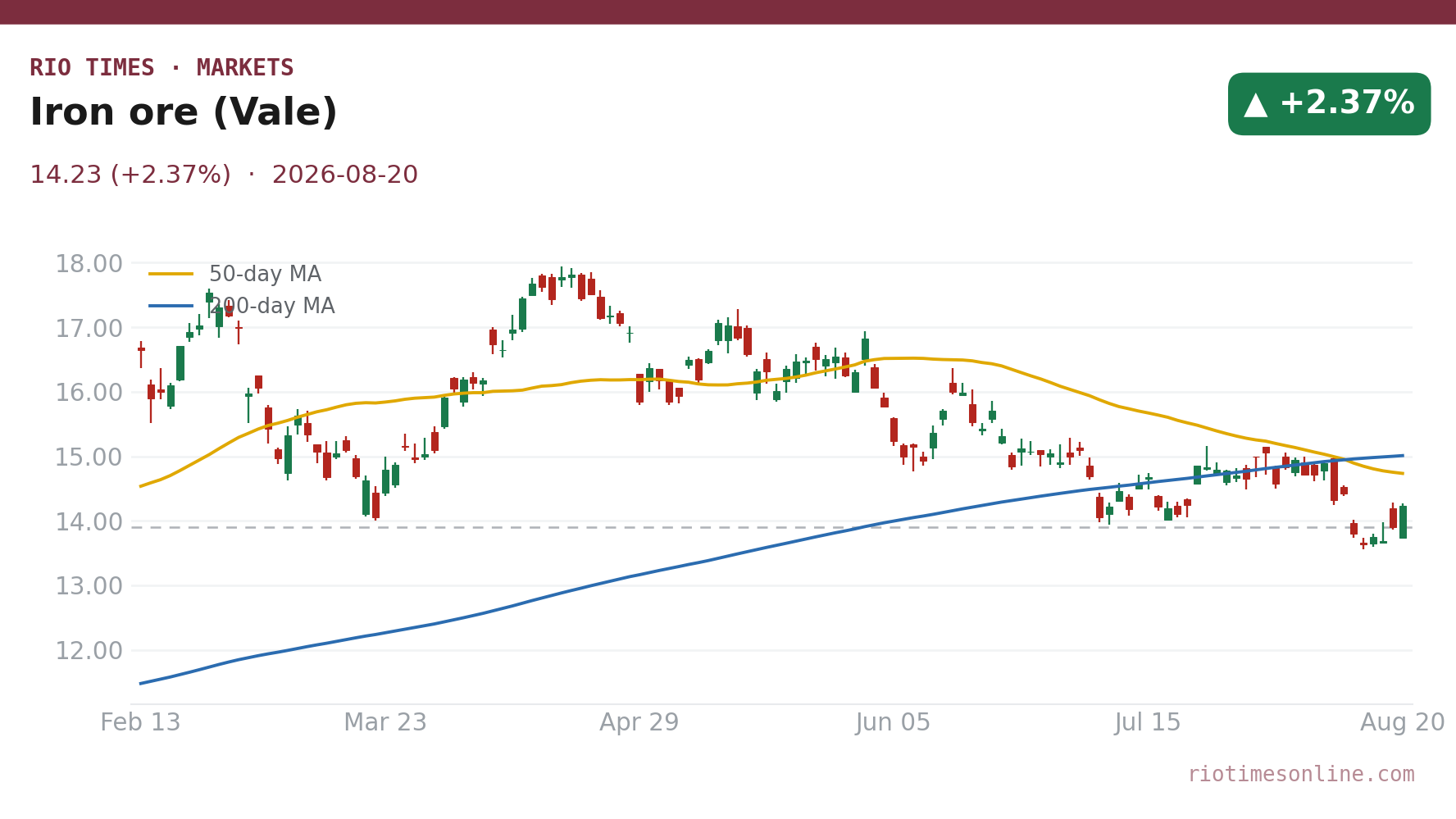
- Vale’s New York-listed shares rose sharply closing up 2.37% at US$14.23, diverging from the flat commodity price.
- China’s steel output is rebounding from maintenance, though still below last year with CISA mills producing 1.973 million tonnes of crude steel per day in early August, up 5.8% from late July.
- Construction steel demand remains subdued with HRB400E 20mm rebar prices at 3,216 yuan per tonne on August 13, down 18 yuan from end-July.
- The Dalian futures contract fell with the most-active I2701 settling at RMB 707 per tonne, down 1.19% on the day.
- Manufacturing is the structural bright spot with China’s manufacturing steel demand forecast at 344 million tonnes in 2026, up 3.3% year-on-year.
Today’s Focus
Iron ore held near US$95.16 per tonne on Thursday, a negligible 0.01% daily decline that masked a mixed session for miners. The most-active Dalian futures contract fell 1.19% to RMB 707, and Qingdao spot prices slipped RMB 4-5 per tonne.
Vale’s New York shares defied the soft commodity tone, climbing 2.37% to US$14.23. Rio Tinto also gained, up 1.72% to US$102.17, but Brazil’s CSN Mineração dropped 4.74% to R$5.63.
The driver is China’s contradictory steel complex. Production is rebounding as blast furnaces return from maintenance, yet construction demand is weak and inventories are building, with key mills holding 17.18 million tonnes of finished steel in early August.
The market is holding roughly flat rather than collapsing because manufacturing demand is structurally growing, offering a floor even as seasonal construction weakness drags on prices.
What matters today. Iron ore is caught between rising Chinese output and weak construction demand, keeping prices pinned near US$95.

01 The session in one read
Iron ore ended Thursday, August 20, 2026, almost exactly where it began, with the benchmark price down just 0.01% at US$95.16 per tonne. Traders in China were less forgiving: the most-active Dalian Commodity Exchange contract for January settled at RMB 707 per tonne, a drop of 1.19% from the previous day.
The flat headline number conceals a genuine divergence. Vale’s New York shares rose 2.37% to US$14.23, while Rio Tinto gained 1.72% to US$102.17, suggesting international investors see value after weeks of softness.
Yet Brazil’s CSN Mineração fell 4.74% to R$5.63, a reminder that domestic Brazilian miners face currency and cost factors beyond the export price alone.
The flat print near US$95 disguised a market still under pressure from rising Chinese mill inventories and weak end-use demand. CISA mills lifted crude steel output 5.8% in early August against late July, but that is supply finding no corresponding construction appetite — and it is still down 4.9% on the year. If rebar prices keep drifting lower and finished steel stocks climb further, iron ore could test levels below US$95. The variable to watch is China’s weekly finished steel inventory.
02 The board
Vale’s ADR at US$14.23 showed the strongest move of the three iron-ore proxies tracked here, up 2.37% on the session. Rio Tinto’s US$102.17 close, up 1.72%, reinforced the view that large diversified miners held up better than the underlying commodity price.
CSN Mineração was the outlier, tumbling 4.74% to R$5.63 in São Paulo. The Brazilian real-quoted stock carries domestic risk that New York-listed names do not, including local demand for construction steel and currency moves.
| Asset | Level | Change |
|---|---|---|
| Iron ore (Vale) | US$14.23 | +2.37% |
| CSN Mineração | R$5.63 | -4.74% |
| Rio Tinto | US$102.17 | +1.72% |
Source: RT close, 2026-08-20. Where a commodity has no spot feed, an exchange-traded tracker or leading producer is shown as a labelled proxy.
Live Market IntelligenceThe live market board
Rio Times · Live Market Intelligence
Latin America — Cross-Market Board
| Instrument | Last | Change | YoY | Prev. | High | Low | Volume |
|---|---|---|---|---|---|---|---|
| IBOV | 167,927.15 | +0.06% | +21.85% | 167,830.27 | 168,310 | 167,142 | — |
| IPSA | 11,237.90 | -0.03% | — | 11,241.32 | 11,210 | 10,984 | 1,513,213,483 |
| IPC MEX | 64,436.38 | +0.68% | +12.17% | 63,999.26 | 66,121 | 65,405 | 108,886,187 |
| MERVAL | 2,875,950 | +0.05% | +30.51% | 3,022,485 | 3,042,365 | 2,991,150 | — |
| COLCAP | 2,444.32 | -0.39% | — | 9.04 | 9.05 | 9.02 | 4,133 |
| BVL PERÚ | 58,380.78 | +0.54% | — | — | — | — | — |
| USD/BRL | 5.16 | +0.01% | -5.13% | 5.16 | 5.18 | 5.14 | — |
| EUR/BRL | 5.95 | +1.01% | -5.83% | 5.89 | 5.98 | 5.94 | — |
| USD/MXN | 17.06 | -0.24% | -8.58% | 17.10 | 17.08 | 17.01 | — |
| USD/CLP | 913.98 | +0.04% | -5.67% | 913.65 | 915.11 | 906.68 | — |
| USD/COP | 3,140 | +0.03% | -22.04% | 3,139 | 3,141 | 3,105 | — |
| USD/PEN | 3.36 | -0.66% | -4.82% | 3.38 | 3.38 | 3.35 | — |
| USD/ARS | 1,493 | +0.10% | +12.96% | 1,491 | 1,494 | 1,480 | — |
| USD/UYU | 40.27 | +1.24% | +1.80% | 39.77 | 40.27 | 40.23 | — |
| USD/PYG | 5,939 | +1.68% | -19.54% | 5,841 | 5,939 | 5,925 | — |
| USD/BOB | 11.64 | -0.76% | +72.04% | 11.73 | 11.72 | 11.64 | — |
| USD/DOP | 58.34 | +1.25% | -3.44% | 57.62 | 58.34 | 58.04 | — |
| USD/CRC | 445.92 | +0.89% | -9.71% | 441.97 | 448.50 | 445.92 | — |
03 What moved it
China is producing more steel while building less. The China Iron and Steel Association reported daily crude steel output of 1.973 million tonnes in the first ten days of August, up 5.8% from late July, as blast furnaces emerged from maintenance.
That supply is piling up. Finished steel inventories at key CISA mills reached 17.18 million tonnes, up 5.6% from the prior period and 14% above the same point in 2025.
Demand remains the weak link. Construction steel buying among sampled contractors is estimated at 6.45 million tonnes for August, a marginal improvement from July but still seasonally depressed by heat and rainfall. Rebar prices were at 3,216 yuan per tonne on August 13, down 18 yuan from end-July.
The structural counterweight is manufacturing. S&P Global forecasts China’s manufacturing steel demand at 344 million tonnes for 2026, up 3.3% year-on-year, with manufacturing set to account for 52% of total steel consumption, up from 46% in 2023.
04 The Latin American read
For Brazil, the mixed session is a warning that export volume growth does not automatically mean revenue gains. Vale is the world’s largest iron-ore producer, and its earnings are heavily leveraged to the price more than the tonnage.
CSN Mineração’s 4.74% slide to R$5.63 shows how quickly domestic Brazilian names can suffer when the China demand narrative wobbles, even if the benchmark commodity price is flat.
The broader regional takeaway is patience. Latin American miners and the governments that tax them need China’s manufacturing pivot to accelerate before construction weakness is offset. Until then, prices near US$95 leave little margin for celebration.
05 The names to watch
Vale’s New York-listed shares, at US$14.23 after a 2.37% gain, remain the purest liquid expression of this market for global investors. The stock’s divergence from the flat commodity price suggests some are treating the recent sag as a buying opportunity.
Rio Tinto at US$102.17, up 1.72%, provides a read on how diversified miners with exposure to copper and aluminium weather iron-ore softness.
CSN Mineração’s drop to R$5.63, a 4.74% fall, highlights the vulnerability of Brazilian names without Vale’s scale. The stock is now the clear underperformer among the proxies tracked here.
06 The outlook
The near-term path depends on whether China’s production rebound overwhelms already weak construction demand. If finished steel inventories climb again in the next CISA update, iron ore could slip below US$95.
But a full collapse looks unlikely while manufacturing demand is growing structurally. The market is more likely to grind sideways, with occasional spikes driven by policy announcements from Beijing. Watch China’s weekly inventory data and any signals on production cuts.
07 What to watch
- China weekly steel inventories: Rising finished steel stocks at key mills signal that supply is outpacing demand, which would push iron ore lower.
- Dalian futures settlement: The most-active contract settled down 1.19% at RMB 707, a useful daily read on Chinese sentiment that leads physical port prices.
- China construction PMI: Any sign that building activity is stabilising could shift demand expectations and tighten the iron-ore market.
- Brazil currency moves: The real’s value against the dollar changes competitive outcomes for Vale and CSN Mineração even when the commodity price is flat.
Frequently Asked Questions
Is iron ore expensive right now?
At US$95.16 per tonne, iron ore is trading in the mid-90s US dollar range, which represents a soft market by historical standards. It is not at a deep low, but it is far from the triple-digit peaks seen in stronger demand years.
Why did Vale rise if iron ore was flat?
Vale’s New York shares climbed 2.37% to US$14.23 even though the benchmark price barely moved. Investors may be positioning for a demand recovery in China’s manufacturing sector, or simply buying after recent weakness.
What is the difference between the Dalian price and the US dollar price?
The Dalian Commodity Exchange contract is the Chinese futures market price, quoted in yuan and settled at RMB 707 per tonne on Thursday. The US$95.16 figure is the international benchmark for physical iron ore delivered to China, and the two track one another closely but with different convenience and currency effects.
How important is China to iron ore?
China buys more than two-thirds of the world’s seaborne iron ore. Its steel mills, property sector, and manufacturing plants effectively set the global price, which is why every CISA production report matters for Brazil and Australia.
This article was produced by The Rio Times’ automated newsroom system. How we use AI · Report an error
LatAm Markets: Live Signals → — real-time movers, turnover leaders and FX across Latin America.
Read More from The Rio Times