India Turns to Venezuela Oil as the Hormuz Crisis Bites
Venezuela · Economy
Key Facts
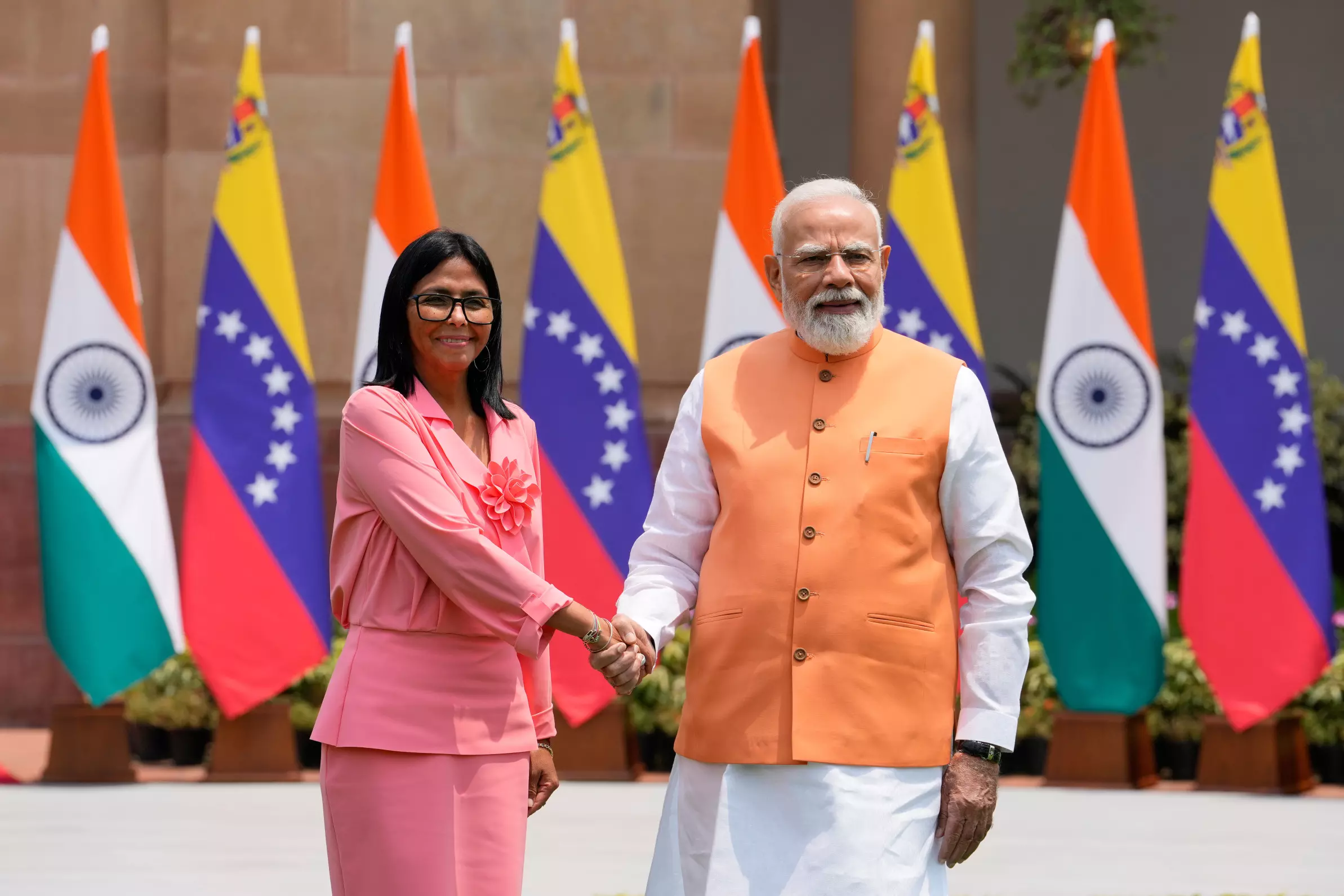
—The meeting. Venezuela’s acting president, Delcy Rodríguez, met Prime Minister Narendra Modi in New Delhi on June 4 during a five-day visit focused on energy.
—The volumes. Venezuelan shipments to India reached about 417,000 barrels a day this month, up from roughly 283,000 in April and from zero for most of the prior year.
—The driver. The US-Israel war on Iran has disrupted the Strait of Hormuz, through which nearly 40% of India’s crude once flowed, forcing New Delhi to diversify fast.
—The buyers. Reliance Industries, one of few refiners able to process Venezuela’s ultra-heavy crude, and state-run ONGC Videsh, which holds Orinoco-belt stakes and expects a license under Caracas’s new regime.
—The reversal. Flows resumed after Washington eased sanctions and signed a supply arrangement with the Rodríguez government following Nicolás Maduro’s removal in early 2026.
With Middle Eastern supply lines under threat, a battered petro-state and the world’s third-largest oil importer have found in each other exactly what each needs — and the barrels are already moving.
Venezuela oil flows back to India
Venezuela’s acting president, Delcy Rodríguez, met Indian Prime Minister Narendra Modi in New Delhi on Thursday, June 4, in talks that put energy cooperation at the centre of a five-day visit. For Rodríguez, leading a large ministerial delegation on her first trip to India since taking office, the official purpose was straightforward: India needs crude, and Venezuela needs customers, cash flow and legitimacy. India’s foreign ministry said the discussions focused on forging an energy partnership spanning the full spectrum of bilateral relations, from oil to trade, investment, pharmaceuticals and health care, with the Venezuelan delegation also meeting energy executives in Mumbai.
The numbers show how quickly the relationship has revived. Venezuela has supplied India with roughly 417,000 barrels a day so far this month, according to data from analytics firm Kpler, up from about 283,000 barrels a day in April — itself the highest level since March 2020. In the nine months before that, under the socialist government of Nicolás Maduro, there had been no Venezuelan shipments to India at all. Those volumes have made Venezuela one of India’s largest crude suppliers in recent weeks, ranking second or third depending on the month, as India’s total imports climbed toward almost five million barrels a day.
A war reshapes the oil map
The timing is no accident. India imports close to 90% of the crude it consumes, and nearly 40% of that supply once moved through the Strait of Hormuz — the narrow Gulf chokepoint thrown into chaos by the US-Israel war on Iran and the effective Iranian blockade that followed. When Hormuz seizes up, India feels it at the pump, in factory costs and in political temperature, and New Delhi has scrambled to broaden its sources. Venezuelan heavy crude, long discounted and shut out of global markets by sanctions, has emerged as a cost-competitive alternative at precisely the moment buyers are hunting for secure barrels.
India is a natural home for that crude. Reliance Industries, controlled by billionaire Mukesh Ambani, signed a term agreement back in 2012 to take as much as 400,000 barrels a day from the Venezuelan state oil company PDVSA, and its refining complex is one of the few in the world able to process the country’s ultra-heavy, sulphur-rich oil efficiently. State-run ONGC Videsh, which holds stakes in the San Cristóbal field and the Carabobo-1 block in the Orinoco belt, expects to receive a license under Venezuela‘s new investment regime and hopes to lift output from those assets. India had been an early mover in Venezuela, briefly overtaking China in 2012 as the largest Asian importer of its crude, before sanctions forced a retreat.
Survival sold as sovereignty
The reopening rests on a sharp geopolitical reversal. After Rodríguez took power following the US military‘s removal of Maduro in January, her government signed an oil-supply arrangement with Washington that lets a limited set of companies buy Venezuelan crude directly from PDVSA, with revenues routed through US-supervised accounts. The Trump administration lifted most sanctions on Venezuelan exports through a sequence of Treasury licenses, and Venezuela’s overall exports climbed to around 1.25 million barrels a day in May, the highest in years. The barrels now heading to India are one strand of that wider unblocking — and a sign that Caracas is courting Asian demand as aggressively as it is welcoming Western majors back into the Orinoco.
For the region, the lesson is clear: Venezuela is returning to the global stage not as an ideological lighthouse but as a battered energy heavyweight with bargaining power, because the world is short of secure crude. The deeper caveat is the one that shadows every Venezuelan oil revival: reserves are not power until a country can pump, refine, ship, insure and collect on them reliably, and the political arrangement underpinning the current flow — a US-supervised interim government with no election timeline — makes the supply outlook as much a geopolitical variable as an economic one. The oil is moving. The question, as ever with Caracas, is for how long and under whose rules.
Frequently Asked Questions
Why is India buying more Venezuelan oil?
The US-Israel war on Iran disrupted the Strait of Hormuz, through which nearly 40% of India’s crude once flowed, pushing New Delhi to diversify toward discounted Venezuelan heavy crude.
How much is Venezuela shipping to India?
About 417,000 barrels a day this month, up from roughly 283,000 in April and from zero for most of the previous year, per Kpler data.
Which Indian companies are involved?
Reliance Industries, one of few refiners able to handle Venezuela’s ultra-heavy crude, and state-run ONGC Videsh, which holds Orinoco-belt stakes and expects a new license.
What made the trade possible again?
Washington eased sanctions and signed a supply arrangement with the Rodríguez government after Maduro’s removal in January, reopening direct purchases from PDVSA.
Connected Coverage
The India push is part of the wider energy reopening Caracas has pursued since January, alongside its move to open the collapsed power sector to private capital and to welcome Western oil majors back into the Orinoco belt.
This article was produced by The Rio Times’ automated newsroom system. How we use AI · Report an error · Editorial responsibility: Matthias Camenzind, Editor-in-Chief