How much do Argentina, Brazil, Mexico, and the rest of LatAm depend on tourism?
The region of Latin America and the Caribbean is the most dependent on tourism globally.
However, this dependence is heterogeneous and varies enormously depending on the sub-region.
When observing how much the Gross Domestic Product of Latin American countries is tied to what happens with tourism, it can be seen that in Mexico, the dependence is much greater than in the other major Latin American economy, Brazil.

HOW MUCH DO ARGENTINA, BRAZIL, AND MEXICO DEPEND ON TOURISM?
A recent report by the Inter-American Development Bank (IDB) focuses on the weight of tourism activity in the three main economies of the region and elaborates on this:
“Between 2017 and 2021, it is estimated that tourism accounted for an average of more than 16% of economic output and employment in Mexico, and close to 10% of GDP and total employment in Uruguay, Argentina, and Chile,” the IDB reviews.
Despite having some of the most beautiful beaches in the world, Brazil differs from its neighbors.
In Latin America’s main economy, it is estimated that tourism contributed about 8% of both GDP and employment.
In aggregate terms, nearly 28 million citizens of Latin America and the Caribbean relied on the tourism sector for a portion of their income and livelihood in 2018 (the latest year for which data is available).
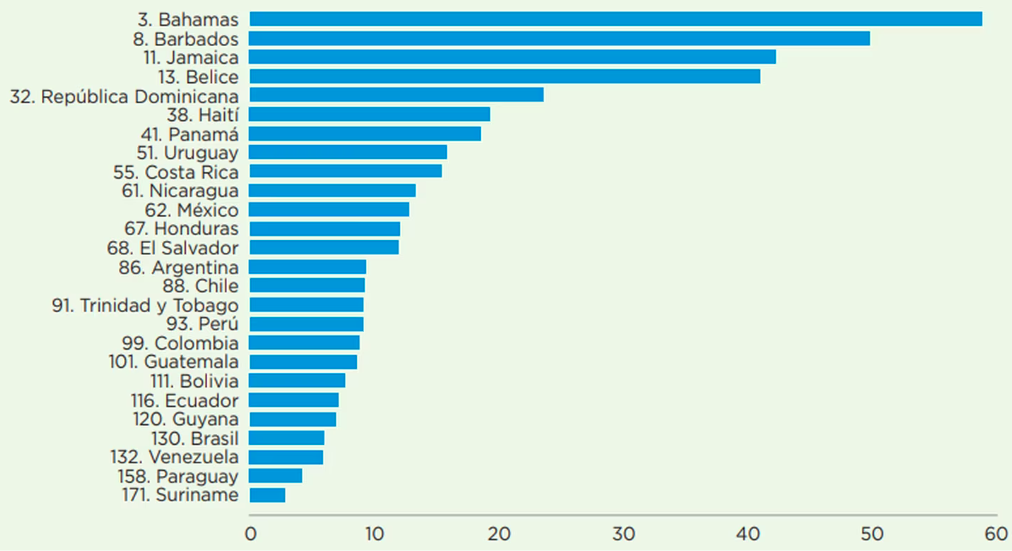
TOURISM DEPENDENCY INDEX FOR THE REGION
Based on data provided by Mooney, the IDB published a ranking called the Tourism Dependency Index (TDI).
This indicator ranks 175 countries in different regions of the world and shows that nearly half of the 20 most tourism-intensive economies in the world are in the Caribbean.
The Tourism Dependency Index (TDI) is calculated using data on the total contribution of tourism to GDP, employment, and exports in each country. It ranges from 0 to 100, where 100 represents total dependence.
Brazil ranks 130th (out of 175) globally regarding tourism dependence. On the other hand, Mexico is ranked 62nd and Argentina 86th.
Why does the IDB consider this region the most tourism-dependent in the world?
Because of the many Caribbean countries with small economies that appear in the top positions.
For example, the Bahamas (third place), Barbados (8th place), Jamaica (11th place), Belize (13th), Dominican Republic (32nd), and Haiti (38th).
According to this measure, Aruba, Antigua and Barbuda, St. Lucia, Dominica, and Grenada are among the 20 most tourism-dependent economies.
Among the Spanish-speaking countries in the region, beyond the Dominican Republic, there are also:
- Uruguay (51st)
- Costa Rica (55th)
- Nicaragua (61st)
- Honduras (67th)
- El Salvador (68th)
- Chile (88th)
- Peru (93rd)
- Colombia (99th)
- Guatemala (101st)
- Bolivia (111th)
- Ecuador (116th)
- Venezuela (132nd)
- Paraguay (158th)
GLOBAL TOURISM OUTLOOK
The most recent survey by the World Tourism Organization’s Tourism Expert Panel highlights that while industry participants remain optimistic about the sector’s global outlook in 2023, confidence declined through the last quarter of 2022, coinciding with deteriorating economic conditions.
Regardless of the results, the regional and global economy faces headwinds, and the outlook for travel and tourism demand is unlikely to improve. Managers in tourism-dependent economies should be prepared to deal with the concerns of this key sector, which is once again at the mercy of rapidly evolving external forces.
With information from Bloomberg
More: Brazil news in English, every day from The Rio Times.
Read More from The Rio Times