The possibility of a new foreign intervention in Haiti brings back the worst memories of the country’s history, which has suffered from occupations since 1915.
The interventions, supported mainly by the United States, the UN, and the OAS, have increased deaths and human rights abuses and encouraged violence.
Haiti, the first Latin American country to proclaim independence in 1804 after a revolutionary process against France, has always suffered from the presence of foreign forces on its territory, mainly from the United States.
As the Organization of American States (OAS) has admitted, the actions of the international community in the country have been “one of the greatest and most obvious failures ever carried out in the region,” although it has supported several of the interventions.

The OAS acknowledged that for 20 years, a “misguided political strategy” was applied in the country that failed to find solutions to the problems of Haitians.
“Under this umbrella of the international community, the criminal gangs that today besiege the country and its people have fermented and germinated; under this umbrella, the process of de-institutionalization and political crisis has taken place,” currently affecting Haiti, the text states.
THE U.S. AND THE FIRST OCCUPATION OF HAITI
The first U.S. occupation of Haiti occurred in 1915 when more than 300 people landed in the Haitian capital of Port-au-Prince on the orders of then-U.S. President Woodrow Wilson (1913-1921).
This was to protect U.S. corporate interests in the country and to prevent establishing an anti-Washington government following the assassination of Haitian President Jean Vilbrun Guillaume Sam, who had led the country for only five months, from February to July 1915.
A measure intended to be “temporary” lasted 19 years, until 1934 when Franklin D. Roosevelt (1933-1945) was at the helm of the U.S. government.
During this period, the U.S. took control of the Caribbean nation’s finances.
Further, it pressured Congress regarding electoral decisions and created a constabulary subordinate to the U.S. Navy.
They ordered the dissolution of Parliament and attempted, albeit unsuccessfully, to push through constitutional amendments that would not restrict the property rights of foreigners in the country.
This is considered the most prolonged occupation by the U.S. government, but it was not the only one.
BILL CLINTON’S PLAN
In 1993, the United Nations and the OAS established the International Civilian Mission in Haiti, justified by the country’s political crisis.
A year later, under President Bill Clinton, the United States again threatened to invade Haiti after the overthrow of then-Haitian President Jean Bertrand Aristide.
Under Operation Uphold Democracy, the U.S. intended to send 20,000 military personnel to remove the new government from office.
However, the military action was aborted at the last minute after a peaceful transition was negotiated.
ALLEGATIONS AGAINST MINUSTAH
Numerous UN peacekeeping missions marked the following years met with heavy criticism and human rights violations.
The most muscular intervention occurred in 2004 with the cestablished in response to the coup d’état against then-President Jean Bertrand Aristide, who was forced to leave the country by an immediate Security Council resolution.
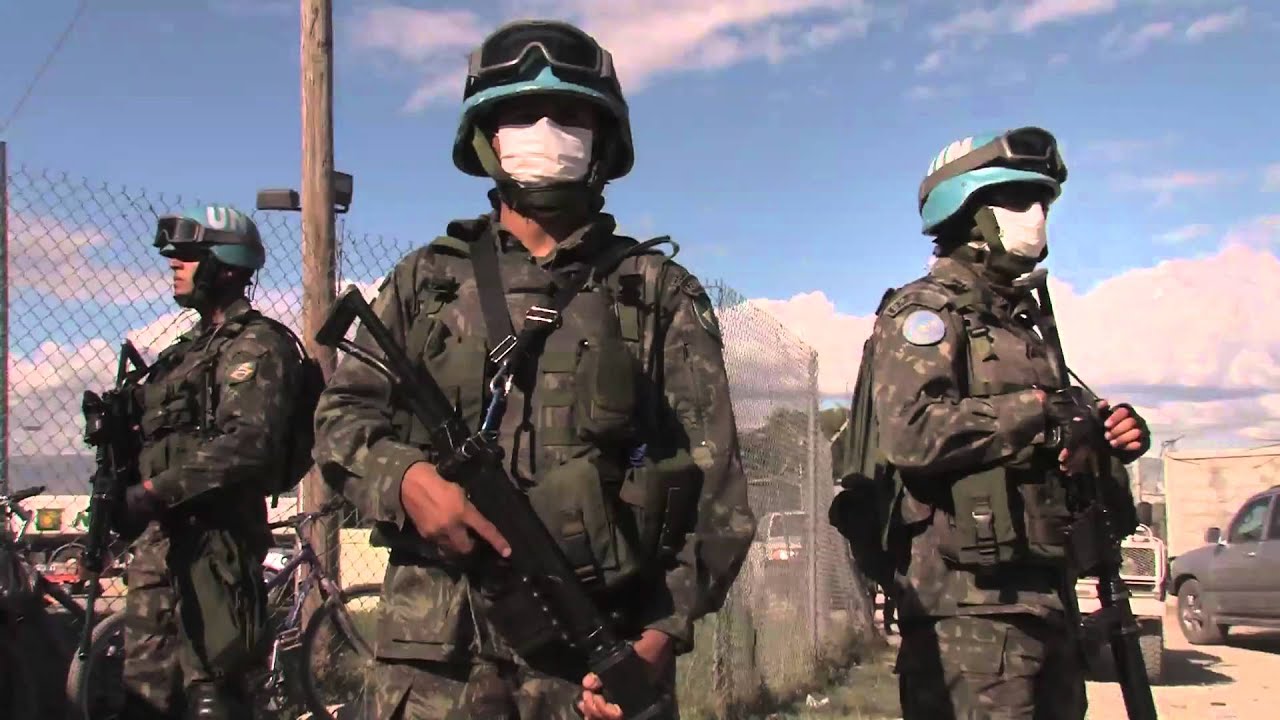
The mission allowed military personnel from the United States, Canada, Spain, Argentina, Brazil, Ecuador, and Uruguay, among others, in Haiti.
However, the mission’s actions were marred by allegations of human rights violations, including sexual exploitation, rape, and unlawful killings.
The cases have been denounced by residents themselves and by the Inter-American Commission on Human Rights (IACHR).
In addition, according to official figures, the troops introduced cholera into the country, a disease that caused 800,000 infections and claimed the lives of at least 10,000 people.
This article was drafted with automated assistance and reviewed before publication. How we use AI · Report an error · Editorial responsibility: Matthias Camenzind, Editor-in-Chief