Guyana Hardwires Local Manufacturing into the Oil Supply Chain
Guyana
Key Facts
—Local supplier spending. Oil operators spent US$743 million on Guyanese suppliers in 2024, with cumulative procurement surpassing US$1.5 billion since 2021.
—Fabrication milestones. Three Guyanese firms are fabricating components for the Jaguar FPSO, and subsea jumpers are now manufactured at the Vreed-en-Hoop Shorebase.
—Workforce composition. Guyanese nationals make up 67 per cent of the oil and gas workforce, with roughly 14,000 people employed directly and indirectly.
—Registered local firms. More than 1,000 Guyanese companies are certified on the Local Content Register, covering 40 designated service areas from logistics to machining.
—Break-even resilience. Guyana’s offshore barrels break even at US$25 to US$35, among the lowest globally, protecting local industrial investment against price swings.
Guyana is deliberately building a local manufacturing oil supply chain that moves beyond services into precision fabrication, reshaping the investment proposition from a pure extraction play into a diversified industrial economy.
The Legal Architecture Behind the Shift
The transformation rests on the Local Content Act 2021, which entered into force in December of that year and identified 40 designated service areas where oil operators must meet minimum Guyanese participation thresholds ranging from 5 per cent to 100 per cent. The law sets unusually high domestic control requirements: a Guyanese company must have at least 51 per cent of voting rights held by nationals, 75 per cent of executive and senior management positions filled by Guyanese, and 90 per cent of non-managerial staff drawn from the local workforce.
A Local Content Secretariat was established to enforce the rules, certify companies, and maintain a register that has grown to more than 1,000 Guyanese firms. This institutional machinery ensures that procurement opportunities in areas such as maritime services, catering, medical support, and technical services flow to businesses with genuine domestic control rather than foreign-registered shells.
Where the Money Flows: Spending on Guyanese Suppliers
The Ministry of Finance reported that oil operators spent US$743 million on Guyanese suppliers in 2024 alone, covering procurement, employment, and workforce upskilling. Of that total, US$612 million was tied directly to the 40 ring-fenced service areas, with US$92 million going to construction, US$88 million to laydown yard facilities, US$34 million to accommodation, and US$26 million to ground transportation.
Cumulative procurement from Guyanese companies and nationals has surpassed US$1.5 billion since the Act took effect. ExxonMobil Guyana reports working with more than 2,000 unique local suppliers since 2015, with total spending exceeding GY$525 billion (approximately US$2.5 billion), and in the first half of 2025 alone the company and its contractors spent GY$87 billion among 1,700 local suppliers.
From Services to Precision Manufacturing
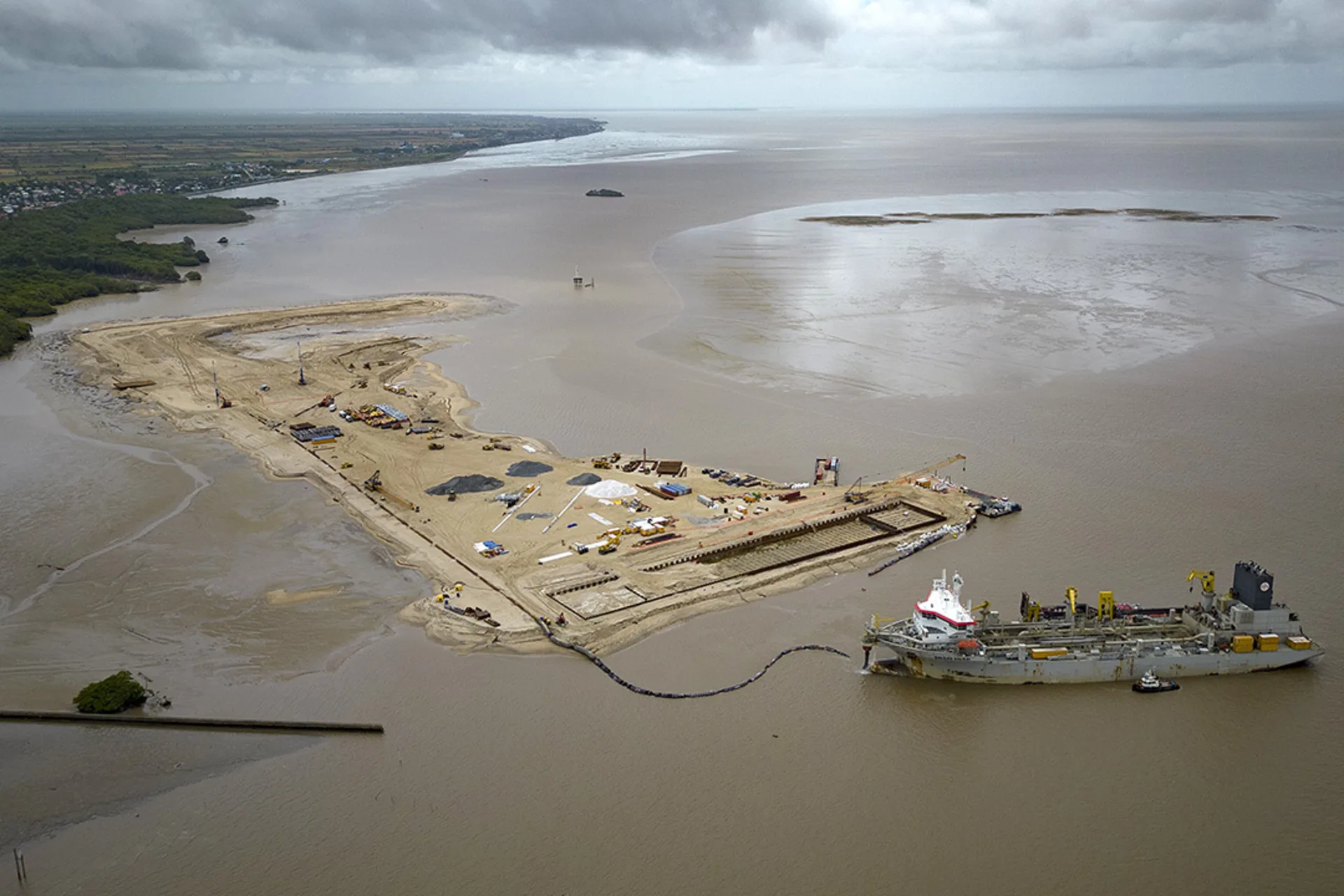
The most telling shift is the emergence of a local manufacturing oil supply chain that now includes fabrication and machining of high-value components previously produced abroad. At the Vreed-en-Hoop Shorebase, contractor Saipem is fabricating subsea jumpers that connect wellheads to flowlines and has begun assembling the first pipeline and flowline end terminations for seabed installation.
Three Guyanese firms are slated to provide fabrication services for the construction of the Jaguar FPSO, marking a leap from peripheral support into capital equipment construction. Local machining suppliers have also started producing premium downhole drilling accessories, including crossovers, pup joints, landing joints, and blast joints, which are specialised components in the drilling supply chain requiring precision engineering.
The Workforce and Skills Base Taking Shape
Guyanese officials estimate that roughly 14,000 people are employed directly and indirectly because of the oil and gas sector, with about 7,000 trained and working directly in the industry and another 7,000 in supporting sectors such as logistics, transportation, catering, and technical support. ExxonMobil’s 2024 annual report states that Guyanese make up 67 per cent of the total oil-and-gas workforce, a figure that reflects the Act’s employment mandates.
The Centre for Local Business Development, established in 2017, has become a key platform for helping Guyanese firms meet international standards and enter the supply chain, offering training, mentoring, and procurement information. Initiatives such as the Guyana Supplier Forum and the Social Performance Network, which links ExxonMobil with eleven prime contractors, are designed to improve vendor readiness and embed local participation as a structural feature rather than a compliance exercise.
Geopolitics, Energy Security, and the Investor Read-Through
Guyana’s rising output is reshaping global energy security by diversifying supply away from the Middle East. In 2024, 66 per cent of the country’s oil exports went to Europe and 29 per cent to the United States, reinforcing its role as a Western-aligned Atlantic basin supplier with break-even costs among the lowest in the world at US$25 to US$35 per barrel.
For outside investors, the deliberate construction of a local manufacturing oil supply chain changes the risk-reward calculus. It reduces operational vulnerability to distant manufacturers and imported specialist labour while creating a parallel investment universe in shorebase infrastructure, fabrication workshops, logistics, and precision machining that did not exist before 2021. The government’s explicit ambition to position Guyana as a regional services and manufacturing hub for the Caribbean adds a longer-term growth narrative beyond the depletion curve of the Stabroek Block.
What to Watch Next
The policy trajectory points from light manufacturing toward heavy manufacturing and industrialisation, with the Natural Resources Ministry explicitly linking oil and gas to processing, refining, and power generation. The Local Content Secretariat reports that local firms already handle about 88 per cent of cargo-carrying unit services and over 90 per cent of freight forwarding and inspection, metrics that suggest near-dominance in core logistics functions.
The key variable is whether the window of high oil revenues, which the IMF projects will support average economic growth of 14 per cent per year over the next five years, is used to lock in durable industrial capacity before price cycles or the energy transition narrow the opportunity. The Natural Resource Fund, expected to exceed US$3 billion by end-2024, provides a fiscal buffer, but the real test is whether the fabrication workshops, machining shops, and certified local firms now emerging can compete on quality and cost when the policy incentives eventually taper.
More: Latin America news in English, every day from The Rio Times.
Frequently Asked Questions
What does the Local Content Act require from oil companies operating in Guyana?
The Local Content Act 2021 mandates that oil operators and their contractors meet minimum Guyanese participation thresholds across 40 designated service areas, ranging from 5 per cent to 100 per cent depending on the activity. To qualify as a Guyanese company, a firm must have at least 51 per cent of voting rights held by nationals, 75 per cent of senior management filled by Guyanese, and 90 per cent of non-managerial staff drawn from the local workforce.
A dedicated Secretariat enforces compliance and maintains a register of certified local suppliers.
How much money has flowed to Guyanese suppliers since the Act took effect?
Oil operators spent US$743 million on Guyanese suppliers in 2024 alone, with US$612 million tied directly to the ring-fenced service areas under the Act. Cumulative procurement from Guyanese companies and nationals has surpassed US$1.5 billion since 2021, while ExxonMobil reports total spending exceeding GY$525 billion (approximately US$2.5 billion) with more than 2,000 local suppliers since 2015.
Is Guyana actually manufacturing oil-industry components locally, or just providing services?
Guyana has moved decisively into fabrication and precision manufacturing. At the Vreed-en-Hoop Shorebase, subsea jumpers and pipeline end terminations are now fabricated locally, three Guyanese firms are engaged on Jaguar FPSO fabrication, and local machining shops produce premium downhole drilling accessories including crossovers, pup joints, landing joints, and blast joints.
These are specialised, high-value components that mark a shift beyond low-skill assembly into industrial manufacturing.
Connected Coverage
Guyana’s Oil Revenue Books Don’t Add Up by $6.7 Billion, Analysts Say
This article was produced by The Rio Times’ automated newsroom system. How we use AI · Report an error · Editorial responsibility: Matthias Camenzind, Editor-in-Chief
LatAm Markets: Live Signals → — real-time movers, turnover leaders and FX across Latin America.