Guatemala SAT Says Tax-Free Fuel Earns No VAT Credit

ECONOMY · GUATEMALA
Key Facts
- —The country Guatemala, Central America’s most populous country, uses the quetzal: Q7.64 to the US dollar on 2 October 2026.
- —What happened On 2 October 2026 the tax authority (SAT) said fuel bought tax-free under the exemption running since 1 October earns no VAT credit, Prensa Libre reported.
- —The numbers January–August 2026 the IDP fuel levy raised Q3.34 billion (about US$437 million), SAT data show. Import VAT raised Q21.25 billion, domestic VAT Q21.02 billion.
- —What it means for you Businesses claim no VAT credit on exempt fuel until 31 December 2026. VAT paid on other taxable purchases is still credited as usual.
- —Still open The real revenue loss (estimated at Q3.32 billion, about US$434 million, Infobae reported) and whether SAT revises its 2026 goal. September figures are not yet out.
Guatemala’s tax authority has set out how the fuel VAT exemption affects tax credits. Fuel bought under the exemption gives buyers no right to a VAT credit, the head of the tax authority (SAT) told Prensa Libre on Friday 2 October.
The clarification matters for companies, hauliers and other VAT-registered buyers who usually offset fuel tax. For ordinary drivers, the cheaper pump price is the only change.
What the tax authority said
Fuel bought under the exemption generates no VAT credit for the buyer, said Werner Ovalle, the superintendent who heads SAT. VAT paid on other taxable purchases stays under the general rules of the VAT law.
The decree itself says exempt sales confer no tax credit on the buyer, news site Deguate reported on 24 September. Operators’ credits on non-exempt inputs follow the VAT law.
“In simple terms, during the exemption there is a temporary interruption of the debit-credit system” for exempt fuel sales, Ovalle said. He stressed that the system continues for every other operation under the general VAT regime.
Why the credit chain pauses
Guatemala charges value-added tax (IVA) at 12 percent. Registered businesses normally deduct the VAT they paid on inputs, the credit, from the VAT they charge customers, the debit.
Under the fuel VAT exemption, Decree 22-2026 suspends both VAT and the IDP, a fixed per-gallon fuel distribution levy, from 1 October to 31 December 2026. With no VAT charged at the pump, there is no fuel VAT left to deduct.
The law took effect on 1 October and cut pump prices by up to about Q9 (US$1.18) a gallon, as reported in Guatemala Premium Petrol Falls to US$4.74 a Gallon. SAT says it has already updated its internal systems for the change.
What it costs the treasury
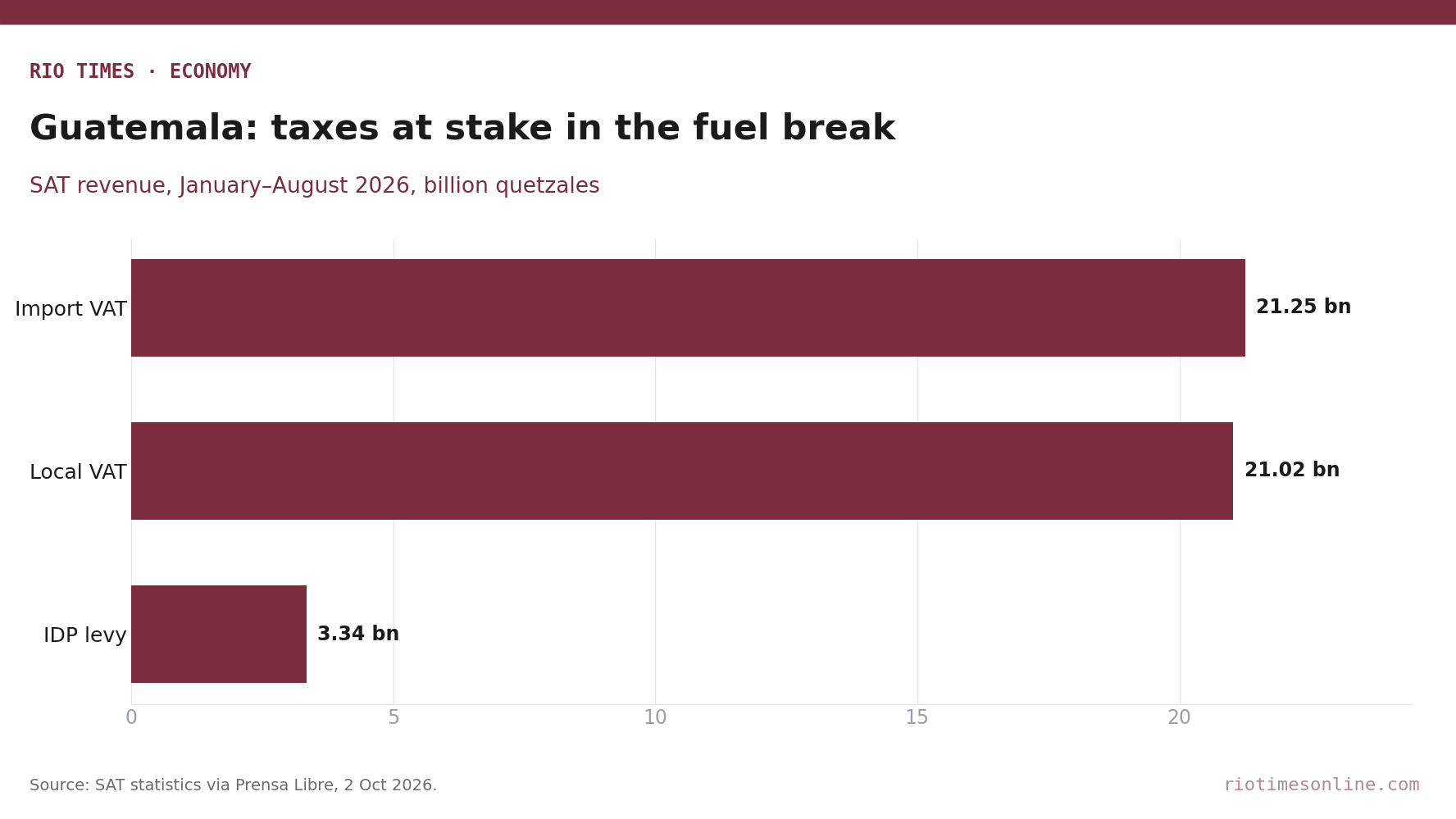
Between January and August 2026 the IDP levy raised Q3.34 billion (about US$437 million), according to SAT statistics cited by Prensa Libre. Import VAT brought in Q21.25 billion (about US$2.78 billion).
Domestic VAT raised Q21.02 billion (about US$2.75 billion) in the same period. Dollar values use Q7.64 to the US dollar, the rate on 2 October 2026.
Fuel is only part of the VAT base, so the loss will be a fraction of those totals. SAT’s board must now assess the impact and whether the 2026 collection targets still hold.
What changes in January
The debit and credit system for fuel imports, local purchases and sales returns on 1 January 2027, when both taxes come back. SAT says its system is already set to switch back on that date.
Because VAT is settled monthly, the effect will show at the end of each month, Prensa Libre reported. The agency is also modernising filing, including pre-filled returns for 305,000 businesses.
What Is Not Yet Known
The three-month exemption is estimated to cost Q3.32 billion (about US$434 million), Infobae reported on 1 October. SAT has not published its own estimate, and September collection figures were not yet available on 2 October.
It is also unclear whether SAT will issue a written guidance note for accountants. So far the rules rest on the superintendent’s statements to the press.
Sources: Prensa Libre, interview with SAT superintendent Werner Ovalle and SAT revenue statistics, 2 October 2026; Decree 22-2026 as reported by Diario de Centro América and Prensa Libre, 30 September–1 October 2026; Deguate, 24 September 2026; Infobae, 1 October 2026; exchange rate from open.er-api.com, 2 October 2026.
This article was produced by The Rio Times’ automated newsroom system. How we use AI · Report an error · Editorial responsibility: Matthias Camenzind, Editor-in-Chief