Grains Wrap: Wheat Jumps on War Risk, Soybeans Gain, Corn Slips
Key Facts
- Wheat jumped 1.77% to US$26.96 on the Wheat Tracker as US diplomatic efforts in the Black Sea faltered and traders repositioned ahead of the WASDE report.
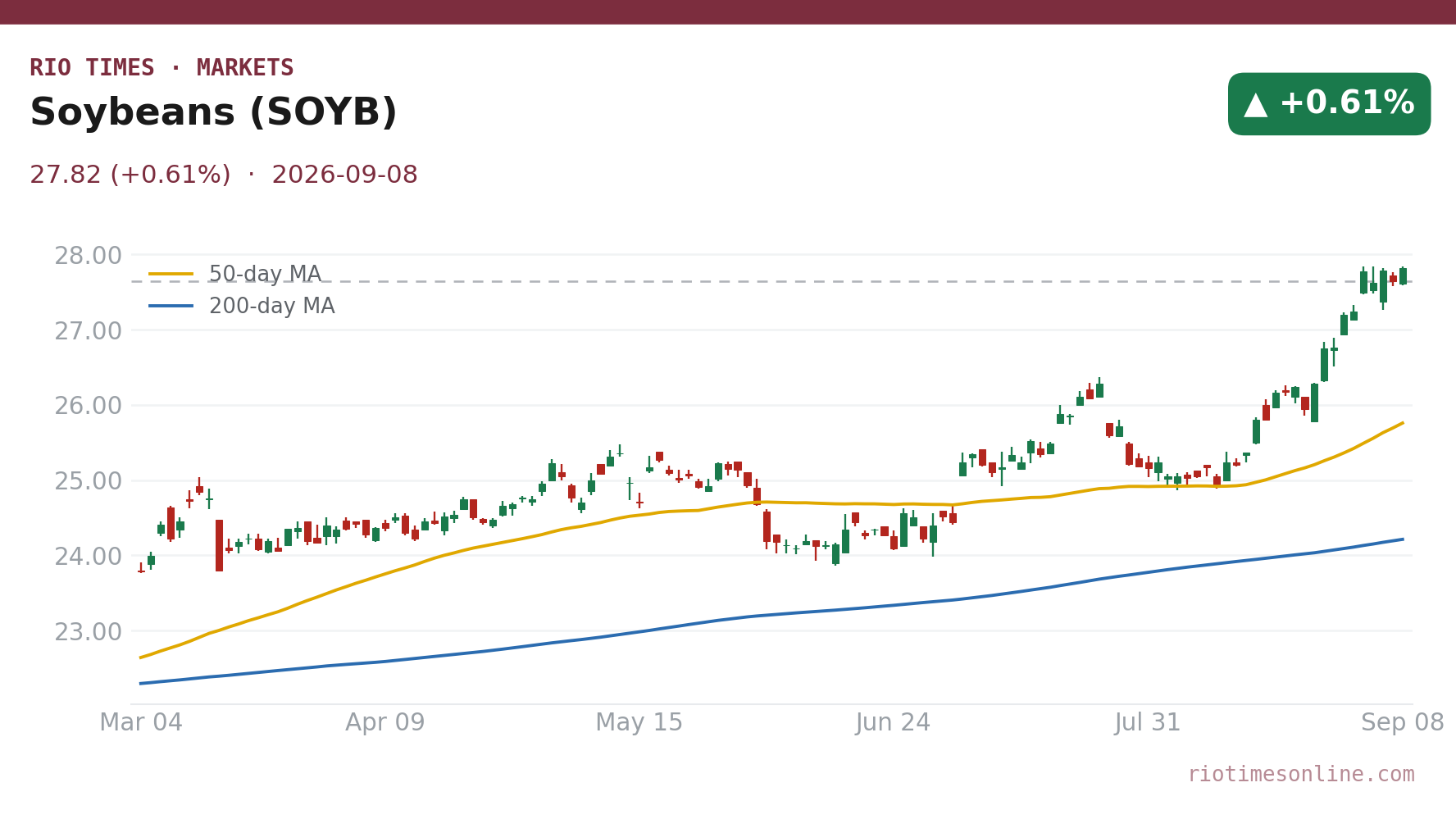
- Soybeans rose 0.61% to US$27.82 on the Soybean Tracker after Reuters reported China’s crushers face a fourth-quarter supply squeeze and Brazilian export premiums held near US$3.15-US$3.20 a bushel.
- Corn slipped 0.50% to US$19.97 on the Corn Tracker despite strong export demand, with traders taking profits after recent weather-driven gains in Chicago.
- Brazil and Argentina remain China’s lifeline with Argentina alone shipping 7.9 million tons of soybeans to China in 2025, the largest volume in six years.
- The currency link is tightening as a firmer Brazilian real versus the dollar would make Brazilian soybeans more expensive in dollar terms, just as Chinese buyers are most price-sensitive.
- WASDE positioning dominated the session, with traders squaring books before the USDA report that could reset global supply forecasts for all three crops.
Today’s Focus
Wheat posted the sharpest move of the session, rising 1.77% to US$26.96 on the Wheat Tracker as hopes for a negotiated pause in Black Sea fighting faded. Traders bought wheat as a hedge against renewed disruption to Ukrainian and Russian export corridors, exactly the risk that has repeatedly jolted global grain markets since the war began.
Soybeans gained 0.61% to US$27.82 on the Soybean Tracker, supported by Reuters reporting that Chinese crushers are scrambling for South American supplies in the fourth quarter. Brazil’s November shipment soybeans commanded a premium of US$3.15 to US$3.20 a bushel over Chicago futures, including freight to China, signalling just how tight nearby supply has become.
Corn was the outlier, down 0.50% to US$19.97 on the Corn Tracker. Traders booked profits on earlier weather-driven gains, even as export demand remained robust. The pullback leaves corn as the laggard in a session otherwise defined by risk premium in wheat and supply squeeze premium in soybeans.
What matters today. Wheat’s war-risk premium is back, soybeans are pricing a China supply squeeze from South America, and corn is pausing to digest strong exports before the next USDA report.
01 The session in one read
Wheat was the session’s clear leader, surging 1.77% to US$26.96 on the Wheat Tracker as traders concluded that US diplomatic attempts to calm Black Sea tensions had stalled. The failure of that channel put fresh energy into the war-risk bid that has periodically dominated wheat trading since 2022.
Soybeans advanced 0.61% to US$27.82 on the Soybean Tracker, with Chinese demand for South American cargoes the unmistakable driver. Corn, by contrast, slipped 0.50% to US$19.97 on the Corn Tracker, as profit-taking overwhelmed what was otherwise a supportive export picture.
T
h
e
s
e
s
s
i
o
n
s
p
l
i
t
i
n
t
o
t
w
o
n
a
r
r
a
t
i
v
e
s
:
g
e
o
p
o
l
i
t
i
c
a
l
r
i
s
k
r
e
p
r
i
c
i
n
g
i
n
w
h
e
a
t
,
a
n
d
a
s
u
p
p
l
y
s
c
a
r
c
i
t
y
r
e
p
r
i
c
i
n
g
i
n
s
o
y
b
e
a
n
s
,
w
h
i
l
e
c
o
r
n
t
o
o
k
a
b
r
e
a
t
h
e
r
.
C
h
i
n
a
‘
s
r
e
l
i
a
n
c
e
o
n
B
r
a
z
i
l
a
n
d
A
r
g
e
n
t
i
n
a
f
o
r
t
h
e
f
o
u
r
t
h
q
u
a
r
t
e
r
i
s
t
h
e
s
i
n
g
l
e
m
o
s
t
i
m
p
o
r
t
a
n
t
f
u
n
d
a
m
e
n
t
a
l
f
o
r
s
o
y
b
e
a
n
p
r
o
t
e
i
n
,
a
n
d
t
h
e
R
e
u
t
e
r
s
c
o
n
f
i
r
m
a
t
i
o
n
o
f
t
i
g
h
t
e
n
i
n
g
B
r
a
z
i
l
i
a
n
i
n
v
e
n
t
o
r
i
e
s
w
a
s
c
o
r
r
o
b
o
r
a
t
e
d
b
y
t
h
e
e
l
e
v
a
t
e
d
f
r
e
i
g
h
t
–
i
n
c
l
u
s
i
v
e
p
r
e
m
i
u
m
s
.
F
o
r
w
h
e
a
t
,
t
h
e
c
o
l
l
a
p
s
e
o
f
d
i
p
l
o
m
a
t
i
c
e
f
f
o
r
t
s
r
e
i
n
t
r
o
d
u
c
e
d
t
h
e
r
i
s
k
p
r
e
m
i
u
m
t
h
a
t
h
a
d
u
n
w
o
u
n
d
i
n
r
e
c
e
n
t
w
e
e
k
s
.
T
h
e
v
a
r
i
a
b
l
e
t
o
w
a
t
c
h
i
s
w
h
e
t
h
e
r
t
h
e
U
S
D
A
‘
s
S
e
p
t
e
m
b
e
r
W
A
S
D
E
,
d
u
e
w
i
t
h
i
n
d
a
y
s
,
r
a
i
s
e
s
S
o
u
t
h
A
m
e
r
i
c
a
n
p
r
o
d
u
c
t
i
o
n
e
n
o
u
g
h
t
o
o
f
f
s
e
t
t
h
e
C
h
i
n
a
d
e
m
a
n
d
i
m
p
u
l
s
e
o
r
i
n
s
t
e
a
d
v
a
l
i
d
a
t
e
s
t
h
e
m
a
r
k
e
t
‘
s
c
u
r
r
e
n
t
t
i
g
h
t
–
i
n
v
e
n
t
o
r
y
b
i
a
s
.
02 The board
The three trackers pointed in different directions, reflecting the distinct fundamentals now governing each crop. Wheat’s 1.77% move was the largest among the grains, a classic repricing of geopolitical uncertainty rather than any shift in physical supply.
Soybeans sat between the two other grains, with a modest 0.61% gain that understated the underlying tightness in Brazilian inventories. Corn fell back by 0.50%, rounding out a session in which the only common denominator was pre-WASDE positioning activity across Chicago.
| Asset | Level | Change |
|---|---|---|
| Soybeans (SOYB) | US$27.82 | +0.61% |
| Corn (CORN) | US$19.97 | -0.50% |
| Wheat (WEAT) | US$26.96 | +1.77% |
Source: RT close, 2026-09-08. Where a commodity has no spot feed, an exchange-traded tracker or leading producer is shown as a labelled proxy.
Live Market IntelligenceThe live market board
Rio Times · Live Market Intelligence
Latin America — Cross-Market Board
| Instrument | Last | Change | YoY | Prev. | High | Low | Volume |
|---|---|---|---|---|---|---|---|
| IBOV | 187,366.84 | +1.20% | +21.85% | 185,147.15 | 168,310 | 167,142 | — |
| IPSA | 11,315.26 | -1.14% | — | 11,445.90 | 11,210 | 10,984 | 1,513,213,483 |
| IPC MEX | 65,010.39 | +0.44% | +12.17% | 64,727.54 | 66,121 | 65,405 | 108,886,187 |
| MERVAL | 3,075,982 | +1.36% | +30.51% | 3,022,485 | 3,042,365 | 2,991,150 | — |
| COLCAP | 2,569.47 | +0.15% | — | 9.04 | 9.05 | 9.02 | 4,133 |
| BVL PERÚ | 59,620.96 | +1.05% | — | — | — | — | — |
| USD/BRL | 5.16 | +0.01% | -5.13% | 5.16 | 5.18 | 5.14 | — |
| EUR/BRL | 5.95 | +1.01% | -5.83% | 5.89 | 5.98 | 5.94 | — |
| USD/MXN | 17.06 | -0.24% | -8.58% | 17.10 | 17.08 | 17.01 | — |
| USD/CLP | 913.98 | +0.04% | -5.67% | 913.65 | 915.11 | 906.68 | — |
| USD/COP | 3,140 | +0.03% | -22.04% | 3,139 | 3,141 | 3,105 | — |
| USD/PEN | 3.36 | -0.66% | -4.82% | 3.38 | 3.38 | 3.35 | — |
| USD/ARS | 1,493 | +0.10% | +12.96% | 1,491 | 1,494 | 1,480 | — |
| USD/UYU | 40.27 | +1.24% | +1.80% | 39.77 | 40.27 | 40.23 | — |
| USD/PYG | 5,939 | +1.68% | -19.54% | 5,841 | 5,939 | 5,925 | — |
| USD/BOB | 11.64 | -0.76% | +72.04% | 11.73 | 11.72 | 11.64 | — |
| USD/DOP | 58.34 | +1.25% | -3.44% | 57.62 | 58.34 | 58.04 | — |
| USD/CRC | 445.92 | +0.89% | -9.71% | 441.97 | 448.50 | 445.92 | — |
03 What moved it
Wheat rose after multiple grains reports flagged that US diplomatic attempts to calm Black Sea tensions had faltered, reviving fears of export disruption. Interest in wheat futures is growing, according to trade commentary, as fund managers rebuild long exposure that had been trimmed during the recent détente hopes.
Soybeans found their floor in China’s fourth-quarter supply calculus. Reuters reported that Brazilian soybean inventories are tightening just as Chinese processors face weak margins and high costs, making the South American premium of US$3.15 to US$3.20 a bushel over Chicago for November shipment a decisive signal.
Corn’s decline on strong export demand is best read as technical. After weather-related gains in recent sessions, traders locked in profits ahead of the USDA’s World Agricultural Supply and Demand Estimates, a report that often resets the narrative on global stocks.
04 The Latin American read
For Brazil and Argentina, Tuesday’s tape confirms their role as the world’s marginal soybean supplier to China. Argentina shipped 7.9 million tons of soybeans to China in 2025, the largest volume in six years, according to the Rosario grains exchange, and that flow now underpins Beijing’s near-term crush margins.
The currency link is becoming more acute. A stronger Brazilian real against the US dollar makes Brazilian soybeans more expensive once converted from reais, potentially eroding the current export premium and handing a competitive edge to Argentine shippers or even to any US cargoes that manage to move despite tariffs.
Brazil’s corn position is equally instructive. With Brazil’s 2025/26 corn crop raised to 142.96 million metric tons and Argentina’s to 70.5 million metric tons in the latest production revisions, both countries are long into a world market that is fully supplied except for localised disruptions.
05 The names to watch
The Wheat Tracker’s move towers over the other two trackers, and it is the clearest candidate for further volatility if war rhetoric escalates. Traders should watch whether the failure of diplomacy translates into new insurance premium in Black Sea freight markets.
The Soybean Tracker’s advance is steadier but possibly more durable, because it rests on physical supply tightness in Brazil rather than on sentiment. The freight-inclusive premium for November shipment is a number to monitor daily.
The Corn Tracker’s fall, while small, is the most technically vulnerable. A strong WASDE print containing upward revisions to South American production could deepen the profit-taking, while any downward revision would force a quick round of short-covering.
06 The outlook
The market’s eyes now turn to the USDA’s WASDE report, due at noon Eastern on Friday 11 September, which will either validate the current tight-soybean, war-risk-wheat setup or puncture it with higher production numbers. For Latin America, the report is a proxy for whether Brazilian and Argentine farmers can monetise today’s elevated premiums, or whether the window is already closing.
07 What to watch
- Black Sea shipping insurance: If war-risk premiums on vessels rise, wheat’s 1.77% gain on Tuesday will look conservative and further upside is likely.
- Brazil November soybean premium: The US$3.15-US$3.20 a bushel over Chicago is the clearest real-time measure of how desperate Chinese buyers are for South American supply.
- USDA WASDE report: The next update could raise Brazil and Argentina production estimates, testing whether the soybean tightness narrative survives a global supply review.
- Brazilian real against US dollar: A strong real erodes exporter margins in dollar terms and could force Brazilian soybean sellers to accept lower premiums to keep cargoes moving.
Frequently Asked Questions
Why did wheat rise so sharply on Tuesday?
Wheat gained 1.77% as US diplomatic attempts to ease Black Sea tensions stalled, reviving concern over Russian and Ukrainian export disruptions.
Why are soybeans rising while corn is falling?
Soybeans are drawing support from a Chinese supply squeeze in South America, with Brazilian export premiums elevated. Corn is seeing profit-taking after earlier weather rallies.
What do Brazil and Argentina have to do with China’s soybean needs?
China relies on Brazil and Argentina for fourth-quarter soybean supplies, with Argentina shipping 7.9 million tons to China in 2025, the largest volume in six years.
What is the WASDE report and why does it matter now?
The USDA’s World Agricultural Supply and Demand Estimates updates global grain and oilseed supply and demand. Tuesday’s positioning reflects traders adjusting ahead of that release.
Market data: RT
This article was produced by The Rio Times’ automated newsroom system. How we use AI · Report an error
LatAm Markets: Live Signals → — real-time movers, turnover leaders and FX across Latin America.
Read More from The Rio Times