Key Facts
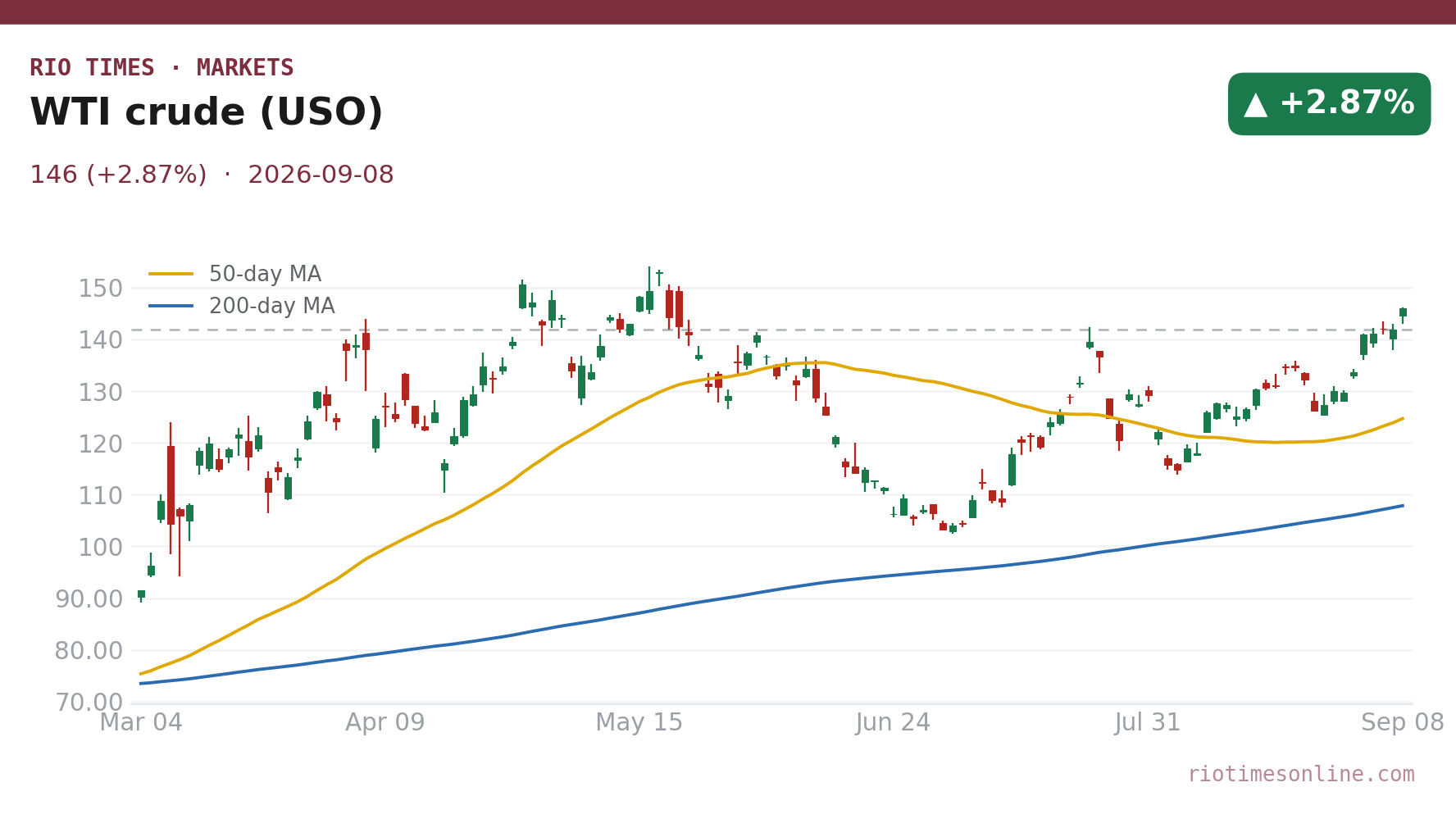
- USO jumped 2.87% to US$146.03 on Tuesday, its sharpest single-session move in the current Middle East escalation.
- Petrobras rose 3.53% to US$20.83 as higher benchmark prices lifted deepwater pre-salt economics.
- Ecopetrol gained 3.07% to US$17.78, tracking the broader rally in Latin American state-backed producers.
- YPF added 0.89% to US$53.09, a more muted move as investors weighed Vaca Muerta activity against Argentina risk.
- Houthi strikes wounded 73 people at Saudi energy facilities, slowing tanker traffic through the Strait of Hormuz and pushing Brent near US$98.7.
- Chevron plans to more than double Venezuela rigs under a five-year expansion targeting roughly 600,000 barrels per day, CFO Eimear Bonner said Tuesday.
Today’s Focus
Oil proxies rallied hard on Tuesday as the Middle East supply scare intensified. USO, the United States Oil Fund, closed at US$146.03, up 2.87%. It holds near-month WTI futures rather than the physical barrel, so it tracks the front of the curve rather than spot.
The trigger was another Houthi attack on Saudi energy infrastructure that wounded 73 people, alongside Iranian threats of further retaliation. Tanker traffic through the Strait of Hormuz slowed again, pushing Brent intraday just below US$100.
Latin American producers followed the benchmark higher. Petrobras rose 3.53%, Ecopetrol 3.07% and YPF 0.89%, with the strongest gains in the names most exposed to Brent-linked export pricing.
Venezuela supplied a quieter subplot: Chevron said it will more than double its drilling rigs there under new contract terms signed last week, backed by more than US$7 billion of investment, a signal that sanctions-era oil politics are shifting.
What matters today. The market is now pricing a prolonged Hormuz disruption, not a short-lived shock, and that revalues every Latin American barrel.
01 The session in one read
Oil markets traded as if the Strait of Hormuz were already half-closed on Tuesday. USO, the fund that tracks WTI crude, closed at US$146.03, a jump of 2.87% on the day.
The immediate spark was a Houthi attack on Saudi energy facilities that wounded 73 people. Iran followed with threats of further retaliation, and tanker traffic through Hormuz slowed again, pulling Brent toward the US$100 mark before settling near US$98.7.
Traders who had spent the early months of the war betting on a quick ceasefire have reversed course. Hedge funds are now piling into fuels, a sign that the market expects the supply squeeze to outlast the fighting.
The Tuesday session confirmed that traders have stopped waiting for a quick de-escalation. Hedge funds are piling into fuels, Iran’s exports are collapsing under fresh sanctions, and the supply squeeze is broadening beyond crude into refined products. For Latin America, the read-through is straightforward: higher benchmark prices improve margins for Petrobras, Ecopetrol and YPF, but the real variable to watch is whether the Hormuz disruption persists long enough to force Asian buyers to source more Atlantic Basin crude from Brazil and Guyana.
02 The board
The rally was broad across Latin American oil equities. Petrobras, Brazil’s state-controlled producer and the main operator of the pre-salt, rose 3.53% to US$20.83, the strongest of the regional names.
Ecopetrol, Colombia’s national oil company, gained 3.07% to US$17.78, reflecting its own Brent-linked crude exports.
YPF, Argentina’s flagship producer and the largest fracturing player in Vaca Muerta, rose a more modest 0.89% to US$53.09, with Argentine country risk tempering the oil-price impulse.
| Asset | Level | Change |
|---|---|---|
| WTI crude (USO) | US$146.03 | +2.87% |
| Petrobras | US$20.83 | +3.53% |
| Ecopetrol | US$17.78 | +3.07% |
| YPF | US$53.09 | +0.89% |
Source: RT close, 2026-09-08. Where a commodity has no spot feed, an exchange-traded tracker or leading producer is shown as a labelled proxy.
Live Market IntelligenceThe live market board
Rio Times · Live Market Intelligence
Latin America — Cross-Market Board
| Instrument | Last | Change | YoY | Prev. | High | Low | Volume |
|---|---|---|---|---|---|---|---|
| IBOV | 205,082.56 | +0.47% | +21.85% | 204,120.12 | 168,310 | 167,142 | — |
| IPSA | 10,746.36 | -0.31% | — | 10,780.31 | 11,210 | 10,984 | 1,513,213,483 |
| IPC MEX | 69,879.62 | -0.01% | +12.17% | 69,889.73 | 66,121 | 65,405 | 108,886,187 |
| MERVAL | 3,017,221 | — | +30.51% | 3,022,485 | 3,042,365 | 2,991,150 | — |
| COLCAP | 2,540.10 | +0.46% | — | 9.04 | 9.05 | 9.02 | 4,133 |
| BVL PERÚ | 57,021.19 | +0.13% | — | — | — | — | — |
| USD/BRL | 5.16 | +0.01% | -5.13% | 5.16 | 5.18 | 5.14 | — |
| EUR/BRL | 5.95 | +1.01% | -5.83% | 5.89 | 5.98 | 5.94 | — |
| USD/MXN | 17.06 | -0.24% | -8.58% | 17.10 | 17.08 | 17.01 | — |
| USD/CLP | 913.98 | +0.04% | -5.67% | 913.65 | 915.11 | 906.68 | — |
| USD/COP | 3,140 | +0.03% | -22.04% | 3,139 | 3,141 | 3,105 | — |
| USD/PEN | 3.36 | -0.66% | -4.82% | 3.38 | 3.38 | 3.35 | — |
| USD/ARS | 1,493 | +0.10% | +12.96% | 1,491 | 1,494 | 1,480 | — |
| USD/UYU | 40.27 | +1.24% | +1.80% | 39.77 | 40.27 | 40.23 | — |
| USD/PYG | 5,939 | +1.68% | -19.54% | 5,841 | 5,939 | 5,925 | — |
| USD/BOB | 11.64 | -0.76% | +72.04% | 11.73 | 11.72 | 11.64 | — |
| USD/DOP | 58.34 | +1.25% | -3.44% | 57.62 | 58.34 | 58.04 | — |
| USD/CRC | 445.92 | +0.89% | -9.71% | 441.97 | 448.50 | 445.92 | — |
03 What moved it
The Houthi strike on Saudi energy sites marked the second significant attack on Gulf infrastructure since the war began. With 73 people wounded and Iran threatening more, shipowners reassessed the safety of Hormuz transits, where much of the world’s oil and liquefied natural gas passes.
Washington added another squeeze the same week: the US Treasury sanctioned a Turkish investment bank and two subsidiaries for allegedly moving Iranian oil revenue. That follows more than six months of disruption in Iranian export flows.
The futures curve told the story clearly. One key WTI contract traded around US$93.99, up 2.74% on the day, while Brent continuous contracts hovered near US$97.67. Spot and front-month prices are being dragged upward by war risk, not by any recovery in demand.
04 The Latin American read
For Brazil, higher Brent prices improve the economics of pre-salt deepwater projects, which are long-life and low-decline but expensive to develop. Petrobras is the clearest beneficiary, and foreign investors read its 3.53% gain as a direct expression of that leverage.
Guyana’s Stabroek block, operated by ExxonMobil with Hess and CNOOC, remains the region’s fastest-growing new source of light sweet crude. It adds Atlantic Basin supply precisely when Asian buyers may need alternatives to Middle Eastern barrels.
Mexico stays the laggard. Pemex reported 1.7 million barrels per day of liquids in the second quarter, and its Olmeca refinery set a July record of 252,498 barrels of fuel per day, but the company is still pushing for faster private contracts through director general Juan Carlos Carpio.
Argentina’s Vaca Muerta continues to ramp. August saw 2,262 fracturing stages, up 12.5% from July, with YPF controlling 47.5% of the 2026 total. A technical report estimated 8.7 billion barrels of sub-US$55 WTI resources and 109 trillion cubic feet of sub-US$3 gas, enough for a decade of development.
05 The names to watch
Petrobras is the tightest link between the war premium and shareholder returns. It gained more than any other Latin American oil name on Tuesday, and its pre-salt portfolio benefits directly from every dollar Brent holds above the company’s lifting costs.
YPF is the volume story. Its 998 August fracturing stages across La Amarga Chica, Loma Campana and Lajas Este show Vaca Muerta is accelerating even as Argentine macro risks keep a lid on the share price.
Chevron’s Venezuela expansion is now the wildcard. CFO Eimear Bonner said Tuesday the company will more than double its rig count under terms signed last week, lifting output from about 290,000 barrels per day to roughly 600,000 by 2031, a shift that would reopen a major heavy-crude province to US capital.
06 The outlook
The market has entered the seventh month of the US-Iran war with no resolution in sight, and the fuels complex is now tightening alongside crude. That supports a higher floor for Latin American oil equities, but also raises the stakes for any diplomatic surprise. The next escalation trigger is a full closure of Hormuz, while the key downside risk is a credible ceasefire in the Middle East.
07 What to watch
- Strait of Hormuz traffic: Any further slowdown in tanker transits would validate the war premium and pull Brent decisively above US$100.
- Petrobras export realisations: How much of the Brent gain flows to pre-salt margins, given Petrobras still sells much of its output domestically at government-influenced prices.
- Vaca Muerta completions: September fracturing stage counts will show whether Argentina’s August acceleration is a one-off or a sustainable ramp.
- Chevron’s Venezuela rig count: Each additional rig confirms that sanctions terms are easing for US operators, reshaping heavy crude supply into the US Gulf.
Frequently Asked Questions
Why did USO jump 2.87% on Tuesday?
Houthi attacks on Saudi energy facilities wounded 73 people and slowed tanker traffic through the Strait of Hormuz, pushing WTI sharply higher.
Which Latin American oil stock rose most?
Petrobras rose 3.53% to US$20.83, the strongest gain among the region’s major oil proxies.
What is happening in Venezuela?
Chevron plans to double its drilling rig count under new contract terms signed last week, targeting roughly 600,000 barrels per day.
Why did YPF rise less than Petrobras?
YPF added 0.89% as strong Vaca Muerta activity competed with Argentine country risk, which tempered the oil-price rally.
Market data: RT
This article was produced by The Rio Times’ automated newsroom system. How we use AI · Report an error · Editorial responsibility: Matthias Camenzind, Editor-in-Chief
LatAm Markets: Live Signals → — real-time movers, turnover leaders and FX across Latin America.