
Key Facts
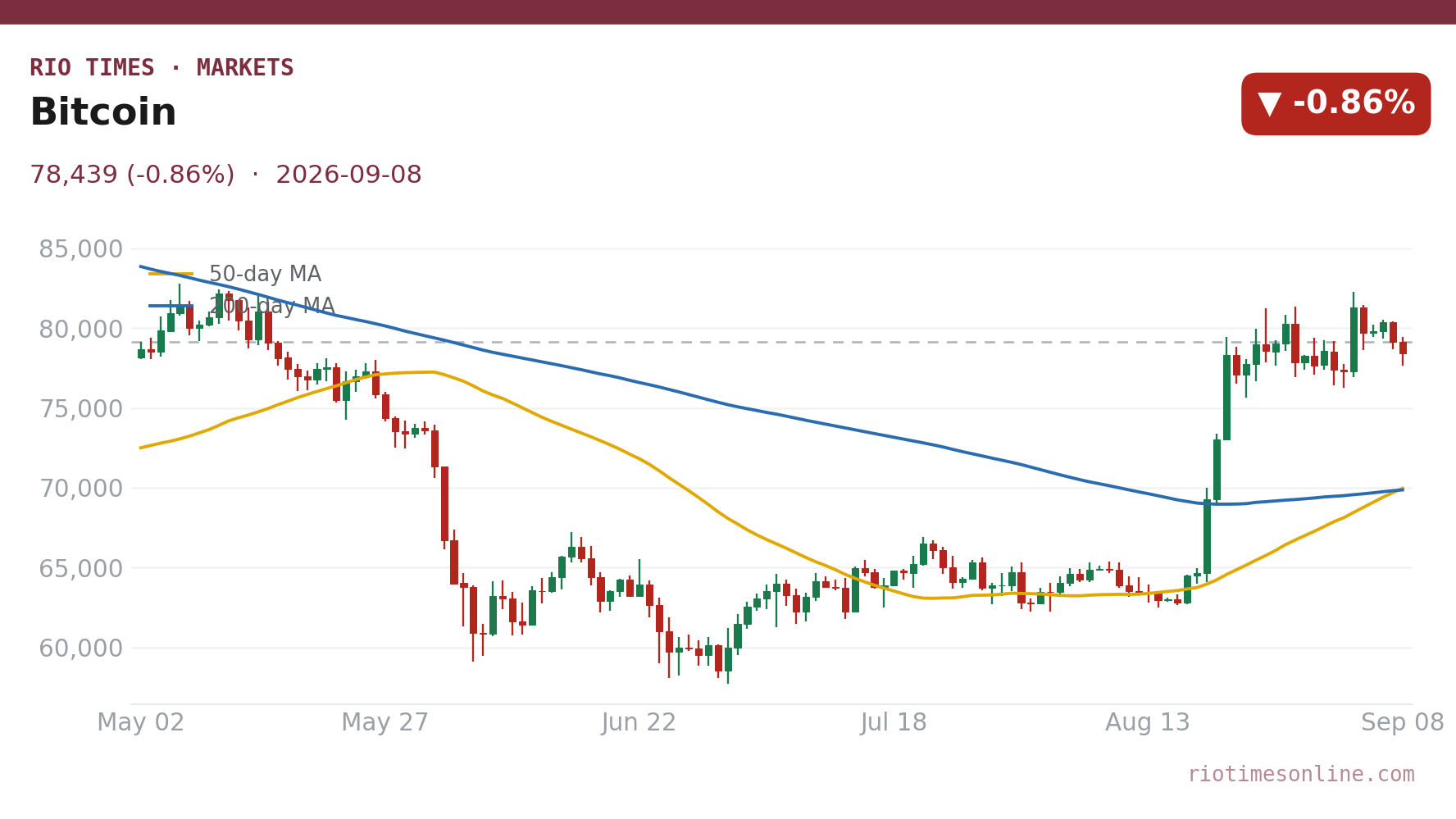
- Bitcoin settled at US$78,439 down 0.86 percent on Tuesday, September 8, 2026, losing the US$80,000 level as oil prices jumped.
- XRP bucked the sell-off climbing 1.32 percent to US$1.4162, the only major token to rise on the session.
- Ethereum eased to US$2,485 a modest 0.24 percent decline, while Solana slipped 0.52 percent to US$103.33.
- Visa is bringing onchain credit to its stablecoin card, pairing VisaNet settlement data with blockchain lending after network volume jumped nearly 200 percent year over year.
- Brazilian crypto turnover is overwhelmingly stablecoins with 98 percent of a US$6.9 billion first-quarter 2026 volume in dollar-linked tokens, according to central bank data.
- El Salvador holds about 7,660 BTC in its sovereign treasury as of May 2026, while digital-currency remittances hit US$35.4 million in the first half of 2026, up 39.1 percent year over year.
Today’s Focus
Bitcoin settled at US$78,439 on Tuesday, September 8, 2026, down 0.86 percent on the UTC daily close, as a three-month high in US crude oil revived fears that the Federal Reserve will keep interest rates higher for longer. Ether fell 0.24 percent to US$2,485 and Solana lost 0.52 percent to US$103.33, while XRP added 1.32 percent to US$1.4162.
The move tracked a weak open on Wall Street, where stocks stalled in a tight range ahead of Friday’s US inflation report and the Fed’s September 16 rate decision. Analysis flagged US$78,300 as a key support level for Bitcoin, with futures pricing showing leveraged traders taking profits after the early-September run-up.
For Latin America, the Bitcoin price swing matters less than the steady build-out of stablecoin payment rails. Visa’s new onchain credit line for stablecoin cards, announced this week, points to where the region is heading: dollar-linked tokens moving at low cost across borders.
Brazil, Argentina and El Salvador are each anchoring adoption through different channels, from Pix-linked stablecoin turnover in Brazil to bottom-up dollarisation in Argentina and sovereign Bitcoin holdings in El Salvador.
What matters today. Bitcoin’s macro-driven pause matters less for Latin America than the accelerating integration of stablecoins into payment and credit infrastructure.
01 The session in one read
Bitcoin slipped back below US$80,000 on Tuesday, September 8, 2026, settling at US$78,439 for a daily loss of 0.86 percent. A jump in US crude oil to a three-month high rekindled concerns that the Federal Reserve will keep monetary policy tighter for longer, prompting profit-taking after the coin’s early-September rally.
Ethereum held up slightly better, easing 0.24 percent to US$2,485, while Solana fell 0.52 percent to US$103.33. XRP was the outlier, gaining 1.32 percent to US$1.4162 as traders rotated into the payments-focused token on news of Visa’s expanding stablecoin card programme.
Bitcoin is again behaving like a risk asset, falling with US stocks when oil prices spike and rate-hike fears return. Yet the durable story for Latin America is not the spot price of one token but the expansion of dollar-linked payment rails that handle over 90 percent of regional digital-asset volume. Visa’s onchain credit feature, Robinhood’s prediction-market equity stake in Crypto.com and Franklin Templeton’s former digital-asset chief taking the helm at StablecoinX all point to institutional plumbing being built during this quiet week. The variable to watch is whether Bitcoin holds the US$78,300 support into Friday’s US inflation print, which could set the tone for the Fed’s September 16 meeting.
02 The board
The board shows a broad but shallow pullback rather than a rout. Bitcoin’s 0.86 percent decline at US$78,439 was the largest among the four majors, while Ether’s 0.24 percent slip to US$2,485 suggests holders are reluctant to sell ahead of a key US inflation week.
The divergence is telling: XRP’s 1.32 percent rise to US$1.4162 came as Visa unveiled onchain credit for its stablecoin card, directly linking blockchain lending to payment settlement. Solana’s 0.52 percent dip to US$103.33 reflects its higher sensitivity to speculative trading volumes, which cooled across the board on Tuesday.
| Asset | Level | Change |
|---|---|---|
| Bitcoin | US$78,439 | -0.86% |
| Ethereum | US$2,485 | -0.24% |
| Solana | US$103.33 | -0.52% |
| XRP | US$1.4162 | +1.32% |
Source: RT close, 2026-09-08. Where a commodity has no spot feed, an exchange-traded tracker or leading producer is shown as a labelled proxy.
Live Market IntelligenceThe live market board
Rio Times · Live Market Intelligence
Latin America — Cross-Market Board
| Instrument | Last | Change | YoY | Prev. | High | Low | Volume |
|---|---|---|---|---|---|---|---|
| IBOV | 205,082.56 | +0.47% | +21.85% | 204,120.12 | 168,310 | 167,142 | — |
| IPSA | 10,746.36 | -0.31% | — | 10,780.31 | 11,210 | 10,984 | 1,513,213,483 |
| IPC MEX | 69,879.62 | -0.01% | +12.17% | 69,889.73 | 66,121 | 65,405 | 108,886,187 |
| MERVAL | 3,017,221 | — | +30.51% | 3,022,485 | 3,042,365 | 2,991,150 | — |
| COLCAP | 2,540.10 | +0.46% | — | 9.04 | 9.05 | 9.02 | 4,133 |
| BVL PERÚ | 57,021.19 | +0.13% | — | — | — | — | — |
| USD/BRL | 5.16 | +0.01% | -5.13% | 5.16 | 5.18 | 5.14 | — |
| EUR/BRL | 5.95 | +1.01% | -5.83% | 5.89 | 5.98 | 5.94 | — |
| USD/MXN | 17.06 | -0.24% | -8.58% | 17.10 | 17.08 | 17.01 | — |
| USD/CLP | 913.98 | +0.04% | -5.67% | 913.65 | 915.11 | 906.68 | — |
| USD/COP | 3,140 | +0.03% | -22.04% | 3,139 | 3,141 | 3,105 | — |
| USD/PEN | 3.36 | -0.66% | -4.82% | 3.38 | 3.38 | 3.35 | — |
| USD/ARS | 1,493 | +0.10% | +12.96% | 1,491 | 1,494 | 1,480 | — |
| USD/UYU | 40.27 | +1.24% | +1.80% | 39.77 | 40.27 | 40.23 | — |
| USD/PYG | 5,939 | +1.68% | -19.54% | 5,841 | 5,939 | 5,925 | — |
| USD/BOB | 11.64 | -0.76% | +72.04% | 11.73 | 11.72 | 11.64 | — |
| USD/DOP | 58.34 | +1.25% | -3.44% | 57.62 | 58.34 | 58.04 | — |
| USD/CRC | 445.92 | +0.89% | -9.71% | 441.97 | 448.50 | 445.92 | — |
03 What moved it
Oil was the spark. US crude hit a three-month high, reviving fears that energy-driven inflation could force the Fed to keep rates elevated beyond what crypto and equity markets had priced in. Bitcoin fell with US stocks at the open of Wall Street’s Tuesday session, with analysis pointing to US$78,300 as a critical support level that bulls must defend.
Institutional buying continued quietly beneath the surface. Vivek Ramaswamy’s Strive added 1,375 Bitcoin last week, its third straight week of 5 percent-plus accumulation, while Tom Lee’s Bitmine purchased enough Ethereum to reach 5.93 million tokens, roughly 4.9 percent of total supply.
Yet the macro backdrop dominated. The S&P 500 ground inside its tightest range of the year, waiting on Friday’s inflation report before the Fed’s September 16 rate decision. Bitcoin futures for the September contract showed leveraged traders taking profits, with daily losses extending beyond spot into derivatives.
04 The Latin American read
Brazil’s crypto market is now essentially a stablecoin market. First-quarter 2026 data shows 98 percent of a US$6.9 billion quarterly turnover flowed through dollar-linked tokens, helped by Pix instant payments and new virtual-asset rules from the central bank that took force in February 2026.
Brazil processed roughly US$89 billion in stablecoin transactions in 2025, more than all of Africa combined. The new rules require virtual-asset service providers to hold capital of BRL10.8 million to BRL37.2 million and comply with travel-rule reporting, a regulatory anchor that is drawing institutions rather than deterring them.
In Argentina, researchers find USDT and USDC account for more than 70 percent of crypto purchases, with roughly 75 percent of crypto-paid workers choosing stablecoin salaries. That is bottom-up dollarisation against local-currency weakness and capital controls, a pattern that intensifies whenever the peso slides.
El Salvador tells a different story. The sovereign treasury held about 7,660 BTC as of May 2026, worth over US$500 million then, yet digital-currency remittances reached only US$35.4 million in the first half of 2026. That is up 39.1 percent year over year but still just 0.7 percent of total remittances, showing everyday use remains concentrated in transfers rather than investment.
05 The names to watch
Visa is the most consequential name this week after pairing VisaNet settlement data with blockchain lending to offer onchain credit to stablecoin card programmes. The company says stablecoin payment volume on its network jumped nearly 200 percent year over year, a signal that dollar-linked tokens are moving from speculation to payment rails.
Robinhood took equity stakes in Crypto.com and OG.com, routing event contracts through OG.com’s CFTC-regulated infrastructure as it expands prediction markets. The multi-year deal positions the brokerage to capture faster-growing, lower-margin trading activity in a market where the core spot business is flat.
Franklin Templeton’s former digital-asset executive Christopher Jensen is taking the helm at StablecoinX, the largest corporate holder of Ethena’s ENA token. That appointment links a traditional asset manager’s alumni network to the newer world of yield-bearing stablecoin infrastructure, a bridge Latin American institutions are watching closely.
06 The outlook
Bitcoin’s immediate fate hinges on Friday’s US inflation report, which will shape expectations for the Federal Reserve’s September 16 rate decision. A hot print could push the coin below US$78,300 support; a cool one could restore the momentum that carried it above US$80,000 earlier this month.
07 What to watch
- US inflation report: Friday’s US inflation data will set the tone for the Fed’s September 16 rate decision and Bitcoin’s near-term direction.
- Visa stablecoin credit: Watch how fast fintechs and stablecoin card programmes adopt Visa’s new onchain lending feature, a signal of mainstream payment integration.
- El Salvador treasury: Any change to El Salvador’s 7,660 BTC sovereign holdings will move sentiment in a country where Bitcoin is national policy.
- Brazil VASP rules: The February 2026 virtual-asset rules are now being enforced; watch for shifts in which exchanges and custodians remain active in Brazil.
Frequently Asked Questions
Why did Bitcoin fall on Tuesday?
Bitcoin fell 0.86 percent to US$78,439 as US crude oil hit a three-month high, reviving fears of tighter Federal Reserve policy and prompting profit-taking.
Why did XRP rise while other majors fell?
XRP gained 1.32 percent to US$1.4162 after Visa announced onchain credit for its stablecoin card, directly tying blockchain lending to payment settlement.
What is driving crypto adoption in Brazil?
Stablecoins account for 98 percent of Brazil’s US$6.9 billion quarterly crypto volume, supported by Pix instant payments and new central bank virtual-asset rules.
How does Argentina use crypto?
USDT and USDC make up over 70 percent of Argentine crypto purchases, with 75 percent of crypto-paid workers choosing stablecoin salaries as a hedge against currency weakness.
Market data: RT
This article was produced by The Rio Times’ automated newsroom system. How we use AI · Report an error · Editorial responsibility: Matthias Camenzind, Editor-in-Chief
LatAm Markets: Live Signals → — real-time movers, turnover leaders and FX across Latin America.