Global Economy Briefing — August 10, 2026
Global economy: Gold surged past $4,340 and silver jumped nearly 3% as US bond yields retreated and the dollar index fell below 99.6, reshaping the global
Key Facts
- Gold vaulted 2.11% to $4,342 an ounce, its highest close since late July, as investors moved into the metal while US bond yields and the dollar eased. Gold remains about 21% below its record close of $5,513, set on 28 January 2026.
- The US 10-year Treasury yield slipped to 4.651% extending its recent decline and signalling that bond traders are betting the Federal Reserve’s tightening cycle is finished.
- The US dollar index weakened 0.39% to 99.539 losing grip of the 100 handle and dragging the greenback lower against nearly every major currency in the risk-on session.
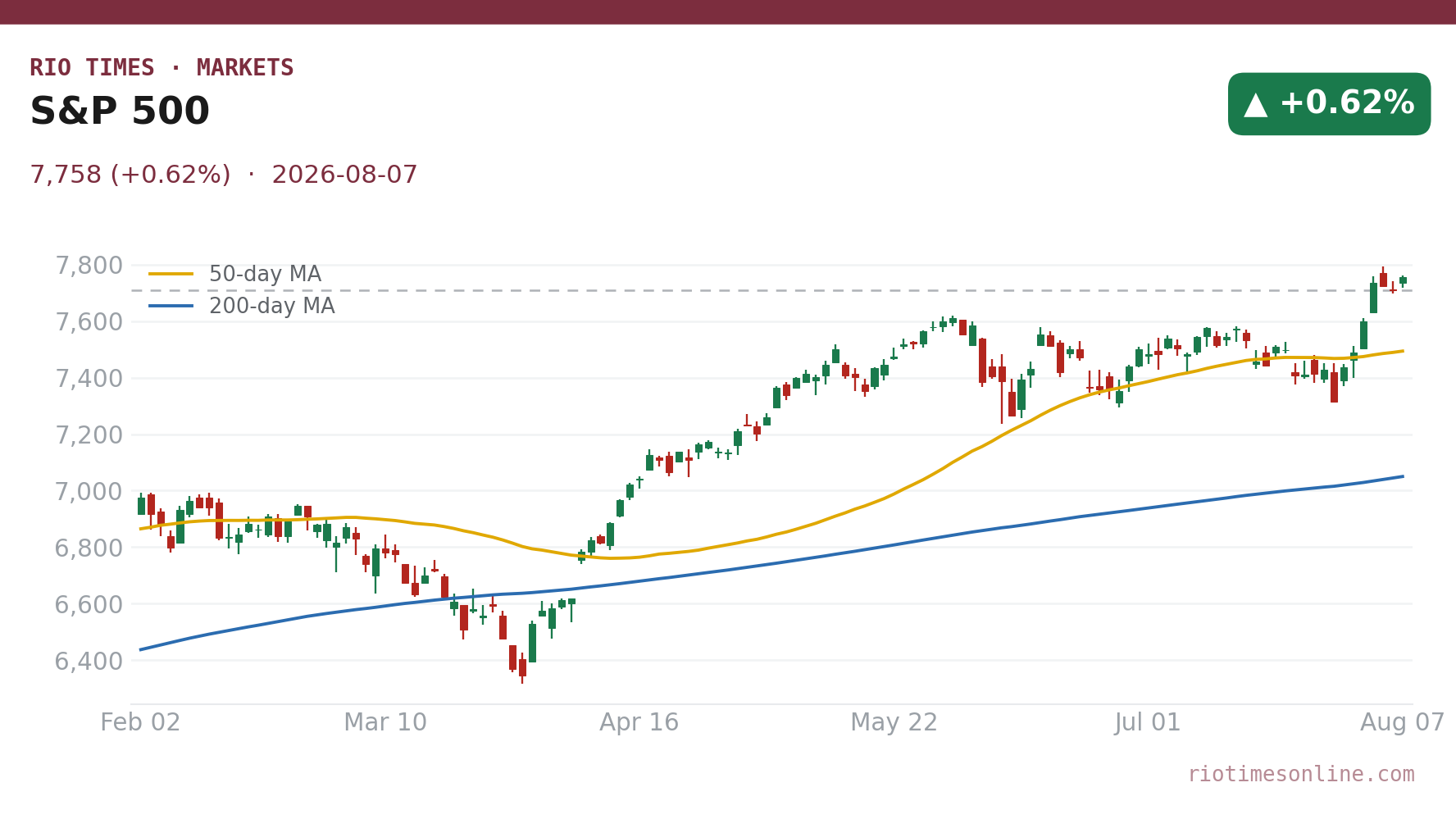
- The Nasdaq jumped 1.30% to lead Wall Street higher while the broader S&P 500 added 0.62% to touch 7,758, tying its 52-week high as tech stocks rebounded sharply.
- The VIX fear gauge eased 1.65% to 14.9 reflecting calm across equity markets even as traders grew skeptical that the Fed would deliver another rate increase this year.
Today’s Focus
Gold’s sprint above $4,342 an ounce was the loudest signal yet that global money is repositioning for a world where the Federal Reserve stays on hold. The metal has now broken out of its recent range, fuelled by a retreat in the US 10-year Treasury yield to 4.651% and a wilting dollar, which slumped 0.39% on the dollar index to 99.539.
The move wasn’t isolated to gold. Silver soared nearly 3% to $63.47 an ounce, confirming that the precious-metals complex is catching a strong bid. This is the classic playbook when bond markets smell the end of a rate-hiking cycle — lower real yields make gold far more attractive as a non-interest-bearing asset.
Equities joined the party, led by a 1.30% surge in the tech-heavy Nasdaq. The S&P 500 closed at 7,758, matching its 52-week peak and erasing weeks of chop. With the VIX volatility index sliding to 14.9, there was little appetite for hedging, suggesting conviction behind the rally.
The catalyst is a growing consensus that the Fed’s next move is a cut, not a hike, even if chair Jay Powell hasn’t said so yet. The NFIB small business optimism reading due later today and the 3-year note auction will test whether the bond-market bid has legs. For now, the world is trading a dovish turn that central bankers have not yet confirmed.
What matters today. Whether the bond market rally can survive this week’s US inflation data and Treasury auction, or if gold’s breakout is getting ahead of the Federal Reserve’s actual stance.

| Instrument | Level | Session |
|---|---|---|
| S&P 500 (US) | 7,758 | +0.62% |
| Ibovespa (Brazil) | 172,513 | -1.73% |
| USD/BRL | 5.0815 | -0.57% |
Global economy — Source: RT close, 2026-08-07. Figures rendered directly from the feed.
01 The world in one read
Friday’s session belonged to gold. The metal surged 2.11% to $4,342 an ounce as traders responded to a broad retreat in the US dollar and government bond yields. It was the clearest statement yet that global investors are positioning for a Federal Reserve that will not raise rates again, even if Fed officials have been cautious in their own public remarks.
That conviction coursed through equities as well. The Nasdaq vaulted 1.30% to 26,691, the Dow edged up 0.28% to 54,037, and the S&P 500 tied its 52-week best at 7,758. The VIX volatility index dipped to 14.9, underscoring the sanguine mood and a lack of demand for portfolio protection.
The macro backdrop is shifting beneath the surface. Japan’s Eco Watchers survey showed sentiment among households and businesses perking up, with the current index rising to 44.4 and the outlook improving. That came as traders awaited the Bank of Japan’s next cue, though the M3 money supply data due later could offer a window into how liquidity is moving in the world’s third-largest economy.
Overnight, investors will get readings on US small-business confidence and existing home sales, alongside a 3-year Treasury note auction. The week’s centrepiece, however, will be US consumer inflation numbers, which have the power to validate — or violently reverse — the bond market’s dovish wager.
Financial markets are pricing a soft landing with near certainty. But the evidence from policymakers is thinner.
The dollar and yields have dropped sharply. This reflects a powerful cross-asset bet that the Fed is done.
That bet faces a key test. US inflation prints and this week’s Treasury auctions will provide answers.
Watch whether gold can hold its breakout. That depends on US 10-year yields finding a floor near 4.60%.
02 The global board
| Instrument | Level | Change | Read |
|---|---|---|---|
| Gold (oz) | $4,342 | +2.11% | Highest close since late July |
| Silver (oz) | $63.47 | +2.94% | Joins gold in a sharp precious-metals bid |
| DXY Index | 99.539 | −0.39% | Slips below 100 as the greenback softens |
| US 10Y Yield | 4.651% | −0.64% | Bond prices jump; yield extends its decline |
| Nasdaq | 26,691 | +1.30% | Tech leads Wall Street higher |
| S&P 500 | 7,758 | +0.62% | Ties its 52-week high in a broad advance |
| VIX | 14.9 | −1.65% | Fear gauge at its lowest in weeks |
The table reflects a classic risk-on rotation with a hard-currency twist. Gold’s jump to $4,342 was not a blip but a breakdown of the old range — the metal has been coiling for weeks and finally broke decisively higher as US real yields compressed. Silver followed in lockstep, a sign that the move is being led by conviction rather than a single safe-haven trade.
The dollar’s decline was equally telling. The DXY sinking below 100 removes a psychological floor that had held through much of the summer. A weaker greenback eases financial conditions globally, which in turn supports equities, emerging-market currencies, and dollar-denominated commodities all at once. Rio Times · Live Market Intelligence
Live Market IntelligenceGlobal Markets — Live Board
Global Markets — Live Board
Instrument Last Change YoY Prev. High Low Volume
SPX
7,751
+0.29%
—
—
—
—
—
NDX
29,799
+0.93%
—
—
—
—
—
DJI
53,810
+0.03%
—
—
—
—
—
RUT
3,041
+0.46%
—
—
—
—
—
US10Y
4.6760
-0.17%
—
—
—
—
—
VIX
14.60
-4.45%
—
—
—
—
—
DAX
26,331
-0.23%
—
—
—
—
—
FTSE
10,833
-0.10%
—
—
—
—
—
CAC
8,675
-0.46%
—
—
—
—
—
STOXX
659.48
-0.16%
—
—
—
—
—
NIKKEI
67,524
+0.83%
—
—
—
—
—
HSI
25,440
-0.83%
—
—
—
—
—
KOSPI
6,579
+3.68%
—
—
—
—
—
CSI300
4,691
+0.58%
—
—
—
—
—
NIFTY
24,436
-0.15%
—
—
—
—
—
TSX
36,619
+0.39%
—
—
—
—
—
GOLD
4,461
+1.78%
+33.20%
4,383
4,503
4,421
139,824
SILVER
65.59
+1.26%
+73.05%
64.77
66.98
64.81
46,406
03 The main event — Precious metals surge as bond yields buckle
Gold’s 2.1% surge past $4,342 an ounce stole the global spotlight, as the move had been brewing for months. The trigger was a sharp decline in the US 10-year Treasury yield to 4.651%, which reduces the opportunity cost of holding a shiny metal that pays no interest. When bond yields fall, gold becomes a more competitive store of value, and the speed of Friday’s rally suggested that algorithmic trading and momentum funds piled in.
The close changes the near-term technical picture. Gold had spent several weeks capped below $4,300, and this clean break opens the door to chart-based buyers who had been waiting on the sidelines. Silver’s near+3% jump to $63.47 confirms the breadth of the trade — industrial and precious demand are both firing.
Underpinning everything is a bond market that no longer believes the Fed’s hawkish rhetoric. The yield on the 10-year has been grinding lower as data shows the US economy is slowing just enough to cool inflation without cracking. Tuesday’s NFIB survey of small businesses will provide a real-time look at whether Main Street shares Wall Street’s optimism.
The 3-year Treasury note auction later in the session is a near-term test. If demand is strong, it will reinforce the lower-yield narrative. If it disappoints, bond yields could snap back and take some of the shine off gold. For now, however, the momentum is squarely with the precious-metals bulls.
04 Policy and data
The economic calendar on Tuesday is dense with US housing and sentiment indicators. Existing home sales for July are expected to edge down to an annualised pace of 4.07 million, a modest retreat that would keep the residential real estate market in a deep freeze. The NFIB small business optimism index is forecast to tick up to 97.8 from 97.4, offering a glimpse of confidence on Main Street.
Japan’s overnight data were modestly encouraging. The Eco Watchers survey, which polls people in service-sector jobs about economic conditions, showed the current index rising to 44.4 from 44, while the outlook gauge hit 46. These are still below the boom-bust line of 50, but the direction points to a slow recovery. The Reuters Tankan manufacturers’ index, due later, is expected to rise to 14 from 13.
In the background, the US Treasury will sell 3-month and 6-month bills alongside the 3-year note. Short-term bill rates have remained anchored around 3.75–3.85%, and any sharp deviation at auction would signal stress in the front end of the curve. Central bank watchers are also parsing the weekend comments from European Central Bank officials, who continue to push back against market pricing for early rate cuts.
05 Commodities and currencies
The commodity complex was defined by the precious-metals rally. Gold at $4,342 and silver at $63.47 led the way.
The weaker dollar also helped industrial inputs. Oil prices stayed steady to slightly firmer.
Traders awaited the American Petroleum Institute’s weekly inventory report. It comes after Tuesday’s settlement, with a build near 2.7 million barrels expected.
On currencies, the dollar’s 0.39% drop on the DXY index tells only part of the tale. The greenback weakened across the board.
Major pairs like the euro and sterling pushed higher. The move came from a sharp rally in US bonds.
The 10-year yield’s drop made dollars less attractive. That spurred weakness against other currencies.
The emerging-market complex rode that wave. A softer dollar and lower US rates are a classic recipe for capital inflows.
Friday’s price action suggested trades were set ahead of inflation data. The risk is a hot US CPI print reversing the move.
For one session at least, the market was happy to lean short dollars.
06 The Latin American read-through
Latin American currencies and equities were well-placed to benefit from the global risk-on mood, but the numbers painted a more complex picture. Brazil’s real gained 0.57% against the US dollar to 5.0815, strengthening alongside the broader emerging-market currency rally. The Mexican peso advanced 0.52% to 17.1335 per dollar, the Chilean peso firmed 0.34%, and the Colombian peso jumped 0.70%, all riding the greenback’s global retreat.
The region’s stock exchanges did not move in lockstep, however. Mexico’s IPC index rose 0.82% to 66,939, aligning with the upbeat session on Wall Street. But Brazil’s Ibovespa, the main Brazilian stock gauge, slumped 1.73% to 172,513 — a fourth straight daily decline and a sharp decoupling from the S&P 500. The Ibovespa now sits 13.2% below its 52-week high, in stark contrast to the tie at the peak seen on the US benchmark.
The drag in São Paulo was concentrated in consumer and financial names. Retailer Lojas Renner saw R$1.3 billion in turnover as its shares tumbled 8.1%, while insurance holding BB Seguridade lost 6.3% on R$320 million in volume. The heaviest trading was in Petrobras preferred shares, which moved R$4 billion, as investors repositioned ahead of the widely followed Brazilian inflation print and the Copom meeting minutes.
Attention now turns squarely to the IPCA inflation reading for July, expected to show a monthly rise of 0.1% and an annual rate of 4.5%. The Copom minutes from the last rate-setting meeting will be dissected for any hint that the central bank is preparing a longer hold at the current Selic rate. If inflation cooperates and the Fed stays on pause, the real could extend its gains — but a hot number would put Brazil’s rate-cut narrative on ice.
07 What to watch
- US NFIB optimism: A small-business sentiment check expected at 97.8 — a miss would add to the soft-landing thesis that is fuelling the gold rally.
- US existing home sales: Forecast at a 4.07 million annualised pace. A sharper drop would signal that high mortgage rates are still weighing on the economy.
- 3-year Treasury auction: Strong demand would confirm the bond rally; weak demand could push the 10-year yield back above 4.70% and test gold’s breakout.
- Brazil IPCA inflation: The July print and the Copom minutes land together, a one-two punch that will set the tone for the real and the Ibovespa.
Frequently Asked Questions
Why did gold surge on Friday?
The US 10-year Treasury yield fell to 4.651% and the dollar index dropped below 100, making gold far more attractive because it doesn’t pay interest and is priced in dollars.
What does the weaker dollar mean for Latin America?
A softer greenback is typically good news — it strengthens local currencies like the Brazilian real and Mexican peso, and eases dollar-debt burdens across the region.
Why did the Ibovespa fall while US stocks rose?
Brazil’s main stock index dropped 1.73% in its fourth straight decline, dragged down by heavy selling in retailers and financials. The index is now more than 13% below its 52-week high, showing domestic worries outweighing the global rally.
What is the next big data point to watch?
Brazil’s July inflation report, the IPCA, is expected to show an annual rate of 4.5%. Together with the central bank’s meeting minutes, it will be critical for the rate outlook in Latin America’s largest economy.
This article was produced by The Rio Times’ automated newsroom system. How we use AI · Report an error
LatAm Markets: Live Signals → — real-time movers, turnover leaders and FX across Latin America.