Brazil’s Flavio Bolsonaro Wants Gangs Declared Terrorists and a Security Ministry

BRAZIL · ELECTION 2026
Key Facts
What happened: Flávio Bolsonaro met El Salvador’s justice minister Gustavo Villatoro in São Paulo on 30 August and called it inspiring.
The plan: A dedicated public security ministry would run the crime fight alongside state forces and municipal police.
The label: He would declare criminal organisations and militias terrorist groups if elected president in October.
The numbers: Brazil has too few prisoners and should have more, the senator told reporters after the meeting.
The catch: El Salvador’s model cut homicides by 97%, but rests on mass incarceration and suspended constitutional guarantees.
What comes next: The platform feeds his October duel with Lula, who has promised a security ministry of his own.
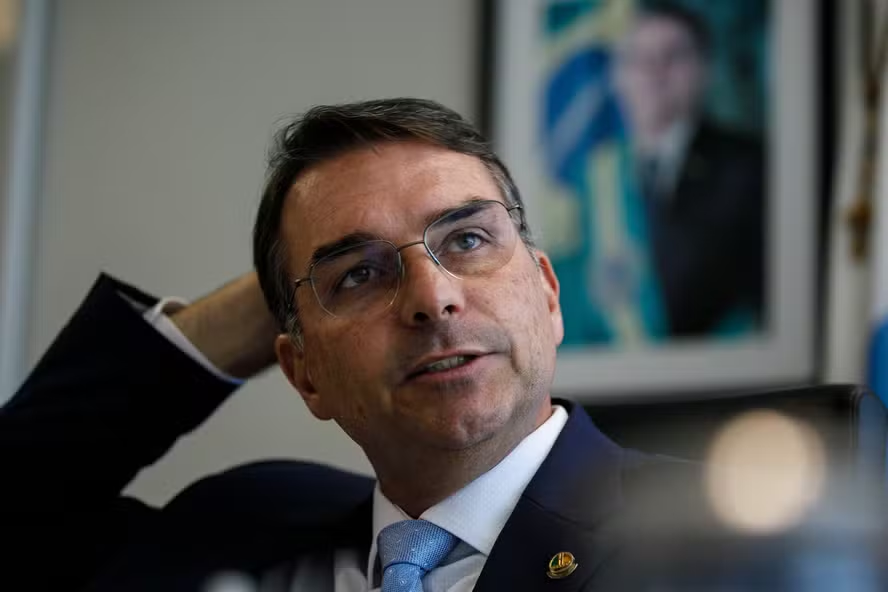
Flávio Bolsonaro has sketched the hardest-edged public security platform of Brazil’s 2026 campaign. Fresh from meeting El Salvador’s justice minister in São Paulo, the senator promised a terrorist label for gangs and more prisoners.
The São Paulo meeting with Bukele’s minister
The meeting happened on Sunday 30 August, as first reported by Poder360. Gustavo Villatoro is El Salvador’s minister of justice and public security and a right hand of President Nayib Bukele.
Bolsonaro said the encounter left him inspired to build a firm anti-crime plan. The aim, he said, is to defend citizens and victims, not criminals, as he claims the current government does.
Villatoro told him the Salvadoran result could be repeated in Brazil. El Salvador is small and poor, Bolsonaro recounted, while Brazil is large and rich, so gang control of territory has no excuse.
The guest list doubled as a campaign photo. Alongside Bolsonaro sat his running mate Alfredo Gaspar, former judge Sérgio Moro, and Senate candidates Guilherme Derrite and André do Prado.
A public security ministry built with the states
The institutional centrepiece is a dedicated public security ministry. It would manage the fight against organised crime together with state forces and municipal police, Bolsonaro said.
In Brazil, policing sits mainly with the 26 states and the federal district. A federal ministry would coordinate rather than command, offering money, organisation and intelligence sharing.
Bolsonaro called himself a strongly municipalist president in waiting. He promised support across all levels of government, from financing to the exchange of intelligence between forces.
The idea is not his alone. President Lula promised his own public security ministry at a Rio de Janeiro campaign event on 22 August. Both frontrunners now sell the same institution.
Terrorists, not just criminals
The sharpest pledge is the label. Bolsonaro said he would declare Brazil’s criminal organisations and militias terrorist groups if elected, Valor Econômico reported on 31 August.
He has named the targets before. In March he said the PCC and the Comando Vermelho would be classed as terrorists under his government. They are Brazil’s two biggest prison-born gangs.
The proposal tracks a United States policy pushed by President Donald Trump. Washington has weighed the same designation for both gangs, and the Lula government treats the idea as a sovereignty risk.
A terrorist label changes the legal toolkit. It can unlock asset freezes, travel bans and deeper international cooperation against anyone tied to the named groups.
“There are too few prisoners in Brazil”
After the meeting, Bolsonaro defended incarceration as policy. Brazil has few prisoners and should have more, he told reporters, in remarks carried by the G1 news portal.
Brazil already holds one of the world’s largest prison populations, and its jails are chronically overcrowded. The senator’s answer is capacity built in the Salvadoran style.
That model is the catch in the whole platform. Since 2022, Bukele’s government has run a state of exception that suspends constitutional guarantees and jails people without normal due process.
The results explain the appeal. Official figures show homicides fell from 3,346 in 2018 to 114 in 2024, a drop of 97%. Bukele was re-elected in 2024 with 84.65% of the vote.
Human-rights groups document mass arbitrary arrests under the same policy. Asked about that record, Bolsonaro brushed the criticism aside, G1 reported.
The political frame around the platform
Bolsonaro is the eldest son of jailed former president Jair Bolsonaro, who is barred from running. The son inherited the family’s voters and now trails only Lula in the polls.
Security is the theme where he polls strongest, and he has built it out for months. We covered the first version in how his security plan mirrors the Bukele model.
The economic half of the platform is in our report on his economic team. The legal war around his candidacy is in Brazil’s election moves into the courts.
What to watch from here
The first marker is the written government plan. The terrorism label and the ministry both need congressional approval, and the detail will show the legal path.
The second is the American track. A United States designation of the PCC or Comando Vermelho would hand Bolsonaro’s argument a tailwind, whoever wins in October.
The third is whether Lula’s rival ministry proposal steals the theme. Two frontrunners selling the same institution is how a campaign idea becomes a mandate.
Frequently Asked Questions
What is Flávio Bolsonaro’s public security platform?
He would create a dedicated public security ministry working with state forces and municipal police. He would also declare gangs and militias terrorist groups and expand imprisonment. He presented the ideas after meeting El Salvador’s justice minister on 30 August 2026.
Who did Bolsonaro meet from El Salvador?
Gustavo Villatoro, El Salvador’s minister of justice and public security and a close ally of President Nayib Bukele. The meeting took place in São Paulo, and Bolsonaro said it left him inspired.
Which gangs would be declared terrorist groups?
Bolsonaro has named the PCC and the Comando Vermelho, Brazil’s largest criminal organisations, and now includes militias. The designation mirrors a policy pushed by US President Donald Trump.
What is the criticism of the Bukele model?
El Salvador’s crackdown runs under a state of exception that suspends constitutional guarantees, and rights groups document mass arbitrary arrests. Official figures show homicides fell 97% between 2018 and 2024.
Does Lula also promise a security ministry?
Yes. Lula promised to create a public security ministry at a campaign event in Rio de Janeiro on 22 August 2026. Both frontrunners now propose versions of the same institution.
Connected Coverage
Read the first draft of this doctrine in Flávio Bolsonaro’s security plan mirrors the Bukele model. The money side is in his economic team. The legal siege is in Brazil’s election moves into the courts.
Sources: Poder360; G1; Valor Econômico; CNN Brasil; Estadão.
This article was produced by The Rio Times’ automated newsroom system. How we use AI · Report an error · Editorial responsibility: Matthias Camenzind, Editor-in-Chief