Evo Morales Speaks of Coup, Declares State of Emergency in Bolivia
RIO DE JANEIRO, BRAZIL – Evo Morales has chosen to strike back against the fraud charges. The Bolivian president denounced on Wednesday that a “coup d’état” by his political opponents is underway and declared a state of emergency.
“I called this press conference to denounce before the Bolivian people and the whole world that a coup d’état is in progress. We already knew it beforehand, the right-wing prepared itself with international support,” the president said in a brief speech at the presidential palace.

“I want the Bolivian people to know that so far we have humbly endured, endured to prevent violence and we are not going to get into a confrontation, and we will never get into a confrontation, but I want to say to the Bolivian people: first, a state of emergency and peaceful and constitutional mobilization”.
More than two days after the polls closed, and amid allegations of fraud, a disputed poll places Evo Morales on the verge of victory in the first round. If this result is officially confirmed, the longest-serving president in the Americas will not have to face former President Carlos Mesa in a second round vote.
“With the votes of the rural areas, I am convinced that we will win in the first round,” Morales said before raising the tone: “We are not in times of colony or monarchy to appoint presidents.” The leader of the Movement for Socialism (MAS) called on his followers to “organize, prepare” themselves. “We are going to defend democracy,” he emphasized.
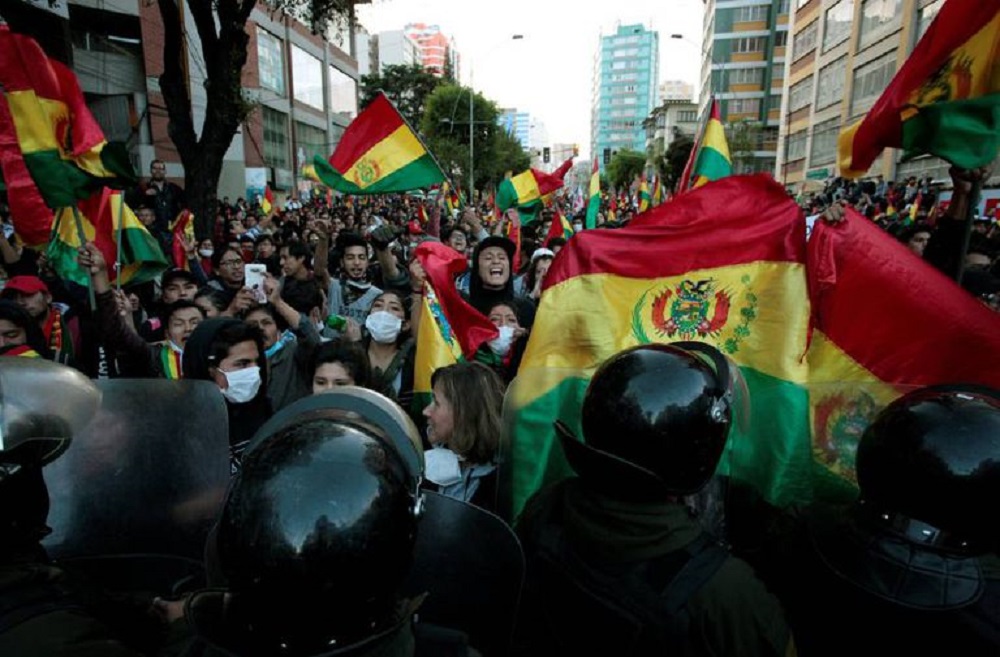
The suspicions surrounding the interruption of the electronic counting of votes, which projected a second round on December 15th, unleashed a wave of protests that shows no signs of coming to an end.
Mesa has already announced that he will not acknowledge the results because he considers them a “scandalous fraud” and has called for a mobilization of his supporters.
Meanwhile, several international bodies, headed by the Organization of American States (OAS), the European Union and the United States, criticized the electoral process and raised serious doubts as to its transparency.
Morales’ crisis of legitimacy began, according to his political rivals, on February 21st, 2016, when he lost a referendum on indefinite re-election after a decade in power. He was able to run in this election for a fourth consecutive term because the Constitutional Court and the Electoral Court allowed him to do so.
Based on this and in addition to the controversy in the counting of votes, tensions escalated. Bolivia’s main cities have experienced violence, unrest, and repression.
The president chose to request an audit of the elections and addressed the OAS. The body agreed to review the counting of votes but demanded that its conclusions be binding. The Bolivian government has yet to clarify whether it will accept the rules of the game.
The multilateral organization will carry out, through its observation mission, a review “that includes, among other aspects, the verification of computations, statistical aspects, verification of the process and chain of custody”.
Morales’ strategy seeks to ease international pressure, from which he has always been exempt until now, unlike his allies in the region like Nicolás Maduro. It is also a way of dispelling doubts and, at the same time, buying time after chaotic days, in which the TSE’s actions sounded all the alarms.
On Tuesday, the vice-president of this body, Antonio José Iván Costas, resigned precisely due to the “unrestrained decision […] to suspend the publication of results” during the vote.
This was the reason that led the OAS mission – which headed the monitoring of the electoral process – to issue a warning to officials on Monday night. The head of the OAS delegation, former Costa Rican Foreign Minister Manuel González Sanz, criticized the interruption of the rapid results and expressed his “deep concern and surprise at the change in trend.”
“At 8:10 PM on Sunday [local time], the Supreme Electoral Court ceased releasing preliminary results, with more than 80 percent of the ballots scrutinized. Twenty-four hours later, it provided data with an inexplicable change in trend that drastically changes the fate of the election and leads to a loss of confidence in the electoral process,” said the body’s representative.
Source: El País
More: Latin America news in English, every day from The Rio Times.
This article was drafted with automated assistance and reviewed before publication. How we use AI · Report an error · Editorial responsibility: Matthias Camenzind, Editor-in-Chief