IBOV 175,135.41 ▲ 0.31% IPSA 11,470.79 ▲ 0.89% IPC MEX 66,090.98 ▼ 0.15% MERVAL 3,001,209 ▼ 0.79% COLCAP 2,489.80 ▼ 0.59% BVL PERÚ 60,629.82 ▲ 0.25% USD/BRL5.16▲ 0.02% USD/MXN16.97▼ 0.10% USD/CLP926.00▼ 0.04% USD/COP3,148▲ 0.64% USD/PEN3.35▼ 0.07% USD/ARS1,512▼ 0.02% USD/UYU40.25▲ 1.53% USD/PYG5,905▲ 0.60% USD/BOB11.65▲ 2.45% USD/DOP58.25▲ 0.34% USD/CRC448.38▲ 1.37% USD/GTQ7.63▲ 2.29% USD/HNL26.83▲ 0.39% USD/NIO36.62▼ 0.02% USD/VES789.69▼ 0.13% USD/PAB1.00— 0.00% USD/BZD2.00— 0.00% USD/JMD 157.28 — 0.00% USD/TTD6.73▲ 1.05% EUR/BRL6.01▲ 0.27% BRENT 88.88 ▼ 0.03% WTI 83.11 ▼ 0.11% IRON ORE 161.91 — — COPPER 6.61 ▲ 0.03% GOLD 4,461 ▲ 1.78% SILVER 65.59 ▲ 1.26% SOY 1,184 ▲ 3.20% CORN 480.50 ▲ 10.02% WHEAT 655.00 ▲ 3.93% COFFEE 317.25 ▼ 5.51% SUGAR 16.43 ▼ 1.79% ORANGE JUICE 138.55 ▼ 0.47% COTTON 85.03 ▲ 2.33% COCOA 5,719 ▲ 3.18% BEEF 223.60 ▼ 3.93% CATTLE 339.10 ▼ 3.16% LITHIUM 75.20 ▲ 1.47% PETR4 41.64 ▼ 0.05% VALE3 72.97 ▲ 0.83% ITUB4 38.60 ▼ 1.03% BBDC4 16.85 ▲ 0.36% ABEV3 14.89 ▼ 0.80% BBAS3 19.37 ▲ 0.47% B3SA3 14.26 ▼ 0.21% WEGE3 47.59 ▲ 0.49% PRIO3 59.14 ▼ 0.19% SUZB3 41.33 ▲ 2.35% RENT3 34.68 ▼ 0.09% AZZA3 15.89 ▼ 2.63% CSAN3 3.22 ▼ 1.83% RAIZ4 0.25 — 0.00% PCAR3 2.75 ▼ 0.36% GMAT3 3.65 ▼ 1.08% PSSA3 48.13 ▼ 0.54% CVCB3 1.33 ▼ 2.92% POSI3 3.36 ▲ 2.44% SLCE3 13.34 ▲ 0.30% NATU3 8.14 ▼ 0.73% IBOV 175,135.41 ▲ 0.31% IPSA 11,470.79 ▲ 0.89% IPC MEX 66,090.98 ▼ 0.15% MERVAL 3,001,209 ▼ 0.79% COLCAP 2,489.80 ▼ 0.59% BVL PERÚ 60,629.82 ▲ 0.25% USD/BRL 5.16 ▲ 0.01% USD/MXN 17.06 ▼ 0.24% USD/CLP 913.98 ▲ 0.04% USD/COP 3,140 ▲ 0.03% USD/PEN 3.36 ▼ 0.66% USD/ARS 1,493 ▲ 0.10% USD/UYU 40.27 ▲ 1.24% USD/PYG 5,939 ▲ 1.68% USD/BOB 11.64 ▼ 0.76% USD/DOP 58.34 ▲ 1.25% USD/CRC 445.92 ▲ 0.89% USD/GTQ 7.62 ▲ 2.21% USD/HNL 26.79 ▲ 1.57% USD/NIO 36.62 ▲ 0.69% USD/VES 762.44 ▼ 0.13% USD/PAB 1.00 — 0.00% USD/BZD 2.00 — 0.00% USD/JMD 157.28 — 0.00% USD/TTD 6.70 ▲ 0.61% EUR/BRL 5.95 ▲ 1.01% BRENT 88.88 ▼ 0.03% WTI 83.11 ▼ 0.11% IRON ORE 161.91 — — COPPER 6.61 ▲ 0.03% GOLD 4,461 ▲ 1.78% SILVER 65.59 ▲ 1.26% SOY 1,184 ▲ 3.20% CORN 480.50 ▲ 10.02% WHEAT 655.00 ▲ 3.93% COFFEE 317.25 ▼ 5.51% SUGAR 16.43 ▼ 1.79% ORANGE JUICE 138.55 ▼ 0.47% COTTON 85.03 ▲ 2.33% COCOA 5,719 ▲ 3.18% BEEF 223.60 ▼ 3.93% CATTLE 339.10 ▼ 3.16% LITHIUM 75.20 ▲ 1.47% PETR4 41.64 ▼ 0.05% VALE3 72.97 ▲ 0.83% ITUB4 38.60 ▼ 1.03% BBDC4 16.85 ▲ 0.36% ABEV3 14.89 ▼ 0.80% BBAS3 19.37 ▲ 0.47% B3SA3 14.26 ▼ 0.21% WEGE3 47.59 ▲ 0.49% PRIO3 59.14 ▼ 0.19% SUZB3 41.33 ▲ 2.35% RENT3 34.68 ▼ 0.09% AZZA3 15.89 ▼ 2.63% CSAN3 3.22 ▼ 1.83% RAIZ4 0.25 — 0.00% PCAR3 2.75 ▼ 0.36% GMAT3 3.65 ▼ 1.08% PSSA3 48.13 ▼ 0.54% CVCB3 1.33 ▼ 2.92% POSI3 3.36 ▲ 2.44% SLCE3 13.34 ▲ 0.30% NATU3 8.14 ▼ 0.73%
since 2009
Friday, August 28, 2026

Brazil Business - Brazil

El Niño gains strength in 2023 and already has a starting date 

By · February 10, 2023 · 3 min read

Daily Brief

The morning intel from across Latin America. Free.

By subscribing you agree to our privacy policy. We never share your email.

By Kellen Severo

The agricultural sector closely follows the occurrence of weather phenomena such as La Niña or El Niño because of the impact they can have on the distribution and regularity of rainfall.

The Climate Department of the United States government has updated the projection for the occurrence of La Niña and El Niño phenomena in 2023.

In Rio Grande do Sul state, corn is the crop most punished by drought (Photo internet reproduction)
One-stop reference
Company Intelligence
Every listed company in Latin America — financials, ownership and structure for 1,450+ companies across 26 exchanges, in one place.
Browse the directory →
RT
Ask Rio Times
Latin American markets, currencies and companies.
Open the full Ask Rio Times →

According to the National Oceanic and Atmospheric Administration (NOAA), in the coming months, the probability of occurrence of the La Niña phenomenon will drop from 15% in the February-March-April quarter to less than 10% between March-April-May.

From April onwards, the chances of El Niño will start to increase, dropping from 15% between April-May-June and reaching over 60% probability between September-October-November.
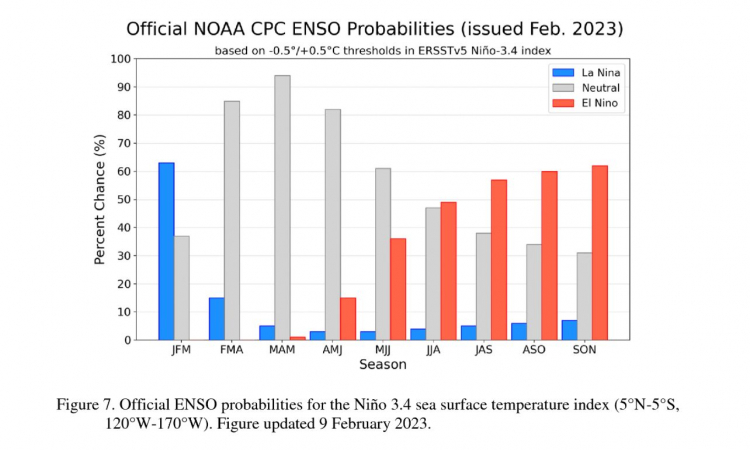
Probability of El Niño, La Niña, and Neutrality, according to NOOA (Photo internet reproduction)

The agricultural sector closely follows the occurrence of climate phenomena such as La Niña or El Niño because of their impact on rainfall distribution and regularity.

In La Niña years, the South of Brazil is traditionally affected by lower rainfall volumes and a tendency for crop failures, as seen in 2023.

In Rio Grande do Sul, corn is the crop most punished by drought.

According to the National Supply Company, there are losses of up to 100% in some areas, such as the West border and Missões, due to high temperatures and water deficit.

Soybeans are also suffering from the lack of rain.

On the other hand, areas of the Cerrado and Matopiba are favored with humidity, which led Conab to predict a record soybean harvest of 152.9 million tonnes.

In other words, despite the presence of La Niña and the drought problems in Rio Grande do Sul, the other areas had favorable weather conditions and should harvest a bountiful harvest.

With El Niño, the scenario is different since there tends to be more rainfall in the South of Brazil and less rainfall in areas of the Center-North.

The El Niño phenomenon, if confirmed of low intensity for 2023, may negatively impact soybean productivity in the Brazilian average.

The conclusion is from a study done by Céleres consultancy, which has followed the impact of La Niña or El Niño phenomena on expected crop productivity for 32 years.

Enilson Nogueira, the company’s analyst, explains:

“If confirmed, it would be considered a low-intensity El Niño. In our model, [soybean] productivity would be 1.8% lower than expected, or – 1.1 bags/hectare, in the Brazilian average for soybeans.”

“The negative effects of El Niño/La Niña dissipate in the national average. When the South region breaks down, Cerrado does well and limits such effects and vice-versa.”

“It generates a relevant positive result for consumer supply strategies and contributes to the food security of the soybean chains.”

With information from Jovem Pan

Read More from The Rio Times

The Rio Times · Power Map
See who really holds power in Latin America
Click to open the Power Map

Rotate for Best Experience

This report is optimized for landscape viewing. Rotate your phone for the full experience.